The Day a Rocket First Came Home,
and On to Mars
December 21, 2015, 8:33 PM EST. Cape Canaveral. The first stage of a launched Falcon 9 — just 9 minutes and 30 seconds after liftoff — came back and landed upright on the pad. A paradigm shift 58 years in the making for the space industry. Launch cost dropped from $20,000 per kilogram to $1,500. And in 2026 — Artemis sends humanity back to the Moon. This is the final chapter of the series.
012015.12.21 — The First Rocket to Return to the Pad
When EP09 ended, SpaceX had survived thanks to the success of Falcon 1's fourth launch. But Musk's real goal was "a reusable rocket." From Sputnik in 1957 to 2015, the first stage of every rocket had fallen into the ocean and been discarded after launch. It was like using a truck once and throwing it away. As Musk put it: "That's the real reason space is expensive."
From 2010 to 2015, SpaceX attempted five Falcon 9 landings. Every one failed. Explosions, crashes, splashing into the sea. Compilations of SpaceX explosion videos made the rounds online. Aerospace industry veterans said, "This is impossible. Once it makes the trip and comes back, the rocket is too damaged to be worth anything."
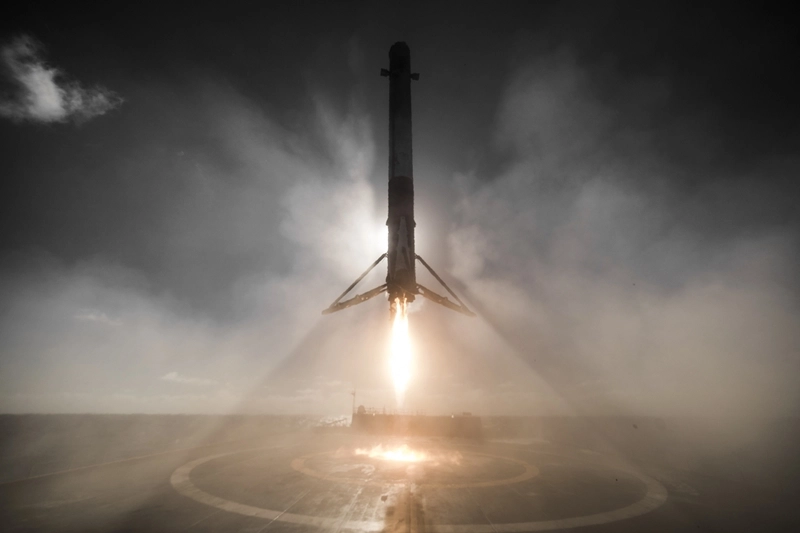
December 21, 2015. Cape Canaveral, LZ-1. Falcon 9 Flight 20. After the payload (11 ORBCOMM satellites) reached orbit, the first-stage booster separated. Four grid fins (lattice-shaped steering surfaces) unfolded. One of its propulsion engines reignited — the boostback burn. Atmospheric reentry — the entry burn. And finally — a landing burn brought it down upright on pad LZ-1. From 80 km up back to the ground in just 9 minutes and 30 seconds.
02Grid Fins + Thrust Vectoring — How It Became Possible
To understand why landing a rocket upright is so hard, one analogy helps. Standing a rocket on its tail is like balancing the end of a broomstick on your palm. Except the broomstick is as tall as a 13-story building, it's falling at 1,000 km/h, and it's nearly out of fuel.
SpaceX's solution:
- Grid fins — four lattice-shaped wings. They unfold during atmospheric reentry to correct the rocket's attitude. They work better than ordinary flat fins in a shockwave environment. It's an adaptation of a Russian ICBM design (borrowed from the Soyuz emergency-escape rocket).
- Thrust vectoring — of the nine Merlin engines, only the center one stays lit during the final landing, and its nozzle is finely adjusted with a gimbal. It's like rapidly moving your fingers while the broomstick balances on your palm.
- Real-time computer attitude control — the same principle as the Apollo Guidance Computer (EP05), but with 10,000 times the processing speed. Attitude is corrected every 0.001 seconds.
032018.02.06 — A Tesla Roadster Headed for Mars
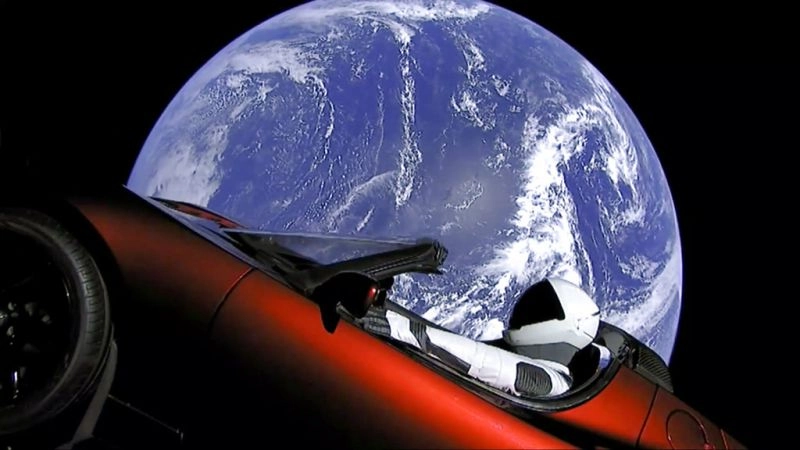
February 6, 2018. SpaceX flew Falcon Heavy for the first time — three Falcon 9 first-stage boosters strapped together. The payload: Elon Musk's own red Tesla Roadster. In the driver's seat sat a mannequin in a spacesuit named "Starman." David Bowie's "Space Oddity" played on an endless loop on the radio.
After the successful launch, two of the three boosters came down upright at almost the same moment — onto pads LZ-1 and LZ-2. The internet practically melted down that day. As one comedian put it: "This isn't a sci-fi movie. This actually happened."
04Starship — The Largest Rocket in Human History
Right after Falcon Heavy, Musk went for an even bigger challenge: Starship. Its specs as of launch (2025):
- 121 m tall — the Statue of Liberty plus another 90 m. Eleven meters taller than EP05's Saturn V (110 m), making it the largest rocket in human history
- 7,500 tons of liftoff thrust — twice that of the Saturn V
- Payload capacity — about 150 tons to LEO (when reused), 250+ tons (when expended). That's 1.5 to 2 times the Saturn V
- Fully reusable — both the first stage (Super Heavy) and the second stage (Starship) return to the pad
- Structural material — stainless steel 304L. A material the aerospace industry hadn't touched in 50 years. Musk's call: "Carbon composite is lighter, but stainless is strong at high temperatures and cheap." That's why Starship's skin shines like a mirror
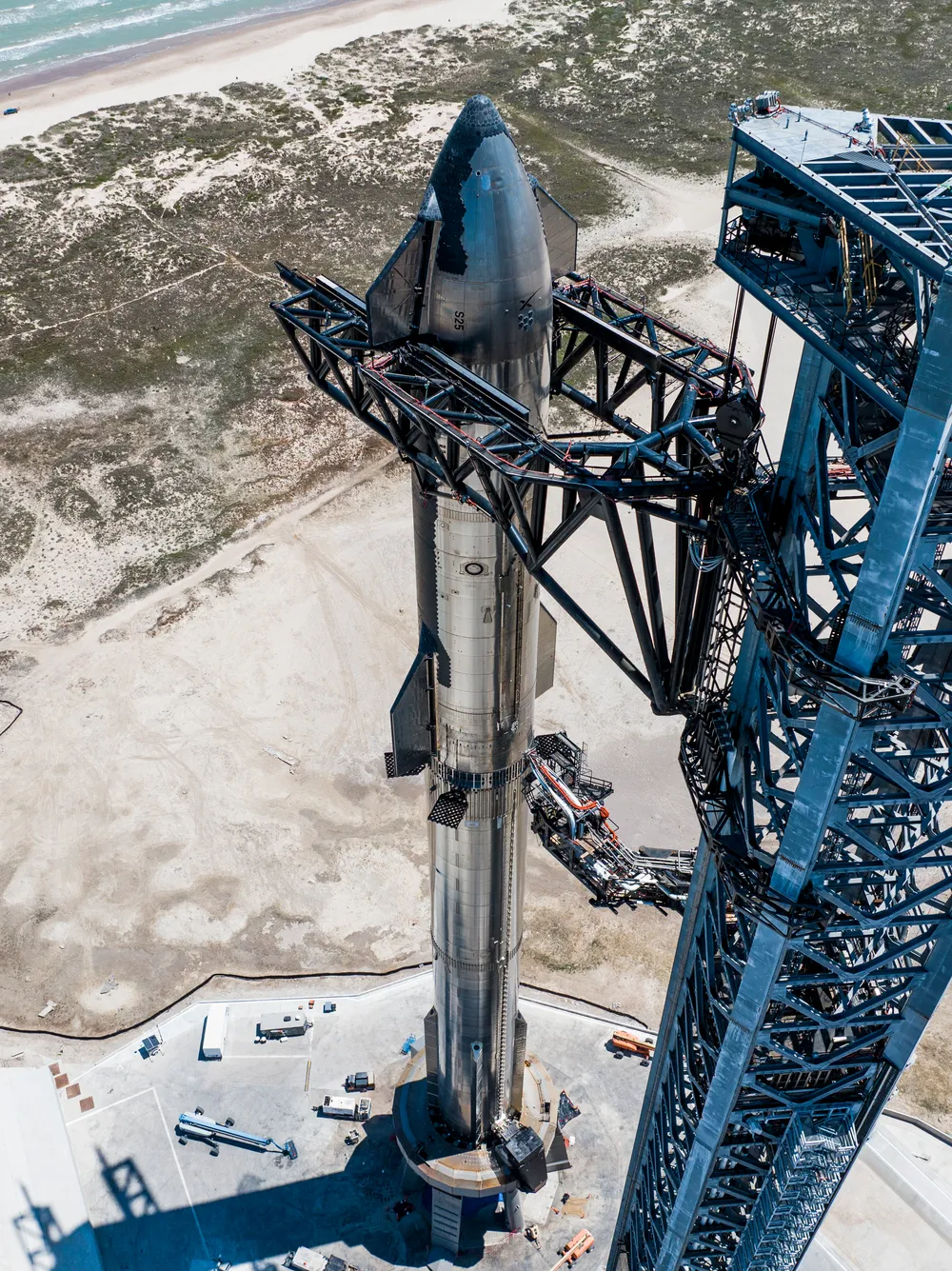
October 13, 2024, IFT-5 (Integrated Flight Test 5). Seven minutes after launch, the Super Heavy booster (71 m tall, 200 tons) returned to the Boca Chica launch tower. And Mechazilla's two arms caught the booster — descending at about 5 km/h — as precisely as a grill clip. It was the first time in human history.
05The Raptor Engine — The Apex of Full-Flow Staged Combustion
At the heart of Starship is the Raptor engine — the most efficient rocket engine humanity has ever built. Its key technology is Full-Flow Staged Combustion (FFSC).
① Soviet RD-270 (1969): Five tests. All exploded. Program canceled.
② SpaceX Raptor (2019–): Humanity's first working FFSC engine.
Raptor V2 (announced 2022) specs:
- Thrust of about 230 tons (at sea level)
- Combustion pressure — about 300 bar (1.5 times that of NASA's RS-25 Space Shuttle main engine)
- Fuel — methane + liquid oxygen. A fuel that can be produced on Mars itself. Methane can be synthesized from the CO₂ in the Martian atmosphere, which is central to Musk's Mars vision.
- Manufacturing cost — about $250,000 (a quarter of a single Merlin, a thirtieth of the Shuttle's RS-25)
06$20,000/kg → $1,500/kg — The Economics of a New Era
The real change reusability brought is in launch cost. The per-kilogram cost of launching to LEO for the rockets featured in this series:
- Saturn V (1969-1973) — about $15,000/kg (in today's money). $1.4 billion per launch.
- Space Shuttle (1981-2011) — about $54,000/kg. The most expensive. It promised reusability, but inspection and reassembly cost $500 million every time.
- Falcon 9 (2010-) — about $2,700/kg (expended), $1,500/kg (reused). A thirtieth of the Space Shuttle.
- Starship (projected) — Musk's target of $10/kg. If that becomes possible, space travel reaches the level of air travel.
What this means is that for the first time, the space industry can become a "worthwhile business." From 1957 to 2015, space was a government project — satellite communications, reconnaissance, science. There was little direct value to ordinary citizens. But at $1,500 per kilogram, SpaceX's Starlink brings in hundreds of millions of dollars in monthly revenue, supplies internet around the world, and satellite internet has become a genuine industry.
072026 Artemis — Humanity Returns to the Moon
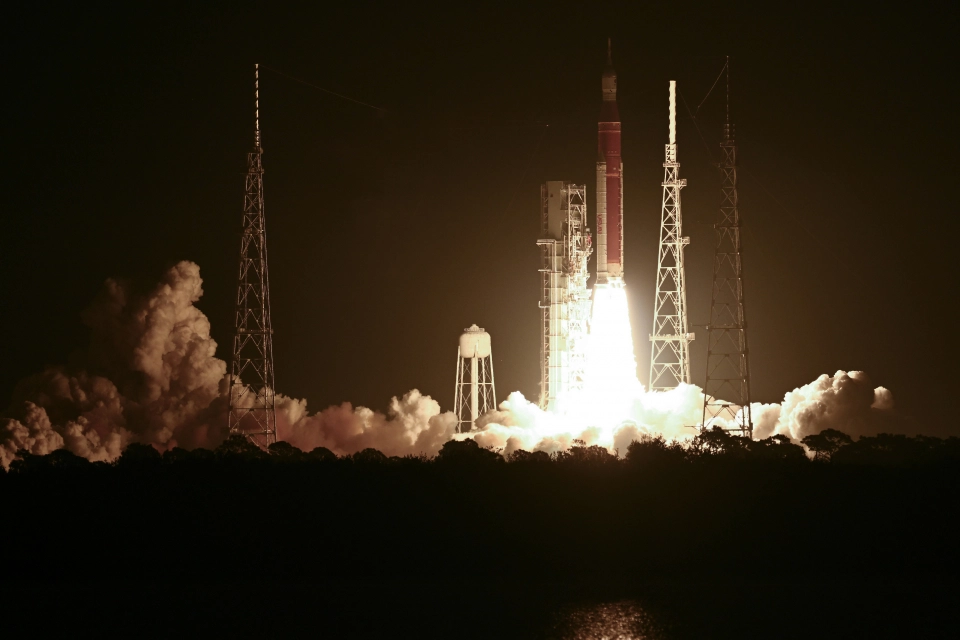
November 2026 (projected). NASA's Artemis III mission. Four astronauts will land on the Moon — 53 years after the last, Apollo 17. NASA has mandated that the roster include one woman astronaut and one Black astronaut (every astronaut who has ever walked on the lunar surface was a white man).
The intriguing part — Artemis III's lunar lander is a variant of Starship. NASA signed a $2.8 billion contract with SpaceX (2021). Compared with EP05's LM (7 m tall, 4.5 tons), the Starship LM is 50 m tall and weighs 200 tons. The gap is enormous.
08From von Braun to Musk — 80 Years of a Single Story
It began in EP01 on September 8, 1944. A single V-2 fell on Chiswick in London. The 32-year-old SS officer who built that rocket, von Braun, designed the Saturn V that sent humanity to the Moon 25 years later.
Korolev's aluminum sphere in 1957, Gagarin's 108 minutes in 1961, 12 seconds of fuel in 1969, the 73 seconds when an O-ring failed in 1986, the Pale Blue Dot 6 billion km away in 1990, Musk's fourth launch in 2008, the first rocket to come home in 2015 — and Artemis and Starship in 2026. All of it is a single thread spanning 80 years.
If this series leaves one thing behind, it's this: the space age is not a story of individual heroes. Von Braun's V-2 was built atop the slave labor of Mittelwerk, Korolev's R-7 was made by a man who survived the Gulag, Apollo 11 ran on code written by a 32-year-old woman, and SpaceX's Falcon 9 was the final gamble of a 31-year-old entrepreneur who nearly went bankrupt in 2008.
Humanity's path toward the stars is a road built by ambition and fear, genius and tragedy, politics and rationalization, slaves and heroes, all together. It's not a tidy hero's tale. And that's what makes it more human.