For 16 Months,
Two Superpowers Collapsed at Once
In January 1966, Korolev died from the lingering aftermath of the Gulag. In January 1967, Grissom, White and Chaffee burned alive atop the launch pad in 17 seconds. In April 1967, Komarov fell to his death in a capsule with 200 defects. The United States and the Soviet Union collapsed simultaneously within the same 16 months — the darkest stretch of the Space Age.
0116 Months, Three Giants
At the end of EP03 I said this: "Kennedy's gamble decided NASA's next decade." So how did that decade begin? It began in total ruin.
From January 14, 1966 to April 24, 1967 — for exactly 16 months — the space programs of the two superpowers, the United States and the Soviet Union, collapsed at the same time. Three great tragedies came one after another:
These 16 months are — the real reason that one step of Apollo 11 became possible. Had the two programs not collapsed, they would instead have failed to learn from tragedy and slid into still more accidents. But the price was — truly enormous.
021966.01.14 — The Gulag's Jaw Killed Him
Korolev (the man from EP02) was 59 in January 1966. A small polyp was found in his rectum, and the doctors called it "a routine operation that would be over in 30 minutes." On January 14, the surgery began at the Kremlin Hospital in Moscow.
But the moment the anesthesia began — something went wrong. Korolev couldn't open his mouth all the way. The jaw that had been broken in 1938 at the Kolyma labor camp, when an NKVD guard beat him — had never fully healed in 28 years. Intubation was impossible.
- 1938 · At the Kolyma camp, Korolev was beaten by a guard and his jawbone was fractured. He received no treatment. He could no longer open his mouth all the way.
- 1966.01.14 · Anesthesia for the polyp surgery. A breathing tube could not be inserted. An emergency tracheostomy was attempted — but it was difficult because the structure of Korolev's throat had been deformed by malnutrition during his Gulag years.
- As the operation dragged on — the doctors found a large tumor in his rectum. It was not a small polyp. It was cancer that had spread deep into his pelvis.
- Soviet Minister of Health Boris Petrovsky attempted the resection himself. An 8-hour operation. The bleeding would not stop.
- At 4:30 p.m., he died of cardiac arrest. He was 59 years old.
The doctors who performed the autopsy on Korolev's body — wondered how this patient had stayed alive all that time. From the malnutrition of his Gulag years his heart wall had thinned, and every organ was in a state of chronic damage. Sputnik, Gagarin, Vostok, Voskhod — through all of it, he had in fact been working in a dying body.
03The Day His Name Was First Revealed (1966.01.16)
Two days after Korolev's death, on January 16, 1966. The front pages of every Soviet newspaper — carried his name and photograph for the first time. The Pravda headline:
"Comrade Sergei Pavlovich Korolev, Academician, twice Hero of Socialist Labor, two-time Lenin Prize laureate, the great Soviet scientist and designer, has died."
— Pravda front page, 1966.01.16The identity the American CIA had so desperately wanted to know for nine years — was revealed in the announcement of his death. That evening, every American newspaper reached the same conclusion. "This man was the 'Chief Designer.' The one we had been tracking."
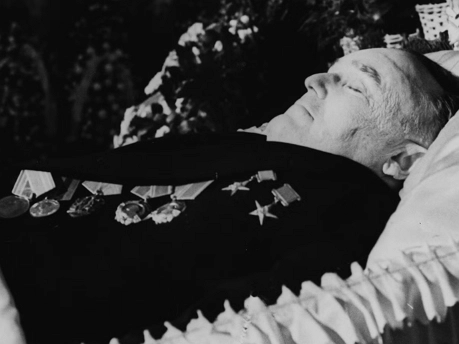
Khrushchev (already ousted in 1964) appeared at the funeral, and the new General Secretary Brezhnev and Premier Kosygin carried the coffin. But — once the funeral ended, the Soviet space program had in effect lost its head.
The man appointed as Korolev's successor, Vasili Mishin, was — a fine engineer, but he lacked Korolev's political charisma and unifying ability. The N-1 Moon rocket begun in the Mishin era is something I'll cover in detail in EP06 — the start of a tragedy of four launches, all four ending in explosion.
041967.01.27, Cape Kennedy LC-34 — The "Plugs-Out" Test
One year and 13 days after Korolev's death. Florida, USA, Cape Kennedy launch pad LC-34. Atop the enormous Saturn IB rocket — sat the Apollo 1 command module (Block I). Launch was scheduled a month later, for February 21.
The test that afternoon was called the "Plugs-Out Test." With all external power and communication cables disconnected, the cabin alone would simulate the entire launch sequence. It reproduced the final four hours before launch exactly. It was classified as a test that was not dangerous — there was no fuel loaded, and the rocket wasn't actually going to ignite.
Gus Grissom (40) — Commander. Mercury 4 (1961, the second American in space), Gemini 3 (1965). One of the most experienced astronauts in the United States.
Ed White (36) — Senior Pilot. The man who performed America's first spacewalk (EVA) on Gemini 4 in June 1965.
Roger Chaffee (31) — Pilot. No spaceflight experience. This was to be his first mission.
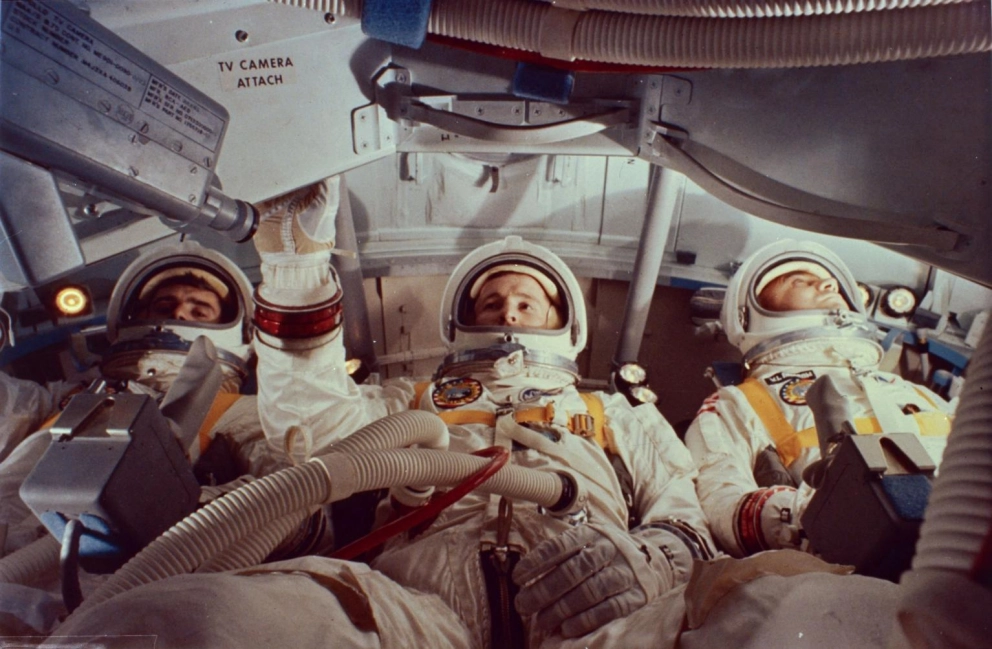
At 1:00 p.m., the three men entered the cabin. And — everything was going wrong from the very start:
- 13:00 — As soon as Grissom connected to his suit, he reported a sour smell. 30 minutes of checks. No cause found. The test continued.
- 14:42 — The cabin was filled with 100% pure oxygen at 16.7 psi (1.13 times atmospheric pressure). A simulation of the launch environment.
- 17:40 — Communication problems. Grissom: "How are we going to get to the Moon if we can't talk between two buildings?"
- After several communication dropouts — the test was temporarily suspended.
0517 Seconds — The Last Transmission of Grissom, White, Chaffee
6:30:31 p.m. A single spark beneath the cabin seats. A frayed wire touched an aluminum surface. But — this was no ordinary spark. In an environment of 100% oxygen at 16.7 psi, even things that would never burn in a normal atmosphere burn explosively.
The nylon netting (for storage), the Velcro, the suit hoses. Everything caught fire at once. In the first 6 seconds, the temperature soared to 1,000°C. The cabin pressure was rising by about 2 psi per second.
[18:30:54] Grissom (not definitively identifiable)
"Fire!"
[18:30:58] White (agitated)
"We've got a fire in the cockpit!"
[18:31:04~12] Chaffee (last)
"We're burning up! Get us out of here!"
[18:31:13]
— Transmission lost. The cabin's outer wall ruptured from the pressure.
From outside, pad workers saw — through the small cabin window, White struggling to open the hatch. They could see him pulling on the handle. But the hatch was — built so that it took 90 seconds to open from the inside, and even then only when the pressure inside the cabin was lower than outside. As the fire raised the pressure — it became a situation where the hatch could never be opened from the inside.
It took the pad workers 5 minutes and 30 seconds to open the hatch from outside — knowing what lay within. The sight they found upon entering was — so horrific that even the report did not describe it in detail. The three men's spacesuits had melted and fused with the cabin's interior structures, and simply separating the bodies took 7 hours.
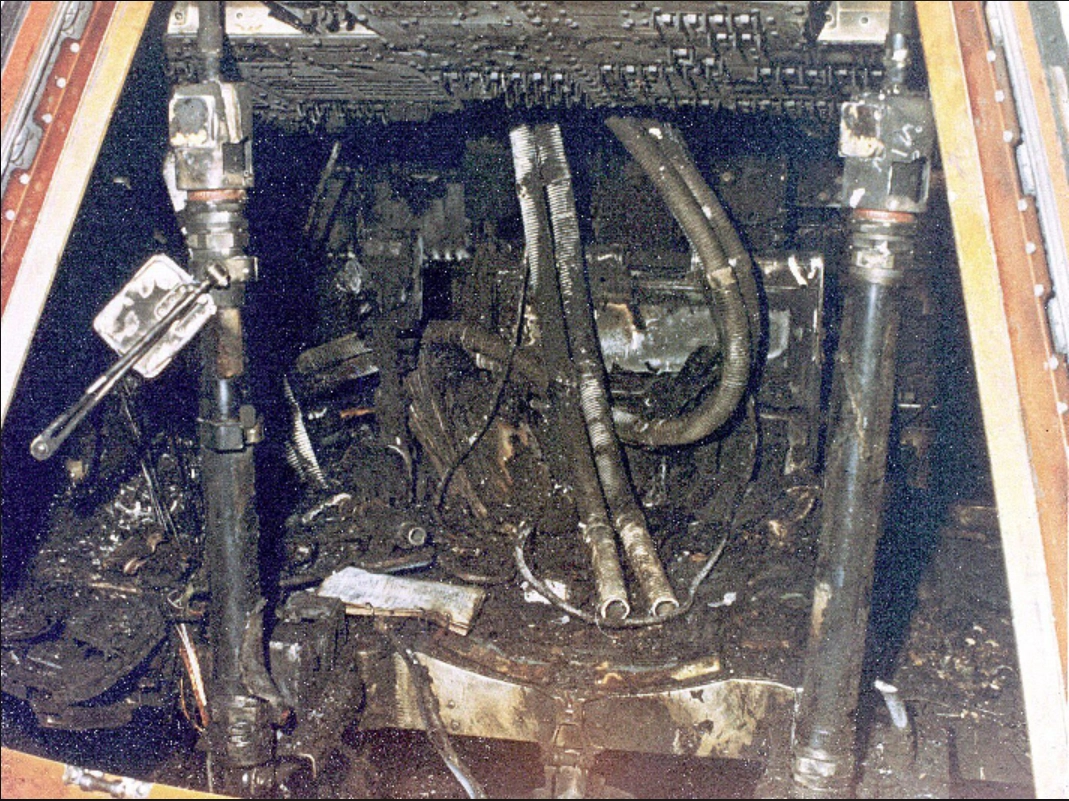
06The Lemon Grissom Hung on the Simulator
The cruelest truth is — that Grissom knew. A month before the accident, he did something at the Houston simulator that looked like a joke. He hung a single lemon on a string. In America, "lemon" is slang for "a defective product, a broken-down car."
What he said that day — surfaced again later in his testimony before a NASA hearing:
"This cabin has too many defects. But no one is going to slip the schedule."
— Gus Grissom, December 1966 (just after hanging the lemon on the simulator)The NASA accident review board produced a 1,407-page report. The critical flaws it uncovered:
- 100% pure oxygen environment (16.7 psi) — a design used since the Mercury and Gemini days. But the danger created by the pressure difference on the pad was ignored. Things that don't burn in ordinary air burned violently.
- Inward-opening hatch — a structure that could never be opened once pressure rose. It was a safety flaw from the start — but it had been designed conservatively because of the trauma of Grissom's Mercury 4 accident (the hatch blew too early and the capsule sank).
- Flammable materials everywhere — Velcro, nylon netting, paint, insulation. Even the spacesuits. Safe in a normal environment, but in an oxygen environment they were all bombs.
- Shoddy wiring — wires under the seats had chafed against an aluminum edge, leaving the insulation stripped away and unattended. That was the source of the spark.
- No emergency escape procedure — the Plugs-Out test was classified as a "safe test" — so there were no firefighting personnel on the pad.
- Atmosphere changed — on the ground, a mix of 60% oxygen + 40% nitrogen (switching to 100% oxygen after liftoff)
- Hatch redesigned — a single-piece, outward-opening hatch. It opened within 5 seconds in an emergency
- Flammable materials replaced across the board — every material re-certified for fire resistance in an oxygen environment
- Wiring protection reinforced — every wire wrapped in protective tape
071967.04.23-24 — Komarov, and Gagarin's 10-Page Memo
Three months after the Apollo 1 fire. On April 24, 1967, at 6:24 a.m. Moscow time. In the middle of the Kazakh desert, at about 140 km/h — the Soyuz 1 capsule slammed into the ground. Inside was the 40-year-old Vladimir Komarov.
Gagarin's closest friend. Spaceflight experience aboard Voskhod 1 in 1964. As commander of Soyuz 1 — almost everyone knew he would not come back alive. He himself, Gagarin, the engineers — and even the Politburo.
Gagarin (the man from EP03) sent a 10-page memo to the Politburo. "This cabin is not ready to fly. Sending Komarov up like this is killing him." The man who personally delivered the memo to KGB chairman Andropov — held onto it and, because it was politically dangerous, disposed of it; this came to light later. The memo never even reached the Politburo.
Before the launch, Komarov told his friends — "If I refuse, Gagarin goes as the backup. Gagarin has to live. I'm going." This anecdote was later testified to by his fellow cosmonaut Alexei Leonov (the man who appeared at the end of EP03).
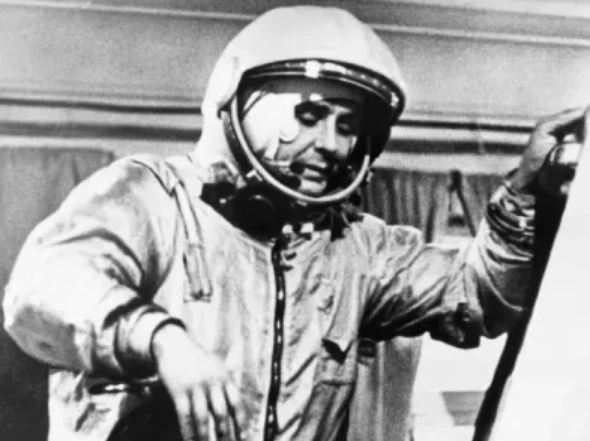
Launch: April 23, 1967, 03:35 Moscow time. From the moment it entered orbit, everything began to fall apart:
- 1 of 2 solar panels failed to deploy — only half the power. The communication antenna also worked only partially.
- Unstable attitude control — the capsule tumbled through the 13th orbit. Komarov attempted to stabilize it manually.
- Decision for emergency reentry — on the 17th orbit. Far later than the originally scheduled 4th orbit.
- April 24, 06:22 — Reentry began. The capsule rotated normally.
- 06:23 — The main parachute failed to deploy. The backup parachute also tangled with the main parachute's cables. Both parachutes were useless.
- 06:24 — Impact at 140 km/h in a field outside Orenburg, Kazakhstan. Komarov died instantly. The capsule caught fire.
There are many conspiracy theories surrounding Komarov's death. The most famous is that — before he died, while communicating with Moscow, he hurled curses at the Soviet leadership, and an NSA listening station in Istanbul recorded it. It appears in some books (especially the 2011 sequel to Doran/Bizony's Starman) — but NASA historians such as Asif Siddiqi are strongly skeptical of this part. The NSA intercept material itself exists, but the primary sources differ as to whether its content was a "cry of rage" or a "calm carrying-out of the mission."
What is certain is — that at the funeral, Komarov's coffin should have been closed, but it was open. Brezhnev ordered it directly. "The people must see the body of a hero of socialism." As for what lay inside — a photograph survives. If you don't want to see it, don't search for it.
08What It Means That It All Happened Within One Year
16 months. On both the American and Soviet sides, the most important figures of the Space Age died one after another:
- Korolev (1966.01.14) — the aftermath of the Gulag. Violence from 28 years earlier killed him in 1966.
- Grissom, White, Chaffee (1967.01.27) — schedule pressure + ignored safety. Grissom knew, but he could not stop it.
- Komarov (1967.04.24) — a political timetable + 200 defects. Gagarin tried to stop it, but the memo never even arrived.
Do you see what these three have in common? Every one of these deaths was — a death no one could prevent though they knew. An injury made by the brutality of the Gulag, the danger of an oxygen environment, a capsule with 200 defects. All of it was known in advance. Someone had already given warning. But — political timetables, pride, and bureaucracy buried that warning.
And yet there is one thing — these three tragedies changed all spaceflight that followed. The Block II cabin born of Apollo 1's 1,407-page report ultimately carried humanity to the Moon. The Soviets, too, redesigned every capsule over the 18 months after Soyuz 1, and the stable Soyuz series that eventually led to the Salyut space station in 1971 — came out of that tragedy. The very capsule that still flies to the ISS in 2026.
In the next installment (EP05) — the story of July 20, 1969, the day humanity set foot on another celestial body with 12 seconds of fuel to spare. But without this EP04 tragedy, that one step would not have existed. Had Grissom lived — he might have been the first man; that was something often said within NASA.