12 Seconds of Fuel, a 22-Year-Old's Half-Second,
and One Footstep
July 20, 1969, 21:17:40 (UTC). For the first time, humankind left a footprint on the surface of another world. But seven minutes before touchdown the computer flashed a "1202 alarm," a 22-year-old engineer in Houston made his call in half a second, and the priority scheduling built by a 32-year-old woman saved the mission. And at that very hour — the Soviet Luna 15 was crashing into the same Moon's surface.
0121 Months of Rebuilding (1967.04 → 1968.10)
Where EP04 left off — both superpowers' space programs lay in ruins at the same moment. Korolev was dead, Grissom, White and Chaffee were dead, Komarov was dead. Kennedy had already died back in 1963. The promise he had made — "to go to the Moon before the decade is out" — was a deadline of December 31, 1969.
After the Apollo 1 fire, NASA suspended crewed flight for 21 months. During that time they rebuilt the capsule from scratch (Block I → Block II). On October 11, 1968, Apollo 7 finally launched — 11 days in Earth orbit, a safe return. The first crewed flight in 21 months. NASA had come back to life.
And then, in December 1968 — with one year left until the Kennedy deadline — NASA made the most audacious gamble in human history. "We don't have a working lunar lander yet — but let's send people into lunar orbit anyway."
Apollo 9 (LM testing), Apollo 10 (a full LM dress rehearsal — descending to within 14 km of the lunar surface). And then — July 1969. It was Apollo 11's turn.
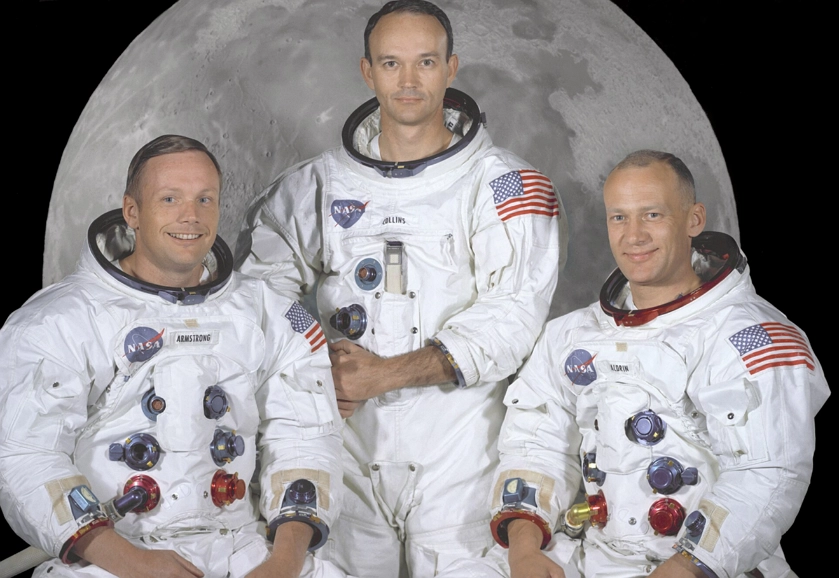
02Four Protagonists — and One Woman
The reason NASA picked him as number one — he was a man whose heart rate didn't climb in a crisis. In 1966, when the Gemini 8 capsule fell into an uncontrolled spin (360 degrees per minute) — a situation that would have sent other astronauts into a panic — he calmly switched off the attitude control system by hand and made it back alive. That is the real reason NASA breathed a sigh of relief that he was there in July 1969, when the 1202 alarm lit up.
She was a 32-year-old working mother. From a cramped office at MIT, she led the entire software effort for the Apollo Guidance Computer (AGC). The core concept she invented: the "Asynchronous Executive." When the computer was handed too many tasks at once, it would automatically discard the low-priority ones and handle only what mattered. That is the mechanism that saved the 1202 alarm. In 1969 her name was barely known. Only in 2016 did Obama award her the Medal of Freedom.
Kranz (35) — flight director. The man who, in a speech after the Apollo 1 fire, made "Tough and Competent" NASA's creed. Garman (24) — a back-room engineer fresh out of MIT. He had memorized in advance every scenario for the 1202 alarm from the simulations. The single word "GO!" that he shouted in half a second — saved the mission.
031969.07.16 — Saturn V Rises
July 16, 1969, 9:32 a.m. (EDT), Launch Complex 39A at Kennedy Space Center. A million people gathered around Cape Canaveral. Wernher von Braun (the man from EP01) was there too. It was the summit of a road that had begun 25 years earlier when he built the V-2.
The launch vehicle was the Saturn V. Specifications:
- 110 m tall — 18 m taller than the Statue of Liberty
- Total mass 2,970 tonnes (fueled) — the weight of about 1,000 tteokbokki food trucks
- First-stage thrust 7.5 million lb (33,400 kN) — five F-1 engines firing together. The most powerful single-chamber liquid engine in human history
- Three-stage design — Stage 1 (S-IC, kerosene + LOX) → Stage 2 (S-II, liquid hydrogen + LOX) → Stage 3 (S-IVB, translunar injection)
- Total cost — roughly $180 million per vehicle (in 1969 value; about $1.4 billion today)
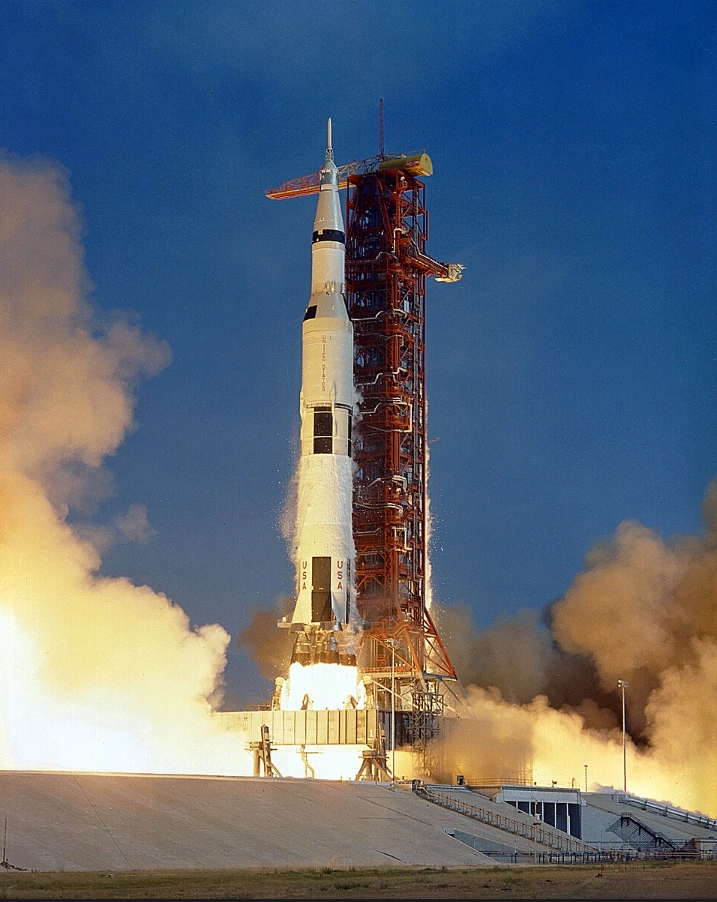
Twelve minutes after liftoff, an Earth parking orbit. After a lap and a half — the third stage (S-IVB) reignited for Translunar Injection. They set off toward the Moon at about 39,000 km/h. From here on it was four days of coasting, floating through space.
04Four Days of the Translunar Coast
Apollo 11's spacecraft was — in fact — two craft:
- Columbia (CSM, command/service module) — piloted by Collins. Responsible for the trip out from Earth and the return. In lunar orbit, Collins would be left behind alone
- Eagle (LM, lunar module) — piloted by Armstrong and Aldrin. It would descend to the Moon, then rise again to dock with Columbia
The things the three did during the four-day coast — a TV camera demonstration, observing constellations, meals (steak and vacuum-packed tortillas), checking every system. And each took turns sleeping in roughly 16-minute snatches to rest. The cabin was tight (the CSM living space was about 6 m³ — roughly the trunk of a small SUV).
July 19 — lunar orbit insertion. They fired the engine in reverse to slow down and let the Moon's gravity capture them. For the 35 minutes while looping behind the far side of the Moon, communication with Earth was cut off. A region no human had ever seen before. When the signal came back, Houston's first words were: "Apollo 11, Houston. How do you read?"
July 20 — the day of separation. Eagle broke away from Columbia, and Armstrong and Aldrin began their descent toward the lunar surface.
05The 1202 Alarm — a Decision a 22-Year-Old Made in Half a Second
July 20, 1969, 4:05 p.m. (EDT). Eagle — at roughly 15 km above the lunar surface — ignited its descent engine for Powered Descent Initiation (PDI). Over 12 minutes and 30 seconds it had to follow a precisely defined trajectory down to exact coordinates (a predetermined point inside the Sea of Tranquility).
But then — about five minutes in, a yellow alarm light came on in Eagle's cabin. The number flashing on the display: 1202.
"Program alarm. It's a 1202." — Aldrin, five seconds later
"1202, 1202." — Armstrong, transmitting to Houston in a calm tone
Houston Mission Control. Gene Kranz and his team. Everyone — "What's a 1202?" — froze for 0.3 seconds trying to recall. There were just too many alarm codes. But one man — the 24-year-old back-room engineer Jack Garman — knew at once. He'd seen it in simulation training.
But the Asynchronous Executive Margaret Hamilton built — automatically discarded the low-priority tasks (processing rendezvous radar data and the like) and kept handling only the tasks essential to landing. In other words, the 1202 alarm was not a signal that said "there's a problem" but one that said "I'm handling a problem on my own."
It was a pattern Garman had seen in the simulator. And so — in half a second — he shouted:
"GO!" (Continue!) — Jack Garman, 24
Kranz took that and relayed it to CapCom (the person who talks to the spacecraft), Charlie Duke. Duke transmitted to Eagle:
"Roger, we're GO on that alarm." (Ignore that alarm and keep going.)
— Charlie Duke, CapCom, 1969.07.20, approx. 16:11 EDTThis is a decisive moment in the history of computing worldwide. The first time software saved a human mission. Until then software had been a danger — a hazard that caused accidents when written wrong. At 16:11 on July 20, 1969 — software became a hero for the first time.
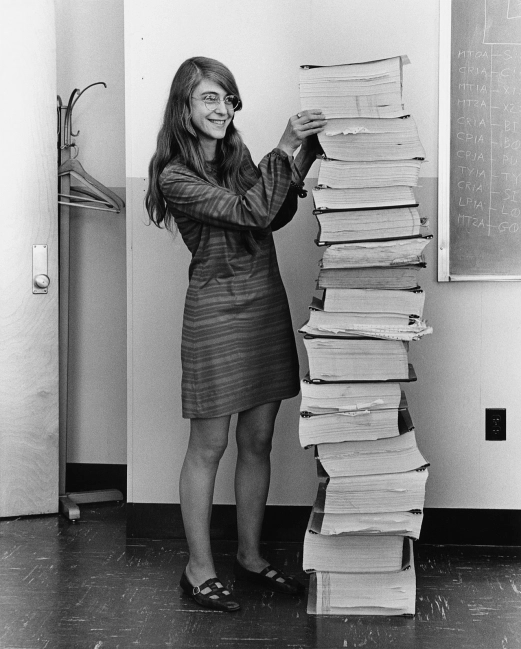
But the alarm came more than once. During the same descent, a 1201 alarm sounded one more time. Garman shouted again. "GO." And again. Five times in all. Every time, GO. All five times — Hamilton's Asynchronous Executive did its work.
06Twelve Seconds of Fuel — Armstrong's Hand on the Controls
While the alarms were being handled — Armstrong was looking out the window. He realized that the coordinates where the AGC was set to land automatically were a field strewn with car-sized boulders on the rim of an enormous crater (West Crater). Set the LM down there and its legs would shatter, and it would never lift off again.
About a minute and a half before touchdown, he — switched off the automatic mode and took over manually. This was an act not in the mission plan. But Houston, trusting Armstrong's composure, did not stop him.
The fuel left in the LM at touchdown — about 12 to 17 seconds' worth (estimates vary by source; NASA's later analysis put it at about 25 seconds). Had Armstrong hovered one more time over the crater — the mission would have been aborted. A second attempt, with Saturn V launching all over again, was impossible before December 31, 1969. Kennedy's promise would have been broken too.
What Kranz later wrote in his memoir — "For five minutes, no one in Mission Control could say a word. We just pounded the desks and wept."
07"A Giant Leap for Mankind"
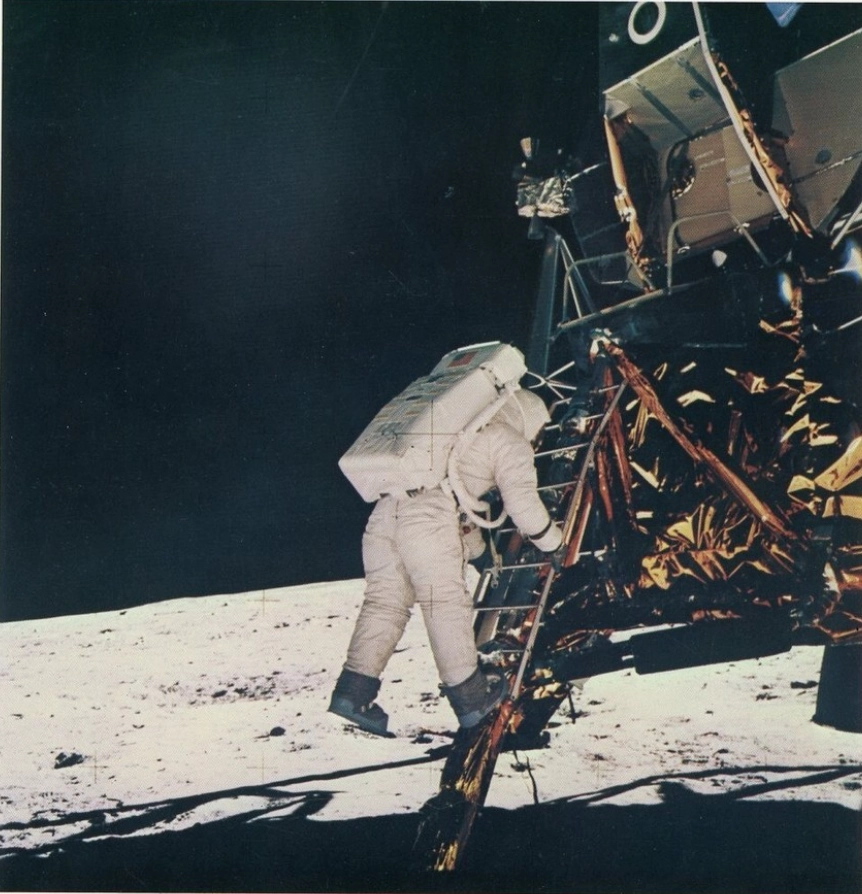
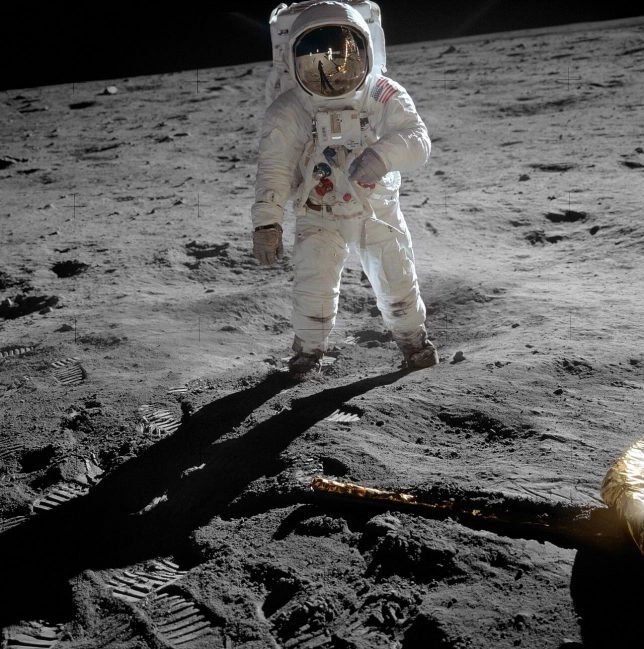
For 6 hours and 39 minutes after landing — Armstrong and Aldrin checked their suits and rested inside the cabin. The plan was to sleep longer, but neither could sleep (understandably). 09:56 EDT (July 21, 04:56 EDT). The LM hatch opened — and Armstrong began climbing down the nine-rung ladder.
The moment his left foot touched the lunar surface — July 21, 1969, 02:56:15 UTC. What he said:
"That's one small step for [a] man, one giant leap for mankind."
(One small step for a man, but a giant leap for mankind.)
Over the radio, Aldrin said: "I would like to ask everyone listening in, whoever and wherever they may be, to pause for a moment and contemplate the events of the past few hours, and to give thanks in his or her own way."
NASA had instructed him "not to make it explicitly a religious ceremony." This came right after atheist activist Madalyn Murray O'Hair had sued NASA over the Genesis reading on Apollo 8 in 1968. So for twenty years Aldrin barely mentioned his communion. Only in 1989 did he write about it in detail, in his memoir "Magnificent Desolation."
At that same hour — another spacecraft was on the same Moon. The Soviet Luna 15. It was a last surprise mission — to scoop up lunar soil samples automatically and bring them back to Earth ahead of Apollo 11. Launched July 13, 1969. Entered lunar orbit July 17. On July 21 — at the very hour Apollo 11 was on the surface, Luna 15 attempted its landing. Its automatic system failed to gauge its altitude. It crashed into Mare Crisium at 480 km/h. Shattered to pieces.
During the roughly 21 hours that Apollo 11's two men were on the Moon — they could not hear the final signal of the Soviet probe crashing in orbit above them. Nor could Collins. One of the loneliest deaths in history occurred in a place no one even saw.
① Success: Nixon would call the astronauts and offer his congratulations
② "In Event of Moon Disaster": for the case in which Eagle's ascent engine failed and the two men had to die on the Moon. Houston would cut communications, Nixon would phone the families, and then deliver the following address:
"Fate has ordained that the men who went to the Moon to explore in peace will stay on the Moon to rest in peace. These two brave men know that there is no hope for their recovery. But they also know that their sacrifice holds out hope for mankind."
This speech was made public only in 1999, by Safire. The Moon landing was no safe undertaking.
08The Way Home, and What It Meant
21 hours and 36 minutes on the lunar surface. In that time the two men — collected 21.5 kg of Moon rock, planted the U.S. flag (the Moon is a vacuum, so the flag wouldn't flutter; they extended it with a horizontal bar), and set up a seismometer and a laser reflector (this laser reflector is still in use today, in 2026 — for measuring the Earth-Moon distance).
July 21, 1969, 17:54 UTC. Eagle's ascent engine ignited. Had this failed to work, Safire's speech would have been delivered. It worked. Docking with Columbia. July 24, 16:50 UTC, splashdown in the Pacific southwest of Hawaii. A return after 8 days, 3 hours, and 18 minutes.
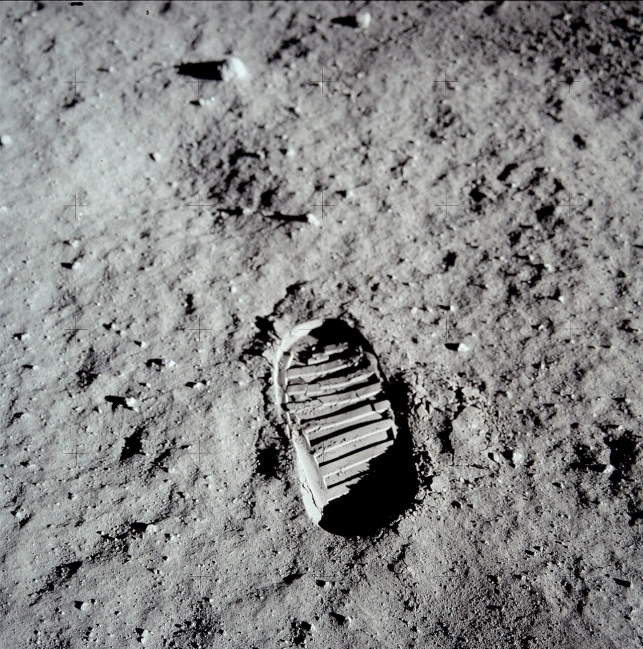
After Apollo 11 — through Apollo 17 in December 1972, a total of 12 people walked on the Moon. And then — for the past 53 years, humankind has not gone back. NASA's Artemis III mission, in 2026, aims to send humans to the Moon again — but not yet.
There is one thing I wanted to stress in this episode. Apollo 11 is not the story of a single hero. Armstrong moved his hand at the decisive moment, yes — but that moment was made possible by von Braun's Saturn V (EP01), by America's fear of Korolev (EP02), by Kennedy's gamble (EP03), by Grissom's death (EP04), by Margaret Hamilton's code, by Jack Garman's half-second — the result of everyone coming together.
In the next episode (EP06) — the real story of why the Soviets, during that same period, couldn't make it. The N-1 lunar rocket built by Korolev's successors after his death. It had to fire 30 engines simultaneously — and the tragic chain of four launches, four explosions. And what that single footstep of July 1969 meant for the Soviet Union.