The Rocket That Had to Ignite 30 Engines at Once
— Why the USSR Lost
Thirteen days before Apollo 11 launched, in the middle of the Kazakh desert — the Soviet N-1 rocket exploded whole atop its launch pad. One of the largest non-nuclear explosions in human history. Yet the USSR hid the fact for 47 years. And in the end, they staked their real bid somewhere other than the Moon.
01July 3, 1969 — The Day America Had Just 13 Days to Launch
The day we saw in EP05 — the Saturn V launch of July 16, 1969. Thirteen days earlier, on July 3, in the middle of the Kazakh desert. A U.S. reconnaissance satellite, the KH-8 "Gambit," passing over the Soviet Baikonur launch site around midnight, captured an enormous fireball.
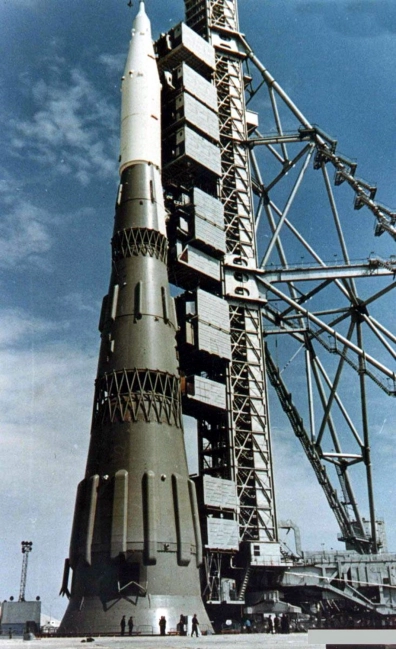
That was the second launch attempt of the N-1 rocket. A massive 110-meter white rocket — 23 seconds after liftoff, it fell back down and exploded together with the launch pad itself. Estimated yield: 7 kilotons. Half the Hiroshima bomb. It's classified as one of the largest non-nuclear explosions humanity has ever produced.
That explosion was effectively a death sentence for the Soviet lunar program. The next N-1 attempt would have been years away. With the American Saturn V just 13 days from launch, there was simply no way to close that gap.
02The N-1 — It Had to Fire 30 Engines at Once
Why the N-1's design was so hard comes down to a single number. Thirty first-stage engines. The American Saturn V had five. Six times as many engines had to fire in perfect unison.
Why did they do it this way? Because Korolev didn't have time to build one big engine. America spent seven years building a single F-1 engine (4 m in diameter, 770 tons of thrust). Mishin, the successor to Korolev (who had already died in 1966 — EP04), didn't have that time. So instead he went with a "cluster" design — bundling thirty small NK-15 engines (154 tons of thrust each) to produce the same output.
But making 30 engines fire in perfect unison is one of the hardest engineering problems in human history. If one engine runs 0.3% stronger, one side of the rocket lifts. If one engine ignites a second late, the thrust goes off balance. An automatic control system (KORD) had to handle all of this — and 1960s computers simply couldn't deliver that precision.
- 1969.02.21 (1st) — 68 seconds after liftoff, the first-stage engines shut down automatically. Crash. Explosion.
- 1969.07.03 (2nd) — 6 seconds after liftoff, an engine exploded → direct hit on the launch pad. The pad itself was destroyed. Thirteen days before Apollo 11 launched.
- 1971.06.27 (3rd) — 51 seconds after liftoff, attitude control failed. Explosion.
- 1972.11.23 (4th) — 107 seconds after liftoff, an engine exploded just before first-stage separation. The N-1 program was permanently canceled thereafter.
0347 Years of Secrecy — KH-8 and the Satellite Intelligence War
After the second N-1 explosion (1969.07.03), the United States knew about it almost immediately. A KH-8 reconnaissance satellite photographed the explosion debris six hours after launch. The CIA's conclusion from its analysis: "The Soviet lunar program is, for all intents and purposes, over."
Yet the United States did not make this information public. The reasons:
- The very existence of the KH-8 reconnaissance satellite was top secret. Disclosing it would have exposed America's surveillance capability to the USSR.
- Announcing in advance that "America wins" would not have helped the mood right before the Apollo 11 mission. It would have dissolved the Kennedy-era sense of urgency in an instant.
- And whether the Soviets knew that America knew they were finished — staying unaware of that would shape their next decisions.
On the Soviet side too — they did not officially admit the N-1 explosions until 1989. They were first disclosed during the glasnost era as KGB documents were released. It wasn't until 2016 that the KH-8 photographs themselves were declassified. A total of 47 years of silence.
04Soyuz 11 — The Only People Ever to Die in Space (1971.06.30)
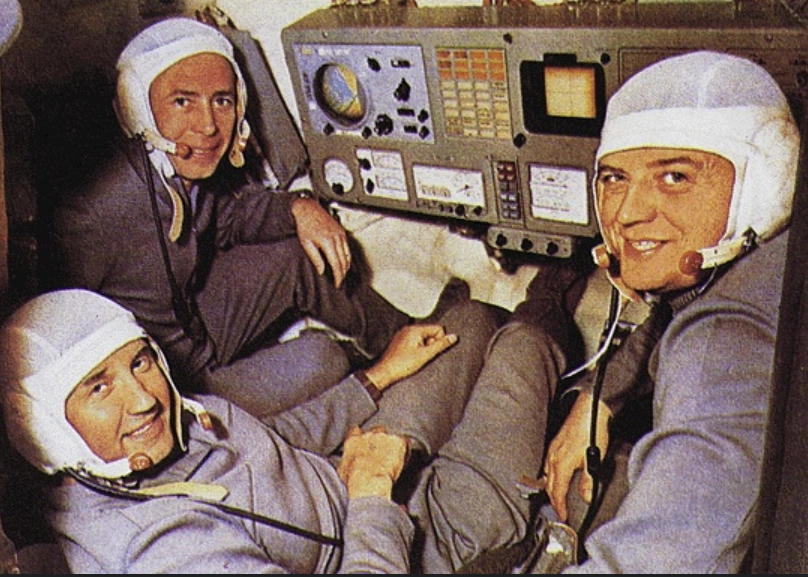
Between N-1 attempts — June 1971. The USSR had launched the first space station, Salyut 1, the previous year, and now wanted to send humans there. Soyuz 11. Commander Georgy Dobrovolsky, flight engineer Vladislav Volkov, and test engineer Viktor Patsayev — three men.
They spent 23 days aboard Salyut 1 (the longest human stay in space at the time). On June 29 they undocked. Early on June 30, reentry began. Everything was normal — by the telemetry Houston was tracking.
But after the capsule landed safely on the Kazakh steppe — when the recovery team opened the hatch — all three men were dead, still strapped into their seats. The autopsy finding: just before reentry (at an altitude of 168 km), a ventilation valve on the capsule was jolted open by vibration, and the air inside vented into space in 35 seconds. Their lungs ruptured instantly.
Knowing this — the decision the Soviet government made created a pattern that recurs throughout this series. Wrapping death in heroism. The three men were interred in the Kremlin Wall. And the West — it took a good while before it learned the truth of the accident.
05Salyut → Mir — The USSR's Real Gambit (1971–1996)
After the N-1 explosions and the Soyuz 11 tragedy — the USSR changed its strategy. It conceded that it had lost the race to the Moon, and resolved to get ahead of America in a different field. That field was long-duration crewed space stations.
- Salyut 1–7 (1971–1986) — a series of single-module stations. A mix of military (Salyut 2, etc.) and civilian use. Humanity's first experiments in long-term living in space.
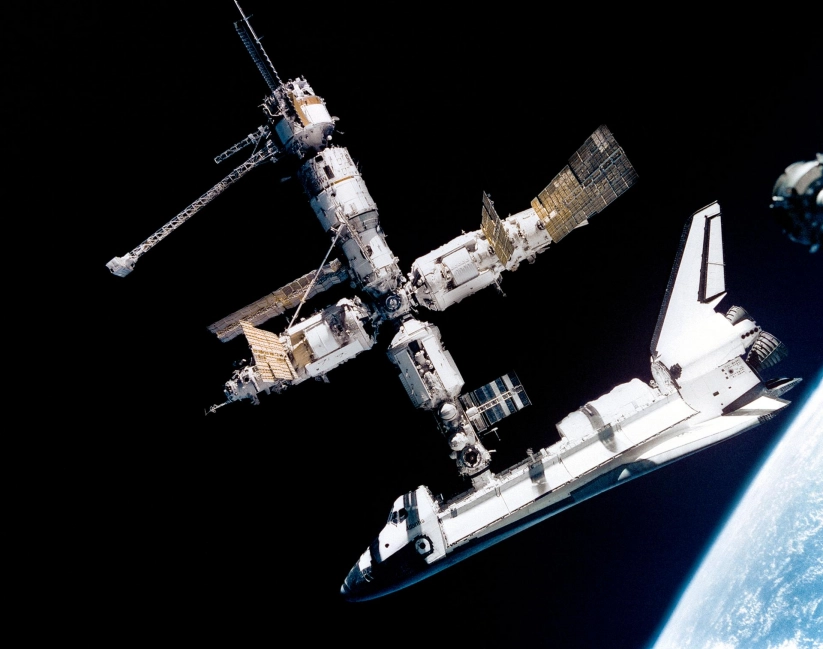
- Mir (1986–2001) — a modular station. About 130 tons. Seven modules added in stages. One person lived aboard for a record 437 consecutive days (Valeri Polyakov, 1994–95). That record still stands today, 30 years later.
- The International Space Station, ISS (1998–) — a joint project of the U.S., Russia, and 14 countries. Half of its core structure is made up of Mir-successor modules built by Russia. The American modules were launched by the Shuttle. So the ISS is really a joint U.S.–Russian project, but its core know-how came from the Soviet-era Salyut and Mir.
06July 17, 1975 — The Day Enemies Shook Hands in Space
Six years after Apollo 11. The Vietnam War was drawing to a close. U.S.–Soviet détente. The two superpowers agreed to mount a joint space mission. Its name: the Apollo–Soyuz Test Project (ASTP).
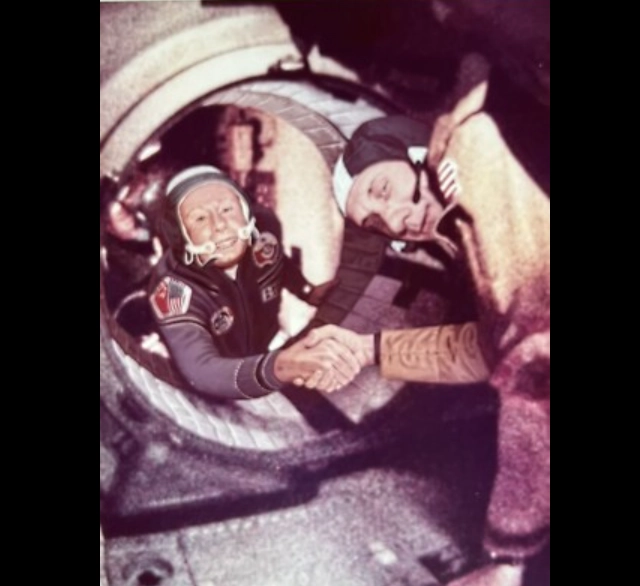
On July 15, 1975, an American Apollo capsule (crew of 3) and the Soviet Soyuz 19 (crew of 2) each launched. On July 17 — they docked in Earth orbit. The docking adapter opened, and American astronaut Thomas Stafford and Soviet cosmonaut Alexei Leonov (the very man who exposed Gagarin's accident in EP04) shook hands in the middle of space.
"Hello, friend!" — Leonov (in Russian)
"Zdravstvuy, drug!" — Stafford (in halting Russian)
07So Who Really Won
Looking only at the Moon race — America won overwhelmingly. Between 1969 and 1972, twelve people walked on the Moon. The USSR: zero.
But if you shift the lens to "humanity's ability to live in space" — the USSR was dominant for 30 years:
- First space station (Salyut 1, 1971) — two years ahead of America's first station (Skylab, 1973)
- First modular station (Mir, 1986)
- Longest single stay in space (Polyakov, 437 days, 1994–95) — a record that still stands as of 2026
- Russia provided 4 of the ISS's 5 core modules
- Even as of 2026, the people who go up to the ISS ride the Soyuz rocket, a direct descendant of the R-7
So — the Moon was a brilliant chapter that passed, and the everyday life of the real space age began on the station. And that everyday life — the USSR built it.
In the next installment (EP07) — January 28, 1986, the 73-second tragedy watched live in school classrooms. The Challenger explosion, and Columbia 17 years later. Both accidents were known to the engineers in advance — a second tragedy of NASA's management culture.