The Day an O-ring Shattered
January 28, 1986
Seventy-three seconds after launch, the Challenger exploded. Seven dead. Millions of American children watched it live from their classrooms — because aboard that flight was a 37-year-old teacher named Christa McAuliffe. Seventeen years later, Columbia fell into the same trap of NASA's management culture. In both disasters, the engineers knew in advance.
01January 28, 1986, 11:38 — 73 Seconds
Cape Canaveral, Florida. That morning it was -2°C. The coldest shuttle launch in history. The launch pad was coated in ice. And yet NASA — pressed ahead with the launch. The flight had already been delayed twice, and another postponement would have tangled the schedule even further.
Aboard that flight was — Christa McAuliffe (37). A high school social studies teacher from New Hampshire. The first participant in NASA's "Teacher in Space" program — selected from 11,000 applicants. In schools all across America — students were watching the launch on classroom TVs. Someone like their own ordinary teacher, going to space.
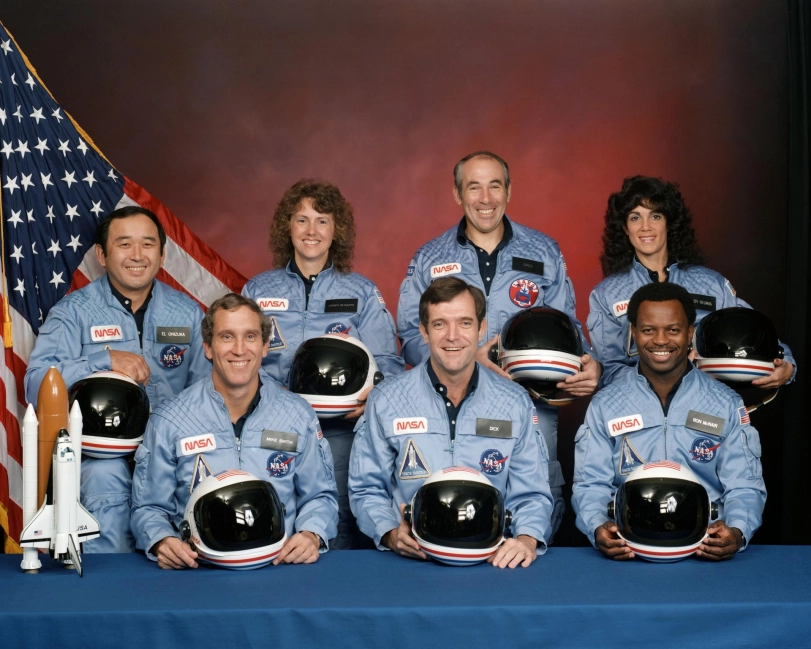
11:38 a.m. Launch. For the first 60 seconds, everything was normal. At 73 seconds — 73 seconds from the moment of liftoff — the screens of TVs across the nation suddenly turned into orange flame and white smoke. Challenger was simply gone. The wreckage of the crew cabin came from about 4 km up — and yet some of the crew were still alive (there were signs that emergency oxygen masks had been activated). The cabin struck the Atlantic at 333 km/h. All died instantly.
02The O-ring — A Trap in the Cold
The cause of the disaster was — two small rubber parts called O-rings. The shuttle's enormous white solid rocket booster (SRB) is — not built as a single tube, but made in several segments, brought to the launch site, and then assembled. What seals the joints between those segments is the O-ring.
The O-ring material is — under normal conditions, a rubber with good elasticity. But below 5°C it loses almost all of that elasticity. At launch, the pressure inside the SRB suddenly spikes to 200 atmospheres — and if a cold O-ring can't keep up with that change, a gap opens for a hundredth of a second and hot fuel gas leaks through.
At 0.678 seconds after launch — that is how the O-ring on Challenger's right SRB failed. At first it was just black smoke. At 58 seconds — a small flame began to leak from the side of the SRB. At 73 seconds — that flame reached the liquid-hydrogen section of the external fuel tank, and that exploded.
03Roger Boisjoly — The Plea the Night Before Launch
From July 1985 — Boisjoly continually sent his own company (Morton Thiokol, which built the SRBs) and NASA memos warning that the O-rings were dangerous in cold weather. Every one was ignored. Then, on January 27, 1986 — the night before launch — he made his final plea.
On the evening of January 27, a cold front hit Cape Canaveral. The forecast called for sub-freezing temperatures by the next dawn. In the company meeting, Boisjoly insisted forcefully that — "the launch must be delayed." The decisive moment:
"The O-rings are absolutely not safe below -1°C. If we launch — Challenger will explode."
— Roger Boisjoly, Morton Thiokol meeting, 1986.01.27 22:45 EST (12 hours before the disaster)A NASA manager who was present at the meeting — pressured the Morton Thiokol executives. The famous line: "Take off your engineering hat and put on your management hat." The company reversed its position in the middle of the night — and changed it to "launch OK." The next day, Boisjoly watched Challenger explode on television.
04Feynman's Ice Water — The Five Minutes That Smashed the Hearing
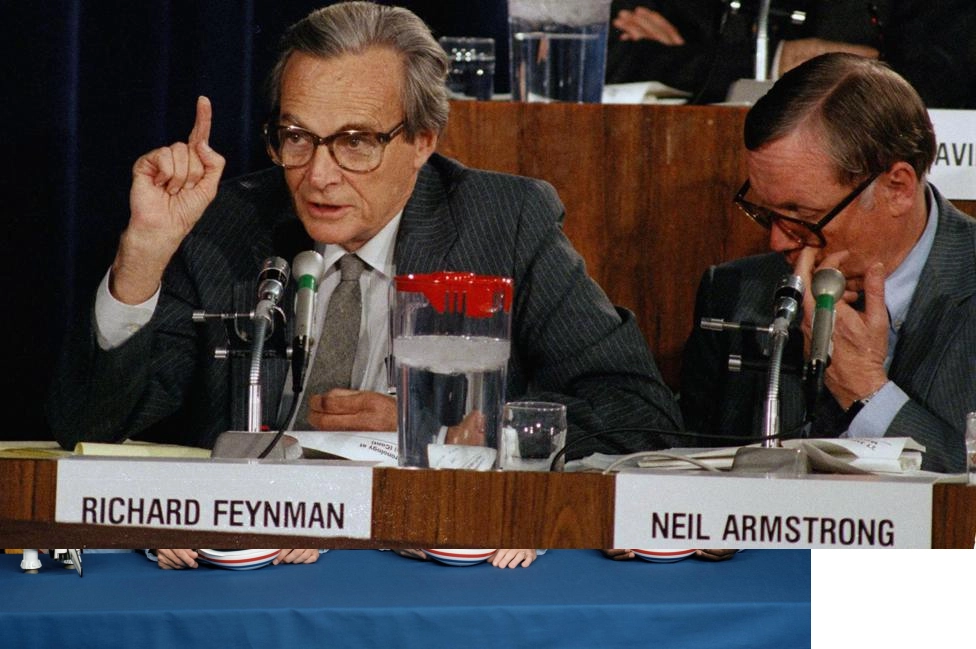
After the disaster, President Reagan appointed an accident investigation commission. One of its members was — Richard Feynman. Nobel laureate in physics, professor at Caltech, one of the founders of quantum electrodynamics. He was 67 at the time, and fighting cancer.
February 11, 1986, Washington, D.C., a congressional hearing. Broadcast live across the nation. NASA managers were — speaking as though the O-ring problem hadn't been all that serious. Then Feynman — pulled a sample piece of an O-ring from the cup of ice water on his desk. It was something he had prepared in advance before the session began.
"I took this and put it in ice water for a few minutes. Look — when I squeeze it, it does not spring back to its original shape. That means that the O-ring, at temperatures at or near freezing, no longer has any resilience. For the shuttle design, what this means is perfectly clear."
— Richard Feynman, Rogers Commission hearing, 1986.02.11 (broadcast live nationwide)This five-minute demonstration — brought down all of NASA's denials in a single stroke. The next day, the front page of every newspaper carried the photo of Feynman and the ice water. It became clear that the blame for the disaster lay — not in the flaw of a small part, but in "a NASA management culture that ignored its engineers' warnings."
05February 1, 2003 — The Same Pattern, 17 Years Later
Seventeen years passed. After the Challenger disaster, the shuttle program was halted for 32 months and resumed in 1988. After that came more than 100 safe flights. NASA read every accident report and reformed the system, too. And yet — on the morning of February 1, 2003.
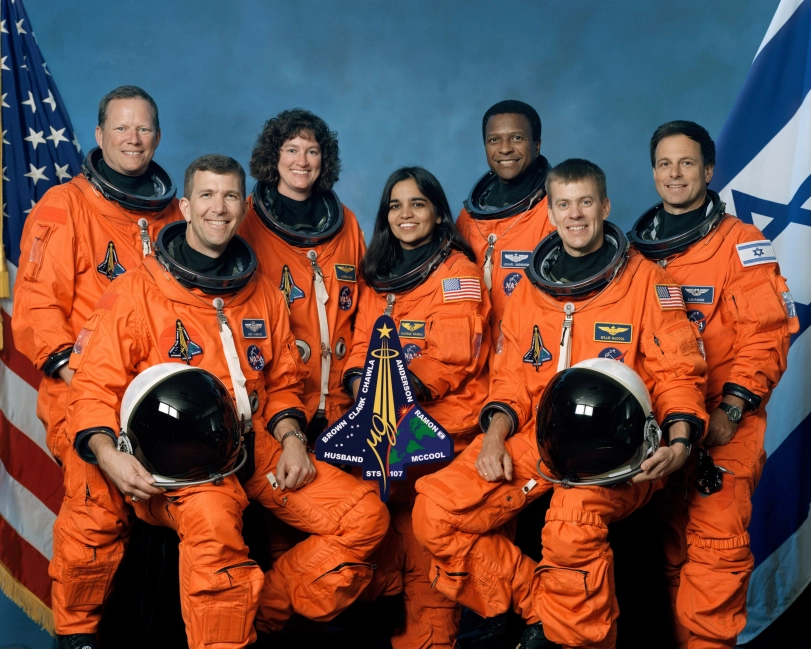
Columbia STS-107 was re-entering over Texas after a 16-day mission in space. About 24,000 km/h. Altitude 60 km. And then — the spacecraft's left wing suddenly disintegrated. All of Columbia shattered to pieces over east Texas. Seven dead.
The cause was — a piece of the external fuel tank's insulation (polyurethane foam) breaking off at launch and striking the left wing. A single chunk of foam about 50 cm across hit the carbon-reinforced (RCC) panel on the leading edge of the left wing at 800 km/h, and broke it. That hole caused no problems during the 16 days in space — but on re-entry, 1,650°C plasma poured in through that hole and melted the interior of the left wing.
06The Same Mistake — Made Twice
When the Columbia Accident Investigation Board (CAIB) report came out — its most shocking conclusion was that it was "almost identical to the earlier Challenger report":
- Engineers warned of the danger in advance — Challenger (Boisjoly), Columbia (NASA's own foam-strike analysis team)
- Managers ignored it under schedule pressure — Challenger (launching in the cold), Columbia (foam strikes had happened more than 100 times in flight, yet were classified as "safe")
- "It was fine before, so it'll be fine this time too" — both disasters followed exactly the same logic (the normalization of deviance)
- Warning signs accumulating — O-rings showed signs of damage in over 60% of 24 flights. Foam strikes occurred on nearly every flight. Statistically, a disaster happening was — a matter of time
07The Shuttle's True Fate — Von Braun Tried to Stop It
Here is a little-known backstory. Von Braun from EP01 (by then director of NASA Marshall) — strongly opposed the shuttle program in the early 1970s. His argument: "A reusable space shuttle is — too complex. A simple expendable rocket is safer and cheaper."
But — in 1972, President Nixon approved the shuttle. Von Braun saw that decision and left NASA in 1972. What he had said — "a reusable spacecraft can work, but the system is so complex that there is always a hidden danger" — was proven, 14 years later (Challenger) and 31 years later (Columbia).
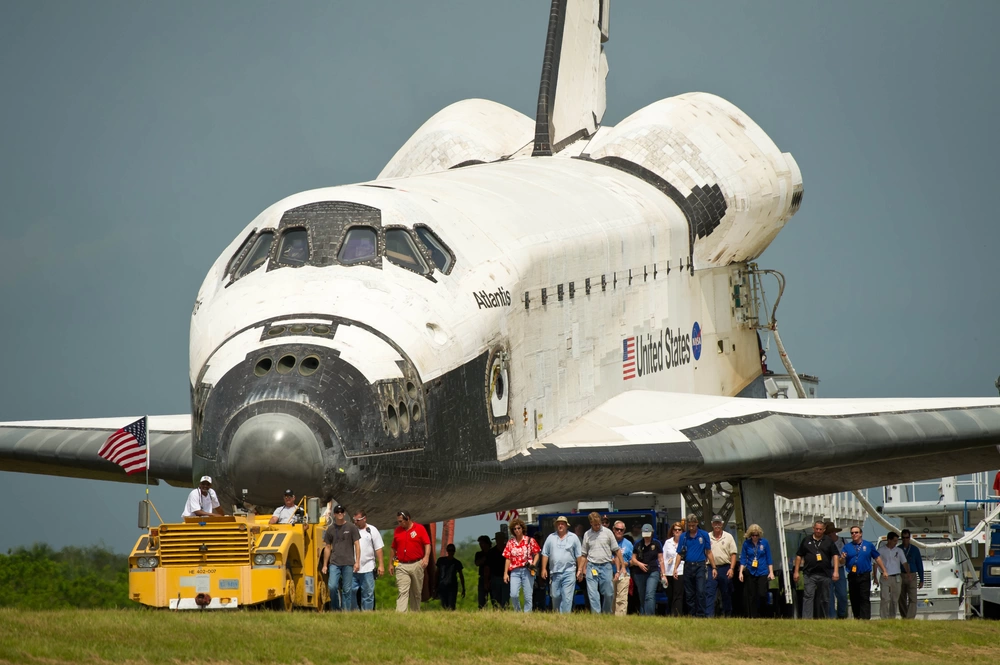
The shuttle was — in the end the most complex vehicle humanity ever built. 2.5 million parts. About $500 million per launch (NASA estimate). The original design goal was a "spacecraft like a truck" — launching once a week. In reality — over the 30 years from 1981 to 2011, there were 135 launches in total. An average of about 4 per year.
08The 14 the Two Disasters Left Behind, and the Lessons
Challenger 7 + Columbia 7 = 14 people. Every fatal accident across 30 years of shuttle operations. By NASA's statistics, the shuttle's fatality rate was 1.5%. That is — if you flew the shuttle 100 times, 1.5 people would die. No reasonable space-travel industry could ever operate on those numbers.
The lesson the two disasters left behind is — not a technical problem. It's that when a management culture ignores its engineers — disaster will eventually happen. That is the real conclusion of the shuttle's two disasters. And — the safety-culture reforms NASA built after Columbia in 2003 — ultimately became the foundation on which private companies like SpaceX and Blue Origin could emerge.
In the next episode (EP08) — at the very time these two disasters occurred, humanity's two loneliest spacecraft were slipping out of the solar system. Voyager 1 and 2. The golden record Carl Sagan placed inside them, the "Pale Blue Dot" photographed from 6 billion km away in 1990, and the story of those two little ships still working in 2026.