The Golden Record, the Pale Blue Dot,
and Two Ships Still Alive After 49 Years
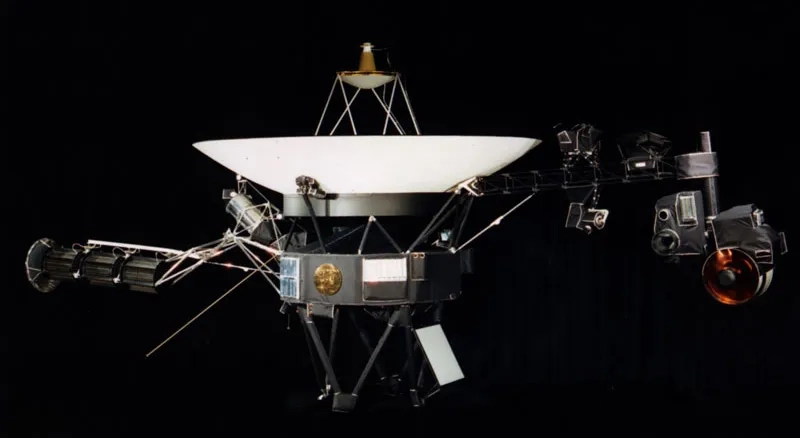
In August and September of 1977, two tiny spacecraft set out on a voyage into eternity. Voyager 1 and Voyager 2. Inside each one is a Golden Record curated by Carl Sagan — a letter from humanity to the aliens. In 1990, from 6 billion km away, a single photograph they took changed humanity's sense of itself forever. And — even now, in 2026, the two spacecraft are still sending signals from interstellar space.
011977 — A Planetary Alignment That Comes Once Every 175 Years
In 1965, a young intern mathematician at JPL (the Jet Propulsion Laboratory), Gary Flandro (then 26), discovered a planetary alignment that occurs only once every 175 years. In late 1977 — Jupiter, Saturn, Uranus, and Neptune would line up on one side. A single, once-in-a-lifetime chance for one spacecraft, on one launch, to fly close past all four planets.
The next alignment would come in — 2152. Which meant NASA would have to wait 175 years if it missed this window. The launch absolutely had to happen in 1977.
The name was originally "Mariner Jupiter-Saturn," before being renamed "Voyager" in March 1977. Two ships (Voyager 1, Voyager 2). Voyager 2 launched on August 20, 1977; Voyager 1 on September 5. Because Voyager 1 was on a faster trajectory, it reached Jupiter before Voyager 2 — which is why the naming order ended up reversed from the launch order.
02Gravity Assist — How to Use a Planet Like a Slingshot
The reason this mission could only happen once every 175 years comes down to one thing — gravity assist is the key. As a spacecraft passes close to a planet, it uses that planet's gravity — like a slingshot, to boost its own speed.
This is no mere trick. If, in 1977, Voyager had tried to reach Neptune on its own fuel alone — it would have taken more than 30 years. But by harnessing the gravity of four planets in turn — Voyager 2 reached Neptune in just 12 years (August 1989).
Voyager was the mission that — used this technique more spectacularly than any other in human history. Jupiter in 1979, Saturn in 1980 (Voyager 1) / 1981 (Voyager 2), Uranus in 1986 (Voyager 2 only), Neptune in 1989 (Voyager 2 only). With each flyby, humanity's knowledge of these planets exploded forward another step.
03The Golden Record — Carl Sagan's Letter to the Aliens
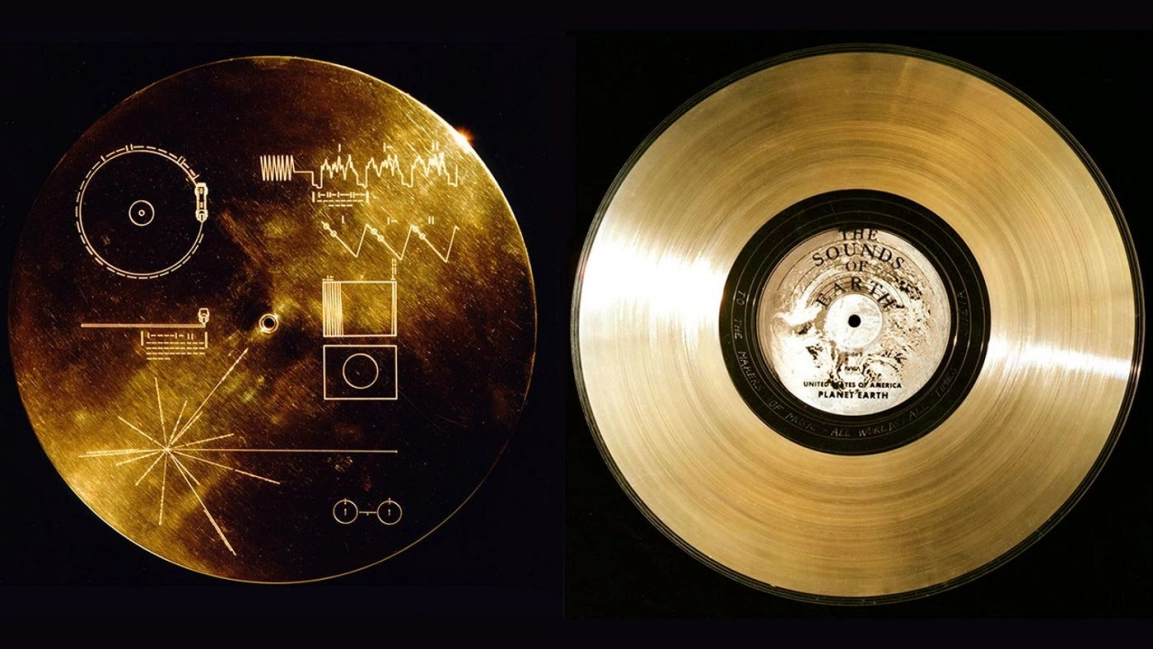
In 1976, a year before launch, NASA decided to attach a metal disc to each of the two Voyagers — a letter from humanity, to be discovered perhaps by an alien civilization. The curation was done by Carl Sagan himself.
He was 42 at the time. Already one of the most famous scientists in America. NASA told him to — curate the Golden Record's content within six weeks. The six-person committee he led — packed 27 pieces of music, 116 photographs, greetings in 55 languages, and the natural sounds of Earth (thunder, birdsong, wind, the sound of a kiss) onto a single disc.
The musical curation was the hardest part. Out of 5,000 years of human music — a single 90-minute disc. The result:
- Bach — Brandenburg Concerto No.2, 1st movement (representing Western classical music)
- Beethoven — Symphony No.5, 1st movement
- Mozart — "Queen of the Night" aria from The Magic Flute
- Chuck Berry — "Johnny B. Goode" (1958, representing rock and roll)
- Chinese guqin — "Flowing Streams"
- Indian raga, Japanese shakuhachi, Peruvian panpipes, a Navajo song, Australian Aboriginal music…
04"Pale Blue Dot" — Earth Seen From 6 Billion km Away (1990.02.14)
February 14, 1990. Voyager 1 was beyond Neptune, 6 billion km from Earth. Every planetary mission was already over. Carl Sagan — made one request to NASA:
"Turn Voyager 1's camera around one last time — to look back. Take a picture of Earth. From out there it will be just a single point. But — humanity needs to see that one point."
— Carl Sagan, request to NASA, 1989–90At first NASA refused. Turning the camera toward the Sun risked damaging the sensor. Sagan spent four years persuading them before — it was finally approved. On February 14, 1990 — Voyager 1, from 6 billion km away — photographed Earth.
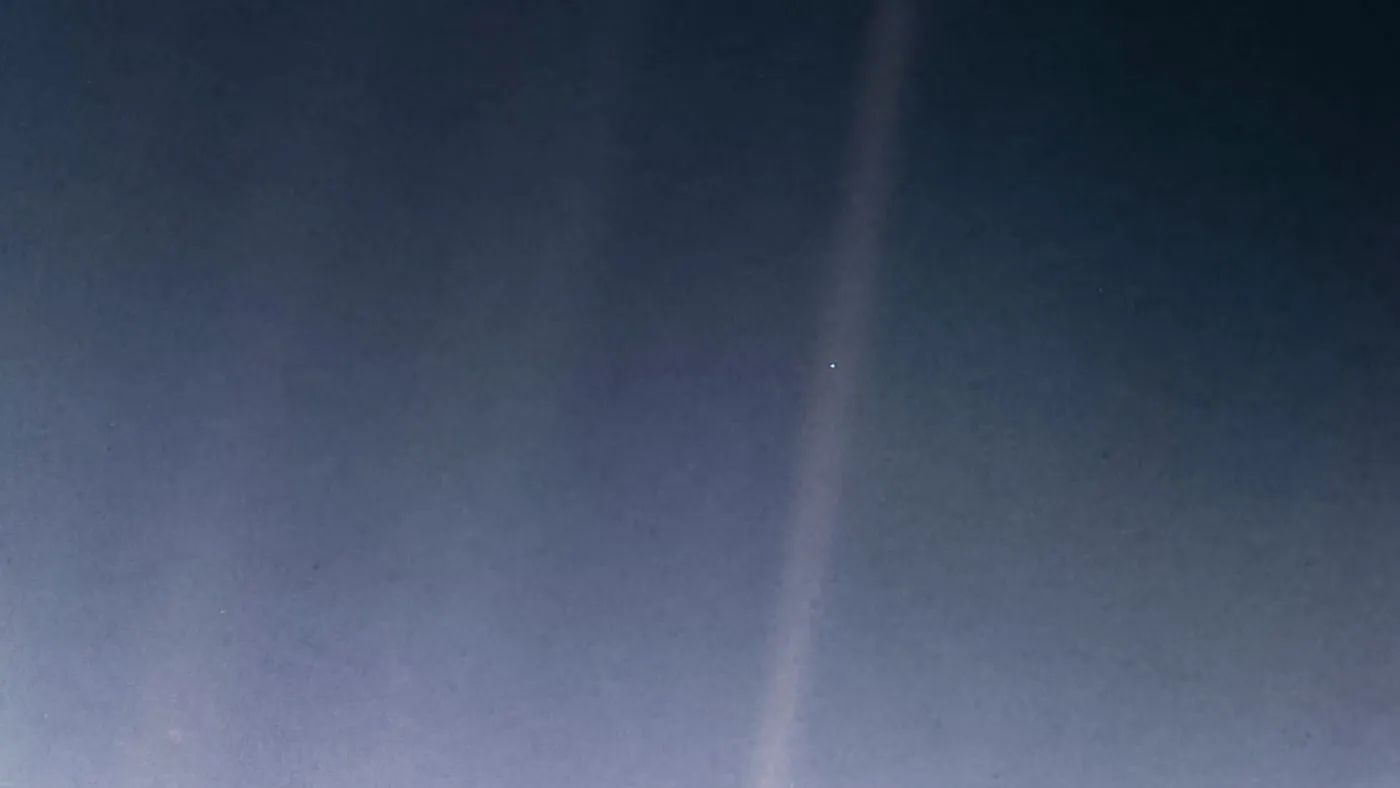
When Sagan saw this photograph — the passage he wrote about it in his 1994 book "Pale Blue Dot" is regarded as having changed human thought forever:
"Look again at that dot. That's here. That's home. That's us. Everyone you love, everyone you know, everyone you ever heard of, every human being who ever was — lived out their lives on that tiny point. (...) Every triumph and cruelty in human history, every conqueror's vanity, every religion, every ideology, every hunter and forager, every hero and every coward, every creator and destroyer of civilization, every king and every farmer, every young couple in love, every mother and father, every inventor and explorer, every teacher of morals, every corrupt politician, every superstar, every supreme leader, every saint and sinner — all of them lived on a mote of dust suspended in a sunbeam."
— Carl Sagan, "Pale Blue Dot" (1994)05Voyager 1's Entry Into Interstellar Space (2012.08.25)
Every star has — its own domain called the heliosphere. Our Sun blasts its solar wind out in every direction, and that wind reaches out to roughly 200 AU (about 30 billion km). Beyond it lies — the space between the stars, interstellar space.
August 25, 2012. Voyager 1 — 35 years after launch — became the first human-made object ever to leave the heliosphere. Distance: about 18 light-hours from Earth. In other words, a place where light takes 18 hours to arrive. Even its data takes 18 hours to reach NASA.
As of 2026, Voyager 1's position — is about 25 billion km from Earth. A distance of 21 light-hours. In 2025, Voyager 2 also entered interstellar space. On the remaining charge in their RTG batteries, the two spacecraft can — keep one or two scientific instruments running until roughly 2030. After that — the signal goes silent. They will drift through space forever.
062026 — The Two Ships Are Still Alive
Forty-nine years have passed. Back on Earth — Carl Sagan died in 1996, most of the NASA mission leads have retired, and nearly all the engineers who stood at the 1977 launchpad are gone.
And yet Voyager — is still operating. Every day, across roughly 22 hours (of light-travel time) — the giant antennas of the Deep Space Network are receiving their signals. The signal strength is 10^{-18} watts (10 to the power of -18). For comparison: a typical cell phone signal is about 10^{-3} watts. The Voyager signal is one hundred-billionth of one hundred-billionth of that.
In November 2024 — Voyager 1 lost communication for a while. NASA debugged it with signals that took 17 hours each way. In the end — they found that one 47-year-old memory chip had failed. They sent up workaround code that rerouted to a different memory, and recovered it. The same kind of thing as the 1202 alarm Aldrin's crew faced and Garman solved in 0.5 seconds in 1969 — happened again on a 47-year-old spacecraft.
07What Voyager Means
Until now, this series has been — a story of human ambition and rivalry. EP01, the moral shadow of von Braun; EP02, Korolev's gulag; EP03, Gagarin's death; EP04, the tragedy of two superpowers; EP05, the 12 seconds of fuel; EP06, the N-1 explosion; EP07, the shuttle tragedies. All of them — stories of two superpowers on Earth fighting over power.
Voyager is — something beyond all of that. Those two tiny spacecraft were not launched to fly the flag of America or the Soviet Union. They were sent to tell the universe — "We humans were here." A Golden Record that aliens may or may not ever decode. Music and pictures made by a humanity they have never seen. And within it — every race, every culture, every era.
What Apollo taught us was "humanity can go somewhere else." What Voyager taught us is — "humanity is part of something larger than its own planet."
In the next episode (EP09) — the moment when space passed back from the hands of nations into the hands of an individual. September 28, 2008: a 31-year-old entrepreneur threw every last asset he had into — the fourth launch of Falcon 1. The story of the night when, had that launch failed, both SpaceX and Tesla would have gone under.