"Поехали (Let's go)!"
The 108 Minutes of a 27-Year-Old Farmer's Son
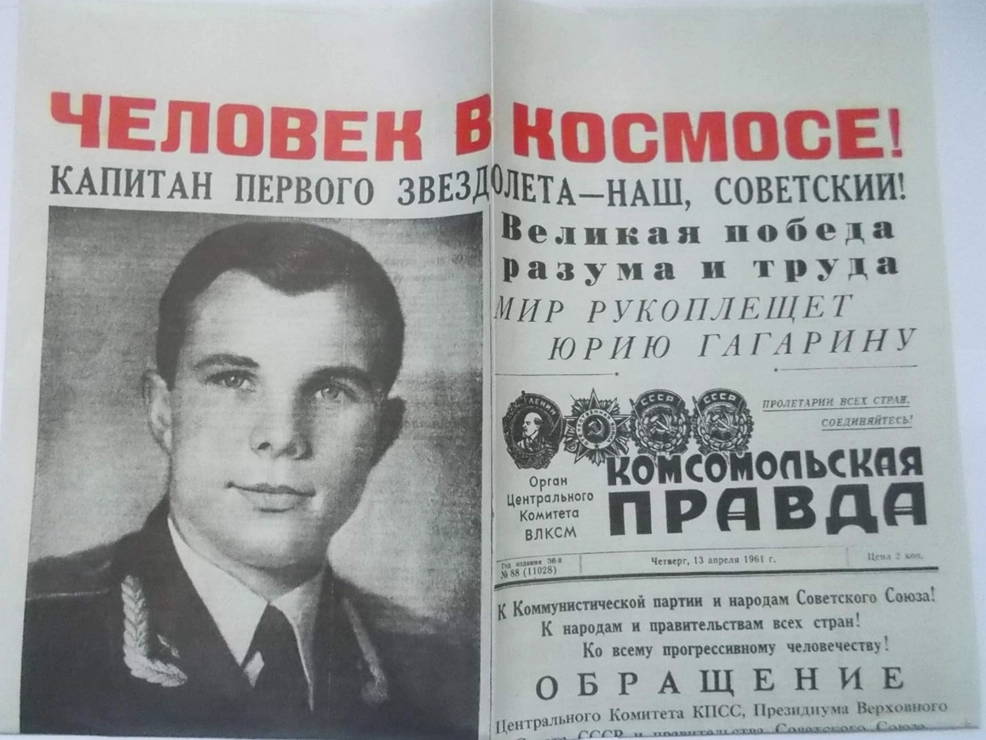
April 12, 1961, 09:07, the Kazakh desert. Sitting atop an R-7 rocket, a 27-year-old said a single word into his radio — "Поехали!" (Let's go!). That was the starting signal of humanity's space age. 108 minutes later he came down by parachute into a farmyard — and the USSR hid that fact for 30 years. Five weeks afterward, in Washington, a 41-year-old president laid down a gamble before Congress.
01April 12, 1961, 09:07, Tyuratam
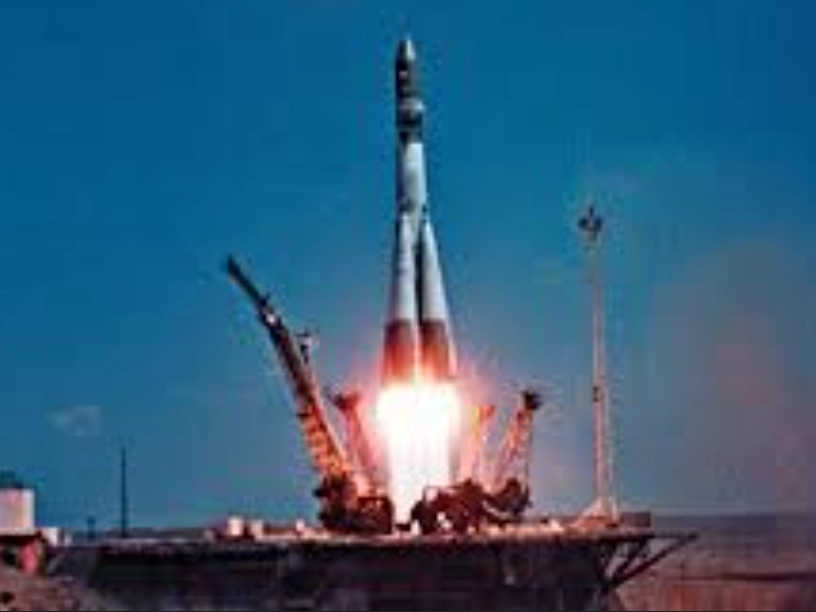
Wednesday morning. The Tyuratam launch site in the Kazakh SSR (later Baikonur). A variant of that R-7 rocket from EP02 — the Vostok-K — stood on the pad. Perched at its very top, a 2.3m-diameter aluminum sphere. The Vostok 1 capsule. And inside it — a 27-year-old lieutenant of the Soviet Air Force.
One minute before launch, the countdown from Korolev (the "chief designer" of EP02) came over the radio. T-minus 60... 30... 15... ignition. As the nozzles of 32 engines spat fire all at once — the young man inside the capsule transmitted a single line:
"Поехали! (Po-ye-kha-li! Let's go!)"
— Yuri Gagarin, 1961.04.12, 09:07 Moscow time, at the moment of Vostok 1's launchThis is the first thing humanity ever said on the road to space. Nothing like Shakespeare. Just an everyday phrase Russian peasants used to set a cart moving. Something like "Right, let's go!" Gagarin simply tossed it off in his ordinary way of speaking. Which, maybe, makes it all the more human.
02The Farmer's Son from the Village of Klushino
His father was the village carpenter, his mother milked the cows. A genuine peasant family. In 1941, when he was 7, German troops occupied the village — and the family was driven out of their own home, living for 21 months in a 3m × 3m mud-walled dugout. Gagarin's older brother and sister were taken off to forced labor in Germany. They did make it back alive, though.
After the war he went to school, graduated from the Saratov Industrial Technical School (1955), flew his first plane at a flying club, and joined the Soviet Air Force in 1957. Up to this point Gagarin was just an ordinary country boy. A farmer's son who worked his way up to becoming an Air Force pilot — a Soviet-style success story.
03One of Twenty — Korolev's Choice
1959. By secret order, the Soviet government began selecting its first космонавт (kosmonavt = cosmonaut). The requirements were fairly strict:
- Under 30 years old
- Under 170cm tall (because the Vostok capsule was so small)
- Under 70kg in weight
- Fighter pilot experience
- A Party member (or someone with a background fit to become one)
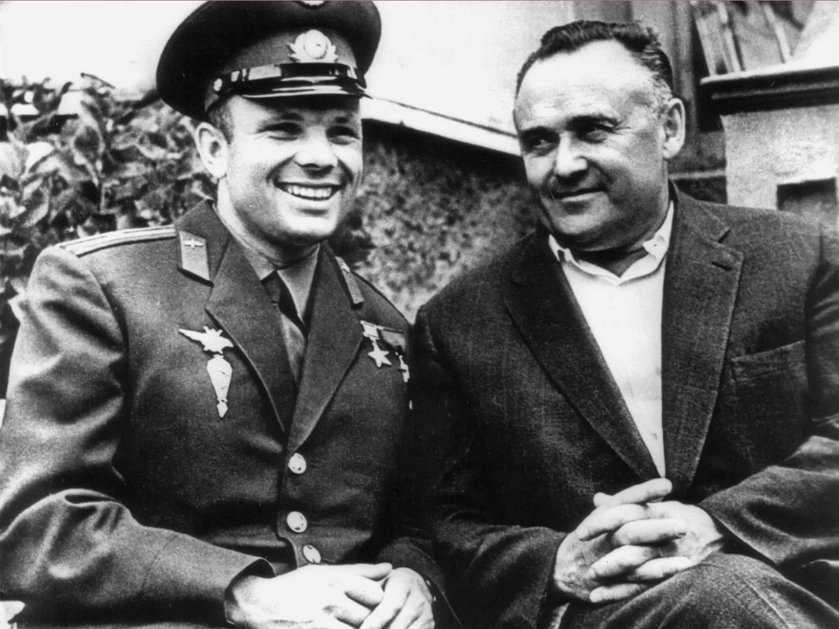
3,000 candidates → 200 → 20 → a final 6 (the "Sochi Six," or "the vanguard 6"). From those six, Korolev personally picked No. 1 and No. 2. The candidates:
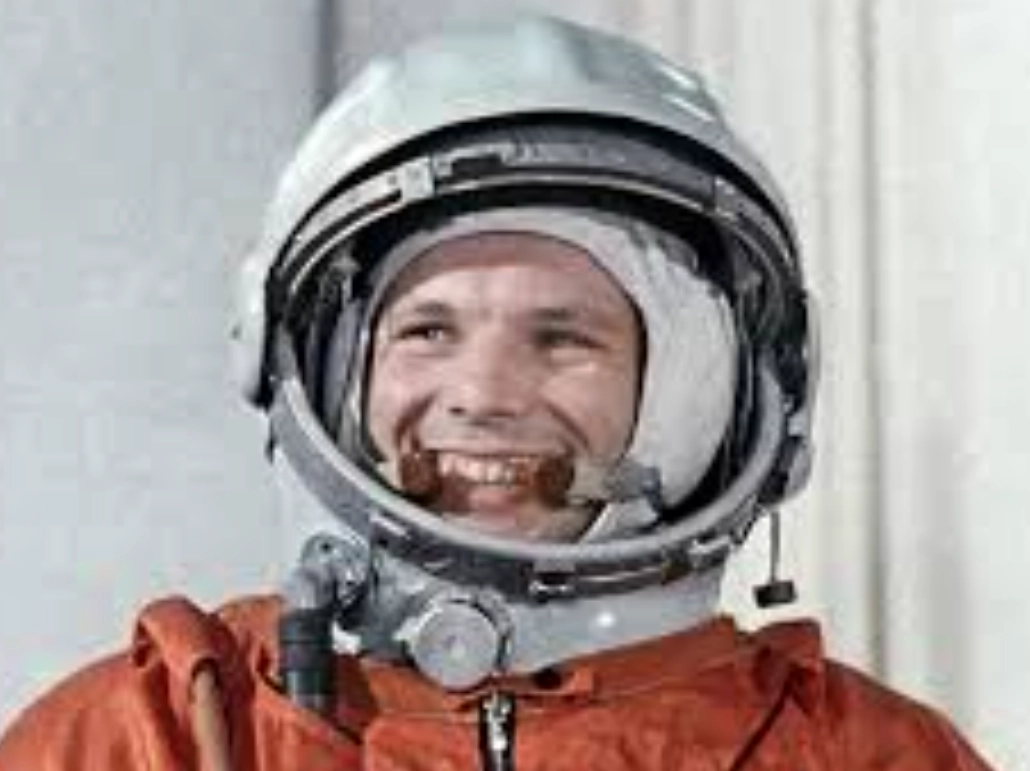
- Yuri Gagarin — height 157cm, a farmer's son, always smiling
- Gherman Titov — slightly taller than Gagarin, from an educated family, better trained
Technically the two were on the same level. And yet Korolev chose Gagarin. The reasons:
- The propaganda value of "a farmer's son went to space" — a perfect symbol of the socialist system
- Gagarin's ever-bright smile and his modesty — a better fit as a media figure
- Titov was more blunt and assertive by temperament — Gagarin was the better choice as a diplomatic representative
04A Bus Tire, and Three Announcements
6 a.m., April 12, 1961. Gagarin and his backup, Titov, boarded the bus heading to the pad in their spacesuits. Then Gagarin suddenly — asked the driver to stop. He got off the bus, and — urinated on the bus's right rear tire.
Nerves? Partly. But there's a deeper reason. Russian peasants had long held a superstition that urinating on a cart wheel before setting off on a long journey brings good luck. Gagarin did exactly that, at the last moment — unconsciously.
Meanwhile, in the Kremlin in Moscow — Khrushchev was having a different kind of preparation made. Three different TASS announcements were being pre-recorded:
- Announcement 1 (success) — "The great socialist motherland has sent the first human into space"
- Announcement 2 (death) — for if Gagarin died in space or during reentry. It included a request to Western nations to help recover the body. In other words, an announcement admitting in advance the fact that "we ourselves don't know where he'll come down"
- Announcement 3 (lost) — for a loss of communications. A memorial-style message implying he was floating in space forever
05108 Minutes — The First Human to Circle the Earth
Launch at 09:07. Past the launch tower in 11 seconds. Orbit reached in 5 minutes. Perigee 169km, apogee 327km, orbital inclination 65 degrees. For the first time in human history — one person saw with his own eyes that the Earth was round, right beneath his feet.
"Я вижу Землю!.. Какая красота! (Ya vizhu Zemlyu! Kakaya krasota! — I can see the Earth! It's so beautiful!)"
— Yuri Gagarin, 1961.04.12, 09:23 (radio transmission from Vostok 1 in orbit)For the next 80 minutes Gagarin — ate from food tubes inside the capsule, drank water, and looked out at the Earth through the window. Humanity's first experience of weightlessness. He reportedly noted that "a pencil floats around."
But during reentry — trouble struck. The service module didn't separate cleanly from the capsule. The two stayed connected by a single cable and tumbled in a spin for 10 minutes. Gagarin, shaken at 8–10G inside the capsule, later recalled thinking "is this how I die?" Fortunately the reentry heat burned through the cable and severed it, and the capsule returned to its proper attitude.
Altitude 7km. The capsule hatch blew off — and Gagarin's seat itself was ejected. Two parachutes opened. He came down into the middle of a farmyard at 09:55. Exactly 1 hour and 48 minutes after launch.
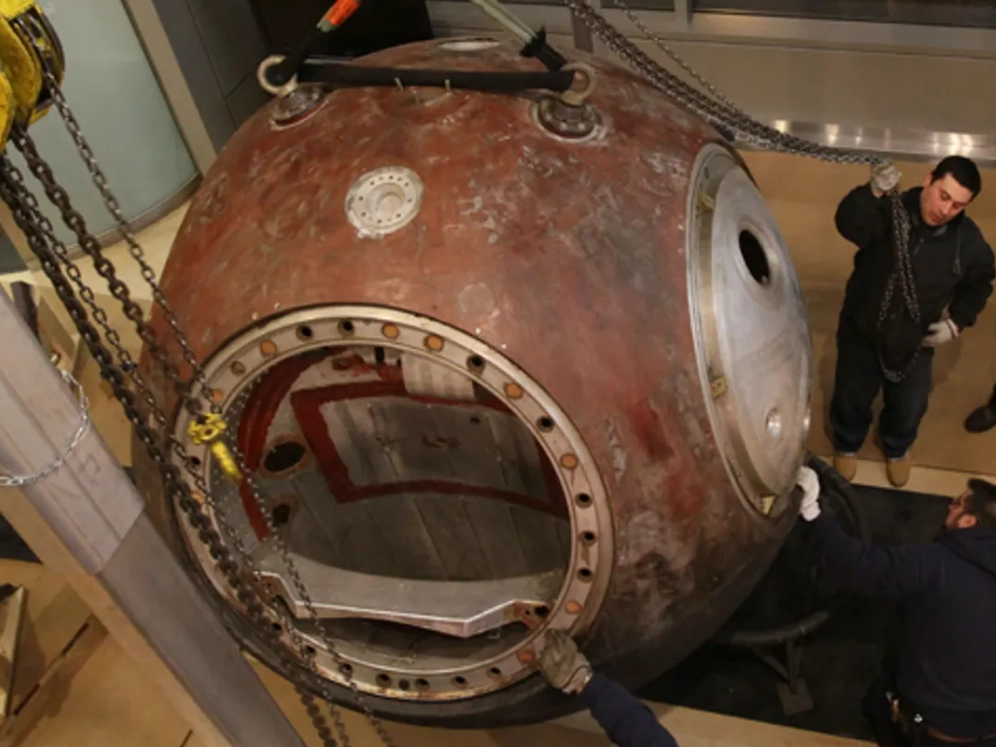
The spot where Gagarin came down was a farmyard in the Engels district of Saratov Oblast. The people there were — a farmer, Anna Takhtarova, and her granddaughter. When this alien-looking man in a spacesuit fell from the sky — both of them ran off. Gagarin took off his helmet and shouted:
"Don't be afraid! I'm a Soviet citizen. I've come from space!"
(Не бойтесь! Я свой, советский! Я прилетел из космоса!)
06The 30-Year Lie — Gagarin Did Not Climb Out of the Capsule
Here the shadow of Korolev's secrecy from EP02 reappears. Gagarin did not land inside the capsule. He was ejected from 7km up and came down by parachute into a farmyard. And yet — the USSR hid this fact for 30 years, from 1961 into the early 1990s.
Why? Because of the FAI (Fédération Aéronautique Internationale) rules.
The Soviet Vostok capsule was — designed from the start for ejection landing. The capsule hit the ground at roughly 100 km/h, so a person inside would die. That's why it was built to eject the cosmonaut at 7km. But that violated the FAI rules. The "first human spaceflight" record was at risk of being voided.
So the USSR — lied, claiming Gagarin stayed inside the capsule all the way down. For 30 years. It wasn't until the glasnost era after the Soviet collapse in 1991 that they admitted the truth. The FAI — kept Gagarin's record intact even after the truth came out (a historic event of this magnitude simply can't be nullified after the fact).
07Kennedy's Gamble (1961.05.25 + 1962.09.12)
Five days after Gagarin's flight, April 17, 1961. The Bay of Pigs invasion. 1,400 Cuban exiles, trained by the CIA, landed on Cuba's southern coast to topple Castro. A complete failure within three days. One of the worst humiliations in the history of American diplomacy.
From Kennedy's standpoint — he'd been knocked down twice in two weeks. While Gagarin was conquering space, the U.S. couldn't even overthrow one Cuba. The 41-year-old president, three months into his term, was close to panic. A single line from a memo he sent Vice President LBJ on April 20:
"Are we working 24 hours a day on existing programs? If not, why not? Is there any space program which promises dramatic results in which we could win?"
— John F. Kennedy → Lyndon B. Johnson memo, 1961.04.20LBJ sent back his answer a week later. "On near-Earth orbit, the Soviets are far ahead. But — no one has reached the Moon yet. There, we can win."
On May 5, Alan Shepard became America's first astronaut. But that was a ballistic flight. A 15-minute hop, never reaching orbit. It was in a completely different league from Gagarin's 1.5-hour orbital flight. Kennedy — 20 days after Shepard's flight, on May 25, stood before a joint session of Congress. And threw down the greatest technological gamble in human history:
"I believe that this nation should commit itself to achieving the goal, before this decade is out, of landing a man on the Moon and returning him safely to the Earth."
— John F. Kennedy, address to a joint session of Congress, 1961.05.25One year and four months later, on September 12, 1962, at Rice University in Texas. Kennedy made the same promise again, more poetically. This is the "moonshot speech":
"We choose to go to the Moon in this decade and do the other things, not because they are easy, but because they are hard."
— John F. Kennedy, Rice University address, 1962.09.12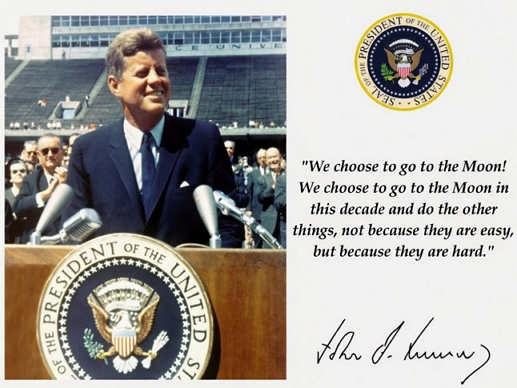
These two speeches — decided the entire direction of NASA's next decade, and of humanity's push into space. The path we'll follow from EP04 through EP05. The Saturn V, the tragedy of Apollo 1, and that one step in July 1969. It all started from Kennedy's panic.
08March 27, 1968 — The Mystery of the MiG-15
After his 1961 flight, Gagarin became a god of the Soviet Union. A tour of 30 countries around the world. A hero of every socialist nation. Castro, Mao Zedong, even Nehru met him. But — he never went to space again. The political judgment was that he was too valuable a symbol to expose to danger.
In 1966–67 — Gagarin trained as the backup cosmonaut for Komarov's Soyuz 1 flight, which we'll cover in EP04. After Komarov died (more on that in EP04), the USSR barred Gagarin from ever going to space again. And so he — around this time, began training to return to being a fighter pilot.
The morning of March 27, 1968. A MiG-15UTI trainer. Gagarin (age 34, a flight instructor) and the flight instructor Vladimir Seryogin (age 45). Over Novosyolovo, near Moscow. Communications were lost 6 minutes into the flight. The wreckage was found 4 hours later. Both men killed instantly.
In 2013, cosmonaut Alexei Leonov (who returns in EP04) made a public statement that he had seen the classified portion of the accident report. The real cause he disclosed:
"An Su-15 fighter broke the sound barrier passing within 10–15m of Gagarin's MiG-15. That shock wave (the sonic boom) threw the MiG-15 into a full spin, and Gagarin and Seryogin had no time to recover."
The Su-15 pilot was in violation of the rules (exceeding his permitted altitude + ignoring air traffic control). The Soviet government hid this for 45 years — because the Su-15 pilot was in a politically protected position.
Gagarin was 34. He was buried in the Kremlin Wall in Moscow. On that day — the Soviet space program, having lost another colossal symbol after Korolev (who died in 1966), was already falling decisively behind the United States.
16 months after his death, on July 20, 1969 — humanity left its first footprint on the Moon. But that flag was an American flag. Gagarin never got to see that moment.
In the next installment (EP04) — the simultaneous tragedies of the two superpowers in 1966–67. Korolev's mysterious death on January 14, 1966; the three Apollo 1 astronauts burned alive atop the launch pad on January 27, 1967; and Vladimir Komarov, who placed a final call to his family just before his death in the defective Soyuz 1 on April 24 — the story of a man who launched knowing "this cabin won't come back."