The Night an 83.6 kg Aluminum Sphere
Threw America Into a 90-Minute Panic
October 4, 1957, 22:28 Moscow time. In the middle of the Kazakh desert, an R-7 rocket climbed into the sky. Ninety-six minutes later, a small aluminum sphere circled the Earth once, transmitting a "beep, beep, beep" signal. The man who built that sphere — was someone who had survived six years in the Gulag, a man whose very identity was a top-secret KGB classification.
01October 4, 1957 — The Signal America Heard
Friday, October 4, 1957. 10:28 p.m. Moscow time. At the Tyuratam test range (today's Baikonur) in the Kazakh SSR, an R-7 rocket lifted off. Ninety-six minutes later, the rocket's nose cone separated — and the single 83.6 kg aluminum sphere inside was released. Diameter: 58 cm. Four antennas on the outside. Its name was Простейший Спутник-1 (Prosteishy Sputnik = "Elementary Satellite 1"). For short: Sputnik 1.
As it entered Earth orbit, it began to transmit. On two frequencies (20.005 MHz, 40.002 MHz) — "beep... beep... beep...". Within an hour, ham radios in Japan, ham radios in California, ham radios in New York all picked up the same signal. It wasn't even a secret code. It was a signal deliberately broadcast for anyone to hear.
The next morning. Every newspaper in America ran its front page — plastered with the same headline:
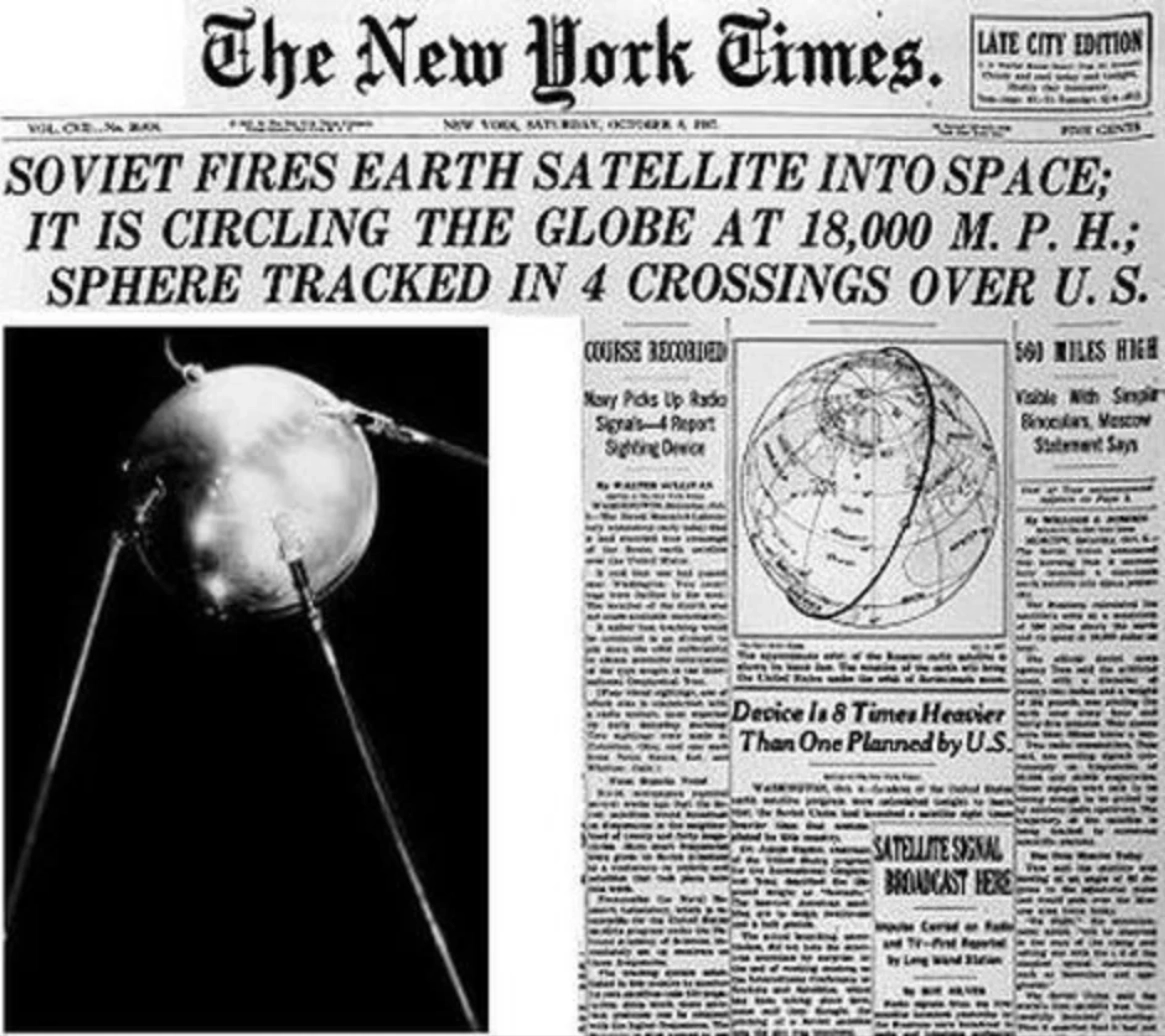
President Eisenhower was on a golf vacation in Rhode Island that weekend. His aides woke him. The first thing he said — "It's not much of a threat." But within a few days, even he realized it. This isn't about a satellite. It's the fact that "they" can put something over "our" heads — and we can't stop them.
Sputnik had almost no military value. Its signal was nothing but "beep beep." But as psychological warfare — it was the single most efficient shot in human history. Weighing 83.6 kg, costing an estimated ten million dollars or so. With that, it shattered America's pride to pieces.
02The Man Who Built It — A Man Known Only as "Chief Designer"
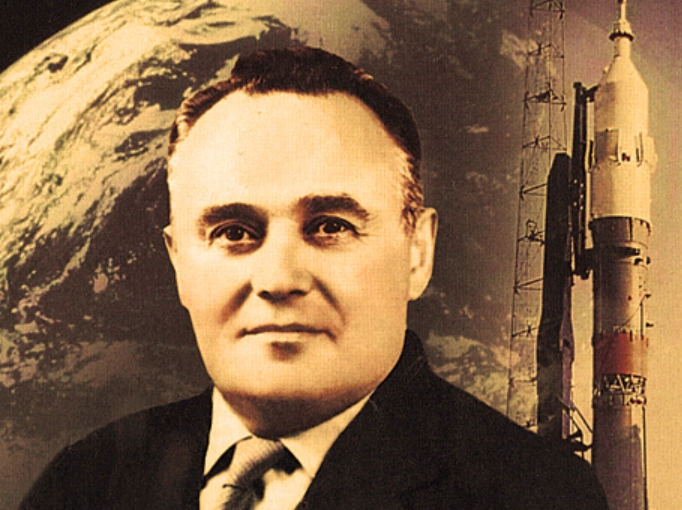
The day after Sputnik launched, the Soviet newspaper Pravda wrote glowingly about the satellite. But one thing was missing — the name of the man who built it. The byline was simply "Главный Конструктор" (Glavnyi Konstruktor, Chief Designer).
This wasn't just routine anonymity. His name was a top-secret state classification of the KGB. For nine years, until he died in 1966. The CIA spent a decade trying to track down who the "Chief Designer" was, and in the end never found out.
Some people call him the Soviet von Braun — but that isn't quite accurate. Von Braun lived as a celebrated hero, while Korolev lived and died without even being allowed to reveal his name. The two men were born in roughly the same years, 1906–1912, and began dreaming of rockets in the same era — but one became an SS-Sturmbannführer, and the other was dragged off to the Gulag.
03The Six Years He Survived in the Gulag (1938–1944)
June 27, 1938, Moscow. The NKVD (the KGB's predecessor) arrested Korolev. At 32, he was at the time a key engineer at RNII (the Reaction Engineering Research Institute). The charge was "subversion of new technology" — a false denunciation by someone. It was the era of Stalin's Great Purge.
The verdict: 10 years, transfer to the Kolyma forced-labor camp. Kolyma was at the far eastern edge of Siberia, a gold-mining forced-labor camp where minus 50 degrees was an everyday reality. More than half of those sent there died in the first year.
- 1938–1940, Kolyma — Malnutrition cost him almost all of his teeth. A single beating broke his jaw, so that for the rest of his life he could never fully open his mouth. This would become the cause of his death 28 years later.
- 1940–1944, the sharashka — Tupolev (the same man behind Tupolev aircraft, imprisoned in the same period) pulled Korolev out into his own in-prison design bureau. A sharashka = a forced design bureau of imprisoned engineers. There he designed bombers and rocket boosters.
- 1944 — Officially released. But his "rehabilitation" did not come until 1957 — just before the Sputnik launch. In other words, right up until he built humanity's first artificial satellite, he was officially an "ex-convict."
When he was released in 1944, a colleague said — "We watched a dead man come back." His cheekbones jutted out, almost all his teeth were gone, and his hair had turned white. At 38, he looked like a man in his sixties.
04The R-7 — It Was Actually an ICBM
Remember Operation Paperclip from EP01? When the United States took von Braun plus 1,600 people, the Soviet Union, under Operation Osoaviakhim, hauled off roughly 2,200 German scientists. And yet — those German scientists did not become the core of the Soviet space program. Korolev had enough with his own team. The Germans only played peripheral advisory roles before being sent back to East Germany in the 1950s.
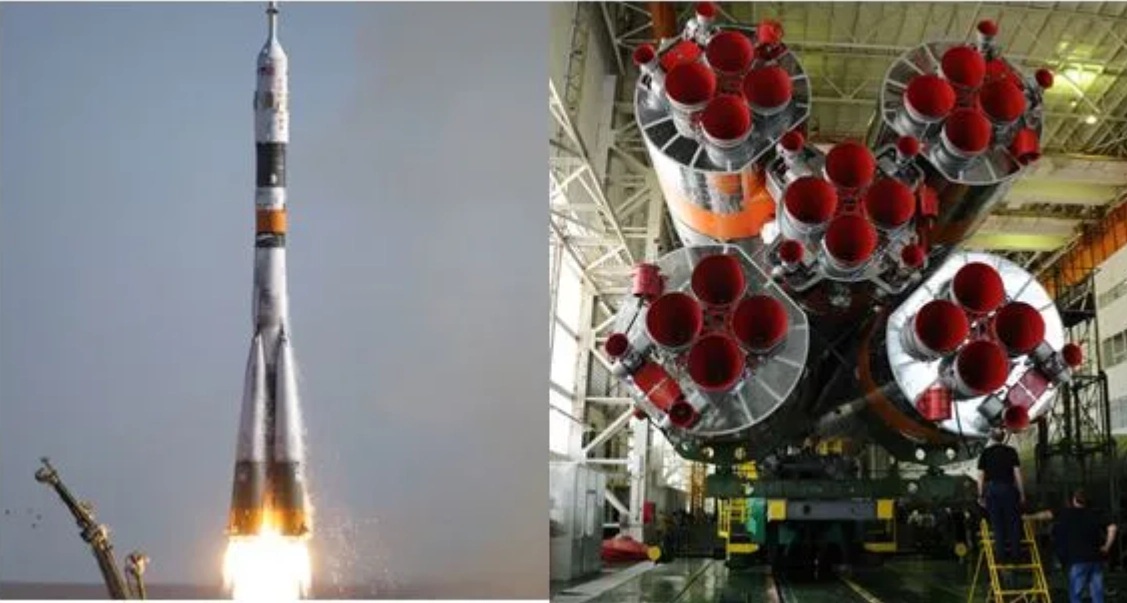
What Korolev's team built — the R-7 rocket. Its first test succeeded on August 21, 1957. Humanity's first ICBM (intercontinental ballistic missile). It was a weapon designed to drop a hydrogen bomb on the American mainland:
- Five-engine cluster — 1 central core + 4 boosters. 32 combustion chambers total
- Liftoff thrust of roughly 400 tons
- Liquid oxygen + kerosene (RP-1)
- Range of about 8,800 km — capable of a direct hit on Washington from Moscow
- Height of 34 m
05The 83.6 kg Aluminum Sphere — The Truth About Sputnik 1
Here's one interesting bit of trivia. Sputnik 1 was never the original plan.
The satellite Korolev's team had originally been building was called "Object D" — a full-fledged 1.4-ton scientific research satellite. A real science satellite packed with instruments to measure cosmic rays, magnetic fields, and solar radiation. But by early 1957 it still wasn't finished. It was too complex.
That's when Korolev got hold of American intelligence — that the U.S. Vanguard program was aiming to launch its first satellite in late 1957 to early 1958. Korolev went to Khrushchev and said:
"Object D needs more time. But a very simple satellite — just an aluminum sphere with two transmitters — could be put up within two months. Ahead of the Americans."
— Sergei Korolev, early 1957 (composite of memoir records)Khrushchev was unenthusiastic at first. His attitude was, "What's the point of that?" But Korolev pushed it through — and in the end, approval. What was built in two months was PS-1 (Prosteishy Sputnik 1 = Elementary Satellite 1). An aluminum-alloy sphere, a radio inside, four antennas. That's it.
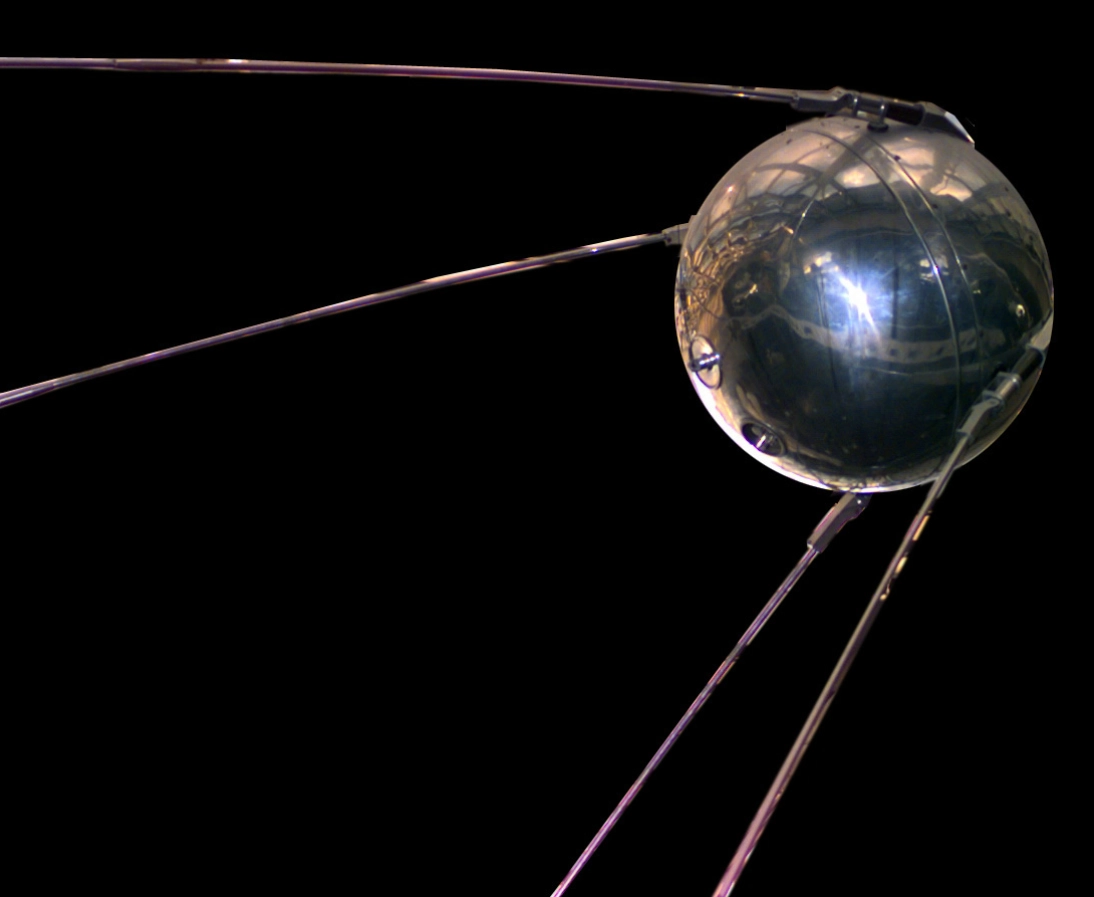
Three months later, on January 4, 1958, Sputnik 1 re-entered the atmosphere and burned up. But over those 96 days — it drove one fact into the minds of people all over the world: "The communists conquered space first."
06The Humiliation of Vanguard — "Kaputnik" (1957.12.06)
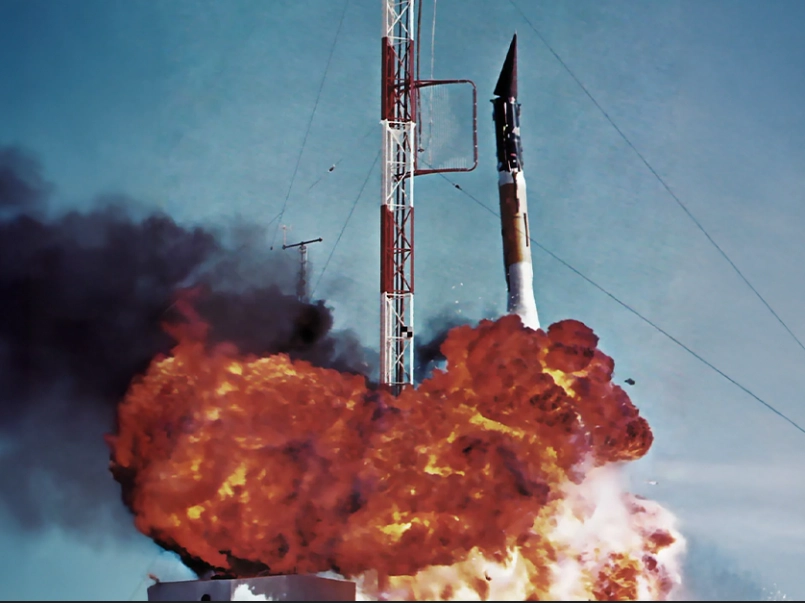
Two months after the Sputnik launch, December 6, 1957. Cape Canaveral. The United States attempted its first satellite launch with Project Vanguard. Broadcast live on national TV. Obsessed with restoring its pride — it went out of its way to show it live.
The rocket rose about 1.2 m off the launch pad. And then — it fell straight back down and exploded. The satellite itself was flung out into the debris, and even there the transmitter survived — sending out a "beep, beep" signal from within the wreckage. The aftermath was so wretched it was funny.
The solution, in the end, was — that man from EP01. Von Braun. The Jupiter-C rocket built by his team (a direct descendant of the V-2) successfully put up Explorer 1 on January 31, 1958. America's first satellite. A former SS officer saved America's pride.
07Laika — The Next Punch Sent Within a Month (1957.11.03)
After Sputnik 1's success, Khrushchev changed. The man who had been so unenthusiastic — suddenly wanted everything. The demand he made of Korolev:
"Put up another one within a month. By November 7 — in time for the 40th anniversary of the October Revolution. And make this one more impressive."
— Nikita Khrushchev, October 1957 (to Korolev)Korolev's team built Sputnik 2 in a single month. Weighing 508 kg, six times heavier than Sputnik 1. And inside it — a stray dog snatched off the streets of Moscow. Her name was Laika (Лайка, "the barker").
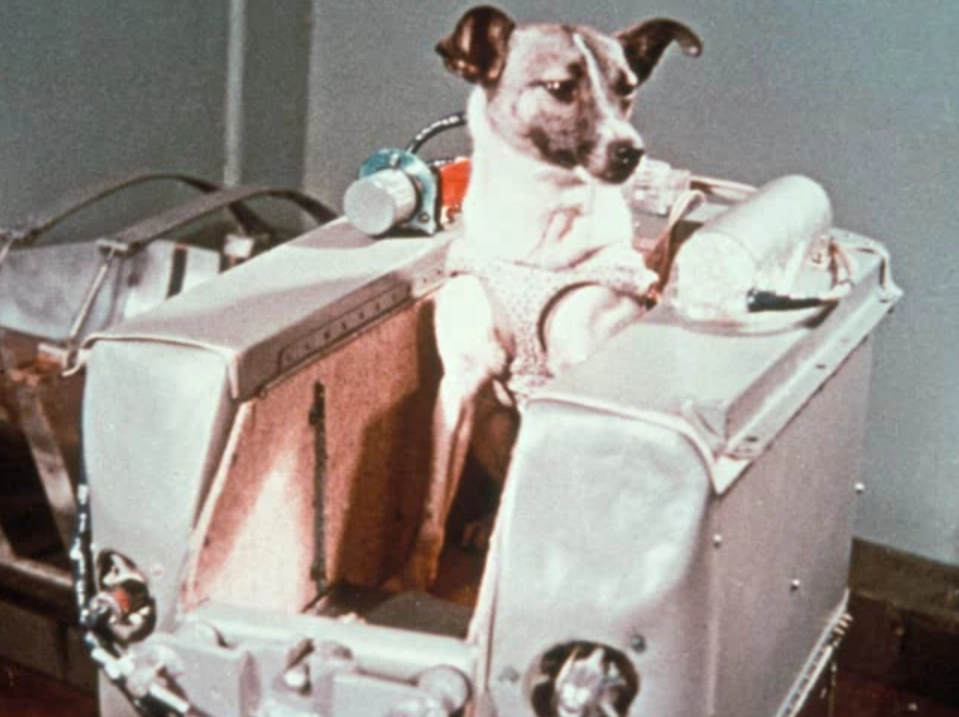
Launched on November 3, 1957. Laika became the first living being to enter Earth orbit. The Soviet Union at first announced that "Laika lived for four days and was euthanized." But the truth wasn't revealed until 2002 — Laika died just 5 to 7 hours after launch, from overheating and stress. The capsule's insulation had been damaged during launch, and the internal temperature had climbed past 40°C.
This is a pattern that comes up again in EP06. The Soviet space program's secrecy + time pressure = a culture of covering up accidents. This would ultimately lead to the tragedy of Komarov aboard Soyuz 1 in 1967.
08The Birth of NASA, and a Secret Death
What America did after the Sputnik shock was genuinely a lot in just nine months:
- 1957.10.04 · Sputnik launched (Day 0 of the shock)
- 1957.11.03 · Sputnik 2 + Laika (Day 30 of the shock — the Soviets punch again)
- 1957.12.06 · The humiliation of the Vanguard explosion (Day 63 of the shock)
- 1958.01.31 · Explorer 1 succeeds (at last, America's first satellite, von Braun's team)
- 1958.02.07 · DARPA founded (the same DARPA that would later become the parent of the internet)
- 1958.07.29 · Eisenhower signs the bill founding NASA
- 1958.09.02 · The National Defense Education Act — about one billion dollars invested in STEM education. Still a cornerstone of American science education today
A single shot of Sputnik — created NASA for America, created DARPA, and created a STEM education revolution. You could say those 90 minutes in 1957 determined the next 70 years of America.
Only after he died — did the Pravda of January 16, 1966 reveal his name and photograph for the first time. The day the identity of the "Chief Designer" was finally revealed. The identity the CIA had failed to uncover for ten years was disclosed in an obituary.
In the next installment (EP03) — we cover "Поехали (Let's go)!" — April 12, 1961, the 108 minutes in which a 27-year-old farmer's son became the first human in space. The last great victory Korolev would win in his lifetime. And the real reason behind the gamble Kennedy made before Congress a month later — "We will go to the Moon before the decade is out."