Google · Meta · xAI · Mistral,
the other competitors and their seats
Beyond OpenAI and Anthropic, other companies are writing their own answers in the same industry. Google, which merged two large labs into one. Meta, which tipped the industry's balance with open weights. xAI, which assembled capital and infrastructure in seventeen months. Mistral, which became Europe's marker on the AI map. And the contenders growing behind them.
Toward a fifth answer
Across installments one through four of this series, we followed the road of two companies. Anthropic and OpenAI, two companies that began at the same desk and wrote different answers. They are not the only companies writing answers in this industry, however. In other seats, on top of different capital and different backgrounds, other answers are being written at the same time.
This fifth installment follows the four largest of those other seats. The first is Google, a company that held two large AI labs inside itself at the same time and, at a certain moment, brought them together. The second is Meta, the company that tried to tip the industry's balance by publishing the weights of its models. The third is xAI, the latest entrant to start, but the one that has pulled capital and infrastructure together the fastest. The fourth is Mistral, the company that has tried, from a European seat, to keep AI from being a thing that lives only between the United States and China.
Behind those four seats are smaller contenders. Cohere, AI21, Reka — the American and Canadian enterprise model companies. DeepSeek, Qwen, Kimi, Zhipu, MiniMax — the Chinese answers. Korea's HyperCLOVA X. Hugging Face, which built itself into the meeting point of model sharing. The latter half of this essay touches their seats briefly as well. The AI industry of spring 2026 is no longer a landscape where one champion takes every seat. It is a landscape of several seats growing alongside one another. Sketching the shape of that landscape is what this installment is for.
Google — how two labs came together as one
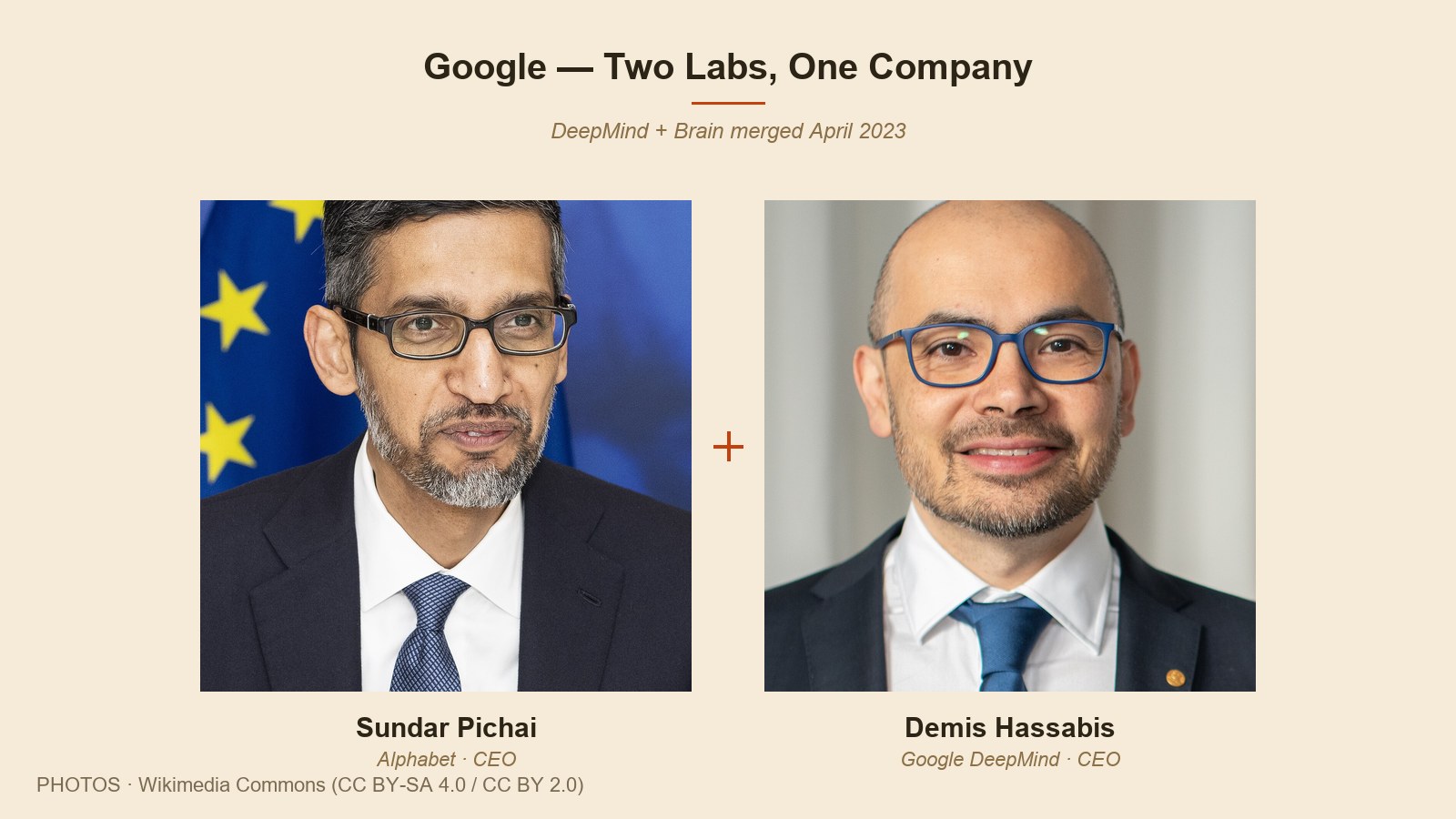
Google's AI history started on two tracks. One track grew inside the company. Google Brain began as an internal project in 2011, and in 2017 it changed the direction of the field with a single paper — "Attention Is All You Need." That paper, which introduced the transformer architecture, sits at the root of nearly every large language model we know today. ChatGPT, Claude, Gemini — all of them grew on the coordinates that paper drew.
The other track grew in the United Kingdom. In 2010, in London, three people — Demis Hassabis, Shane Legg, and Mustafa Suleyman — founded a small lab called DeepMind. Google acquired it in January 2014, at a price reported to be around $500 million. For an AI acquisition at that time, this was a large number. DeepMind kept its base in London after the acquisition and grew into the strongest single lab in the reinforcement-learning corner of the field. AlphaGo in 2016, AlphaFold in 2020, with MuZero and AlphaStar in between — each of those results placed a clear marker on the field's map.
The fact that one company carried two large AI labs on separate tracks, however, grew more awkward over time. The two labs were working in the same technical area but with different cultures, different reporting lines, different priorities. After ChatGPT arrived in November 2022, the phrase "code red" started circulating inside Google. The company's first response, the chatbot Bard, was unveiled in February 2023, but a small factual error in the demo video took over the news of the day, and reports followed that the company's market capitalization dropped roughly $100 billion that same day.
Two months later, in April 2023, Google announced a major decision. Google Brain and DeepMind would be combined into a single organization called Google DeepMind. The merger was a signal that the company was going one step deeper into AI as a single domain, and at the same time a move to resolve the awkward dual structure that had built up over the prior decade. Demis Hassabis was named CEO of the new organization. Adding to that, he was given a seat on Alphabet's board of directors — a clear signal of how much weight AI had now come to carry inside the company.
Google — Gemini and the depth of the in-house ecosystem
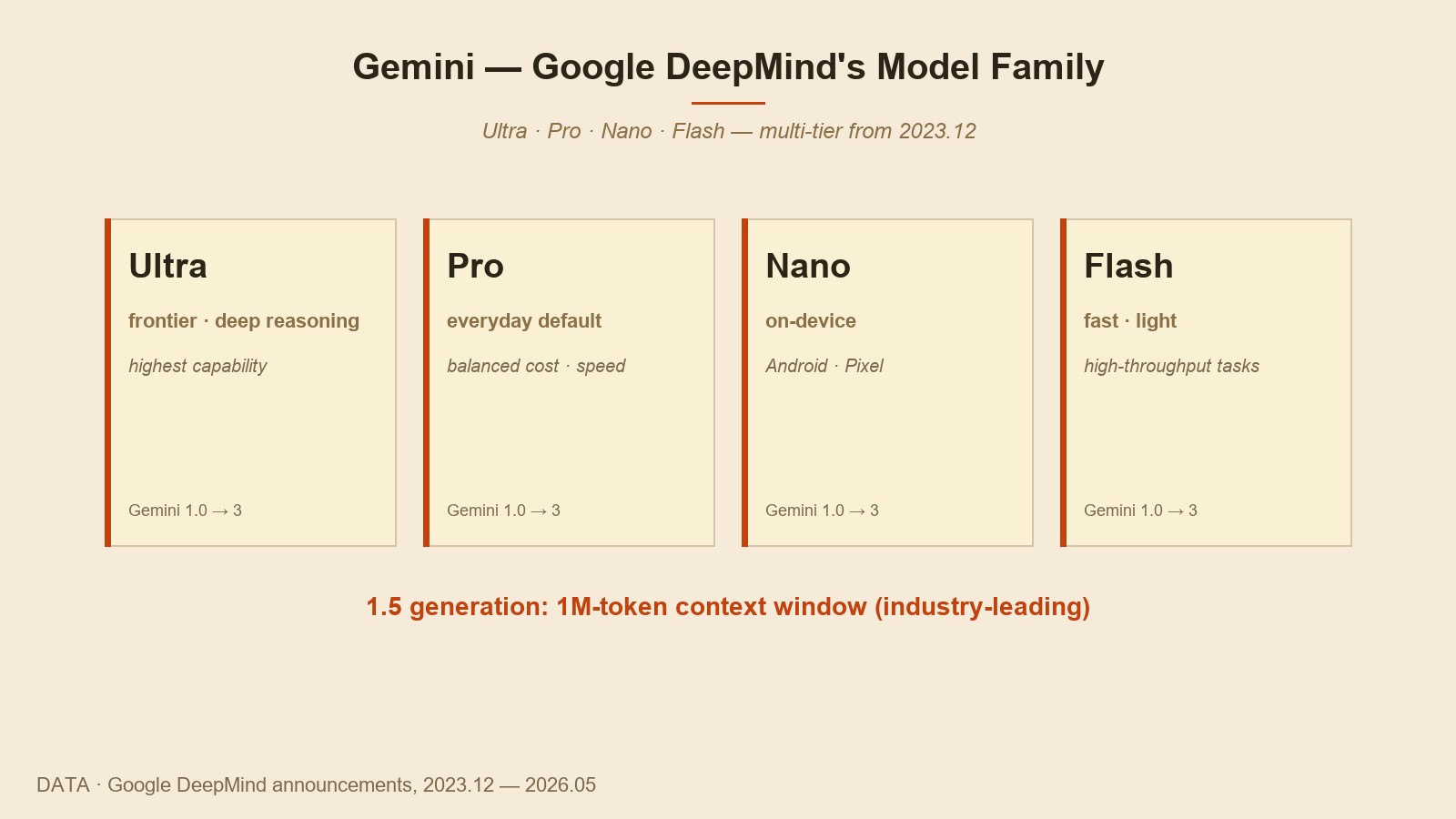
Eight months after the merger, in December 2023, the new organization shipped its first major product. The name was Gemini. It arrived as three sizes at once. Ultra at the top, Pro for everyday work, and Nano for mobile and on-device environments. Claude 3's Haiku/Sonnet/Opus family arrived roughly three months later. The pattern of a single company carrying multiple breaths of the same model inside one family became the industry standard form during this period.
Two months later, in February 2024, Gemini 1.5 was announced. The single line that defined that model was "a one-million-token context window." Some evaluations reported processing of up to two million tokens. No other commercial model at that moment handled context of that scale. An entire book, or the full codebase of a company, could be dropped in as a single input. For a stretch, this was Gemini's clearest differentiator, and it became the stimulus that accelerated context-window expansion across other model providers.
Google's real strength, however, is less about the model itself and more about how deeply that model is woven into the company's own ecosystem. Search's AI Overviews places an AI answer above the search results every week for billions of users. Workspace embeds Gemini's writing assist and summarization into Gmail and Docs. Android, through the Pixel line, became the first mass consumer device to run Gemini Nano on-device. And the fact that all training and inference runs on the company's own TPU silicon means that this is not a simple model company. It is a full-stack company that owns the line from chips to data centers to search to cloud to mobile OS, all under one roof.
As of the spring of 2026, Gemini's user count sits in a position no other single model company can easily match. The number of users who run into a Gemini-generated answer in their search results every week, by itself, is estimated to exceed ChatGPT's 500 million weekly active users. The catch is that most of those users do not have the conscious sense that "I'm using Gemini." This is the largest difference from OpenAI's shape. Google's AI does not live as a tool the user reaches for. It lives as an environment.
Meta — FAIR, Yann LeCun, and the open-weight answer
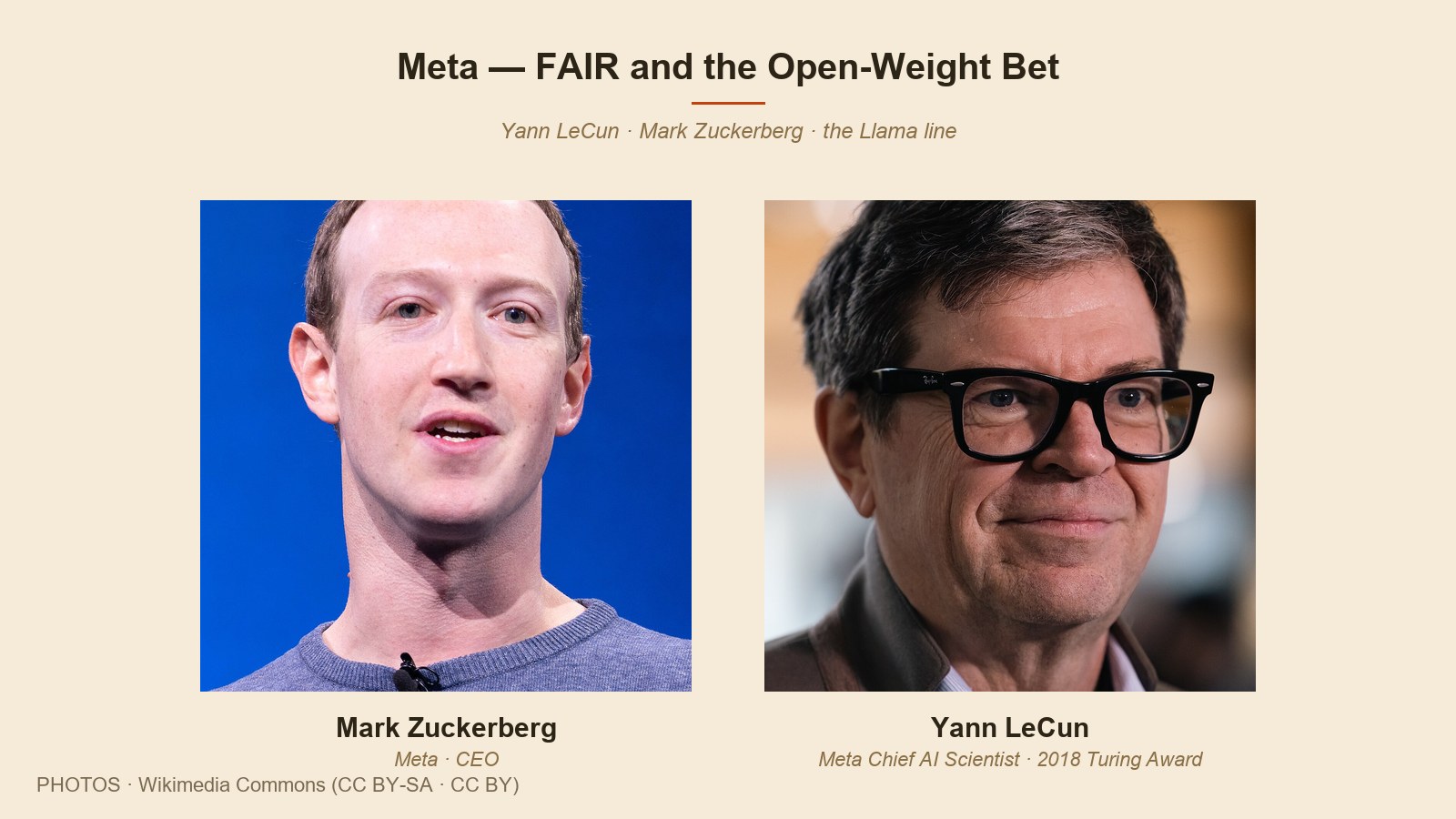
Meta's AI research began in December 2013, under the name FAIR (Facebook AI Research). At the moment of its founding, the company hired one person, and that hiring set the tone of the lab. The person was Yann LeCun. He was one of the early designers of the convolutional neural network, and in 2018 he received the Turing Award jointly with Geoffrey Hinton and Yoshua Bengio. With LeCun at the head, FAIR grew into an industry lab that carried a clear academic color.
Two characteristics define LeCun's line. First, he has been openly skeptical, for years, of the claim that large language models alone can reach AGI. In that view, he has continued to push research into new architectures such as JEPA (Joint Embedding Predictive Architecture). Second, he has been consistent, inside and outside the company, in arguing that model weights should be published. The Llama series is the policy expression of that second position.
In February 2023, FAIR released its first model under the name LLaMA. At first, it was distributed for research use only. But within days the model's weights were leaked onto the internet, and that leaked copy ended up in the hands of researchers and developers around the world. From the company's perspective this was an accident. From the industry's perspective it made one point clear. Where there are weights, use cases grow.
Five months later, in July 2023, Meta took a further step with Llama 2. This time it was released from the start under an open-weight license that permitted commercial use. Microsoft sat at one side of that decision: Llama 2 was hosted on Azure, and other cloud providers followed in bringing Llama 2 into their stacks. The path for companies that did not own a model of their own to add AI to their own products widened, in a single move.
Meta — the Llama line and the industry's counterweight
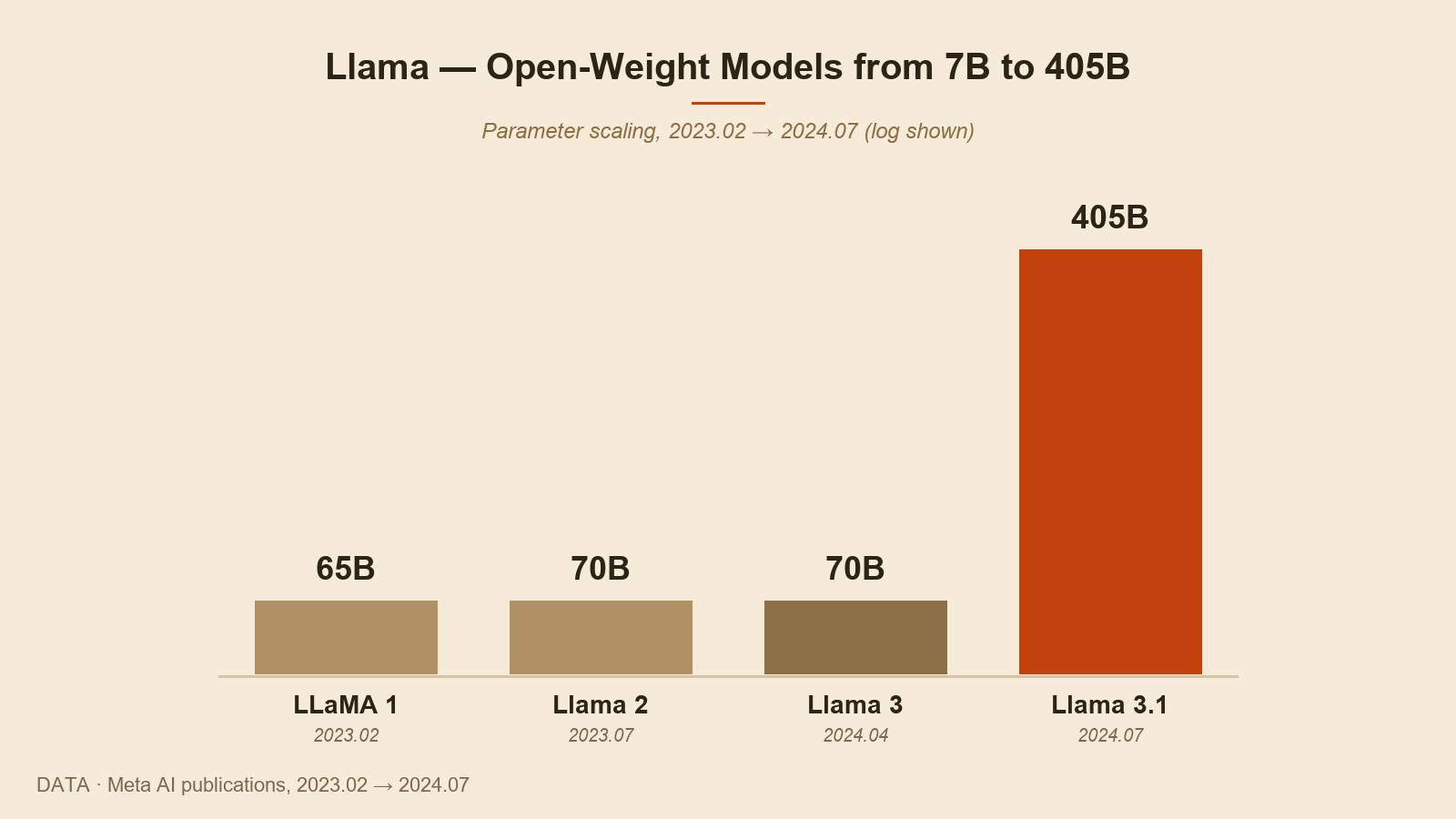
After Llama 2, the line grew heavier with each release. In April 2024, Llama 3 arrived in two sizes — 8B and 70B. Three months later, in July 2024, Llama 3.1 took a further step by releasing alongside its smaller siblings a 405B-parameter frontier-tier model. It was the first open-weight model to stand on the same stage as the closed frontier models.
The effect this line cast on the industry was bigger than a single model release. After it, other companies began moving in the same direction. France's Mistral released open-weight variants of Mixtral 8x7B and Mistral Large. China's Alibaba released the Qwen series with open weights. DeepSeek piled on stronger follow-up results. The single line in a license that Llama wrote shifted the center of gravity of the industry, step by step.
Meta's AI strategy, though, has another axis. The Reality Labs division, which bundles virtual reality and augmented reality. Across the five years from 2020 to 2025, this division was reported to have accumulated losses of more than approximately $60 billion. AI and Reality Labs are tied together inside the company, and Mark Zuckerberg has consistently framed the two as a single future: the next generation of computing surfaces, the place where "AI lives," being built as new kinds of devices.
From late 2024 onward, Meta began integrating its own AI assistant Meta AI directly into Instagram, WhatsApp, Messenger, and Facebook. The line the company emphasized most internally in that period was something like this. "Put AI on top of three billion users worldwide." Make AI a natural fit inside the messaging windows and feeds that those three billion users open every day. Not market share at the model level, but presence at the daily level. That is the picture Meta has been drawing.
xAI — capital and infrastructure assembled in seventeen months
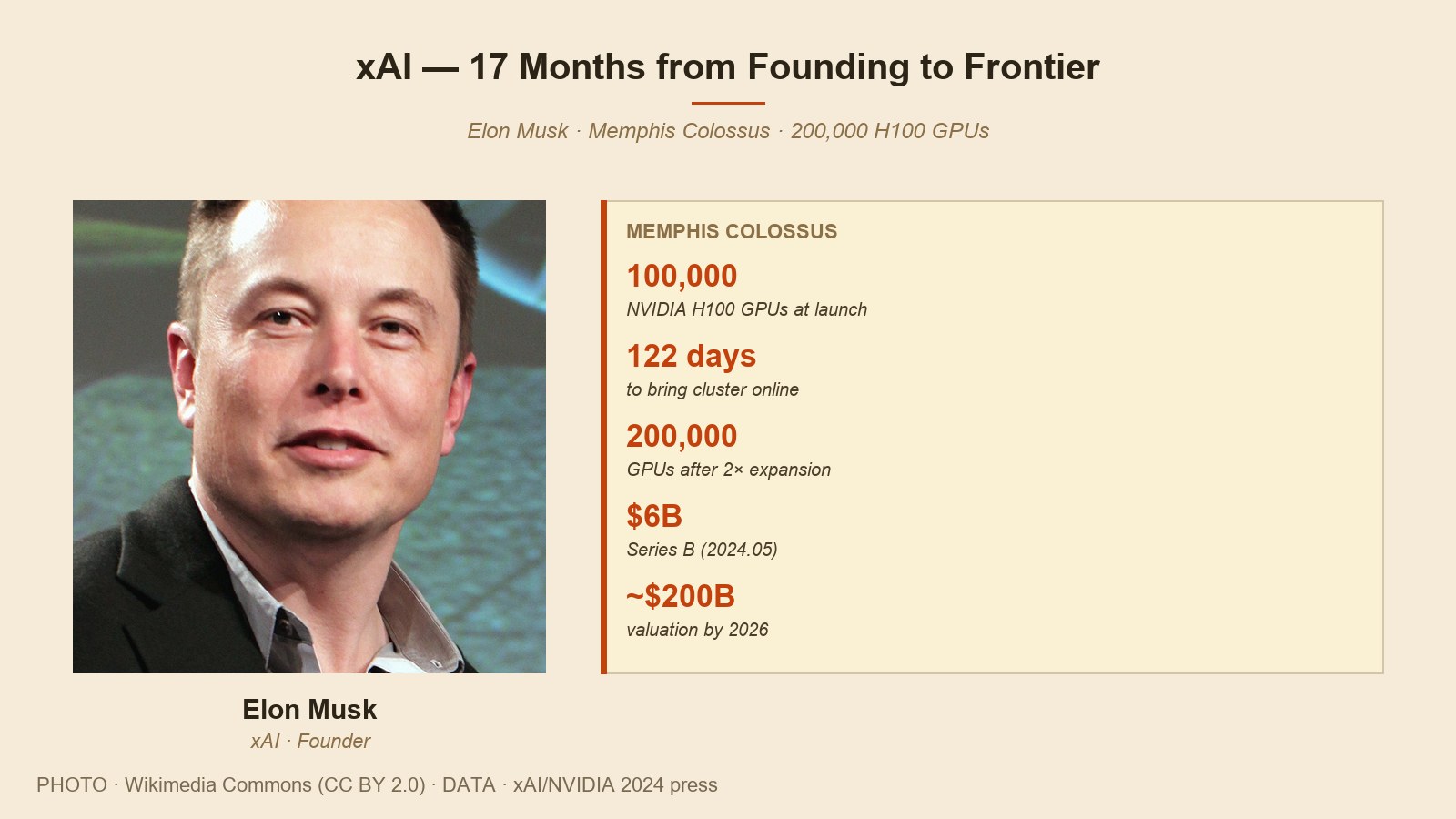
In July 2023, Elon Musk announced the founding of a new AI company called xAI. It was the fifth company he was running, alongside Tesla, SpaceX, Neuralink, and The Boring Company. The founding roster included researchers who had been working at DeepMind, Google Brain, OpenAI, and Microsoft Research. The latest entrant to the frontier AI club was assembled in a single move.
The first model, Grok-1, was released four months later in November 2023. It opened first to X (formerly Twitter) Premium+ subscribers — the same person's other company brought the model directly into another of his products. From this start, the identity of Grok in one line became clear. "A model that handles X's real-time information alongside the conversation." While other models depended on static training data, Grok was, from early on, designed to pull live X posts on the spot to support its answers.
The company's growth was as fast in capital and infrastructure as it was in modeling. In May 2024, xAI raised approximately $6 billion in a Series B round, the largest Series B in any AI company at that point. In September of the same year, the Memphis Colossus data center came online. A single cluster of 100,000 NVIDIA H100 GPUs, installed in roughly 122 days. The conventional wisdom in the industry that a cluster of that size would take a year or more to stand up was overturned in a single line.
Grok-2 followed in the fall of 2024, and Grok-3 arrived that December. The model received three large upgrades inside a single twelve-month window, and during that same period Colossus was doubled to 200,000 GPUs. Through the 2025 capital rounds and the Grok 5/6 releases into 2026, xAI's valuation reached an estimated $200 billion. The company had been operating for less than three years.
The seat xAI sits in carries one variable that the other companies do not have. Every adjacent thread of Elon Musk as a person connects to the company's reputation. Musk's political and social posts on X, the running disputes over Tesla's self-driving features, SpaceX's IPO plans, the controversies Grok itself surfaces from time to time. Because the case of one person running five large companies at the same time is essentially unique in this industry, xAI's future moves alongside that bundle, whether the bundle moves with it or against it.
Mistral — the European bet for AI sovereignty
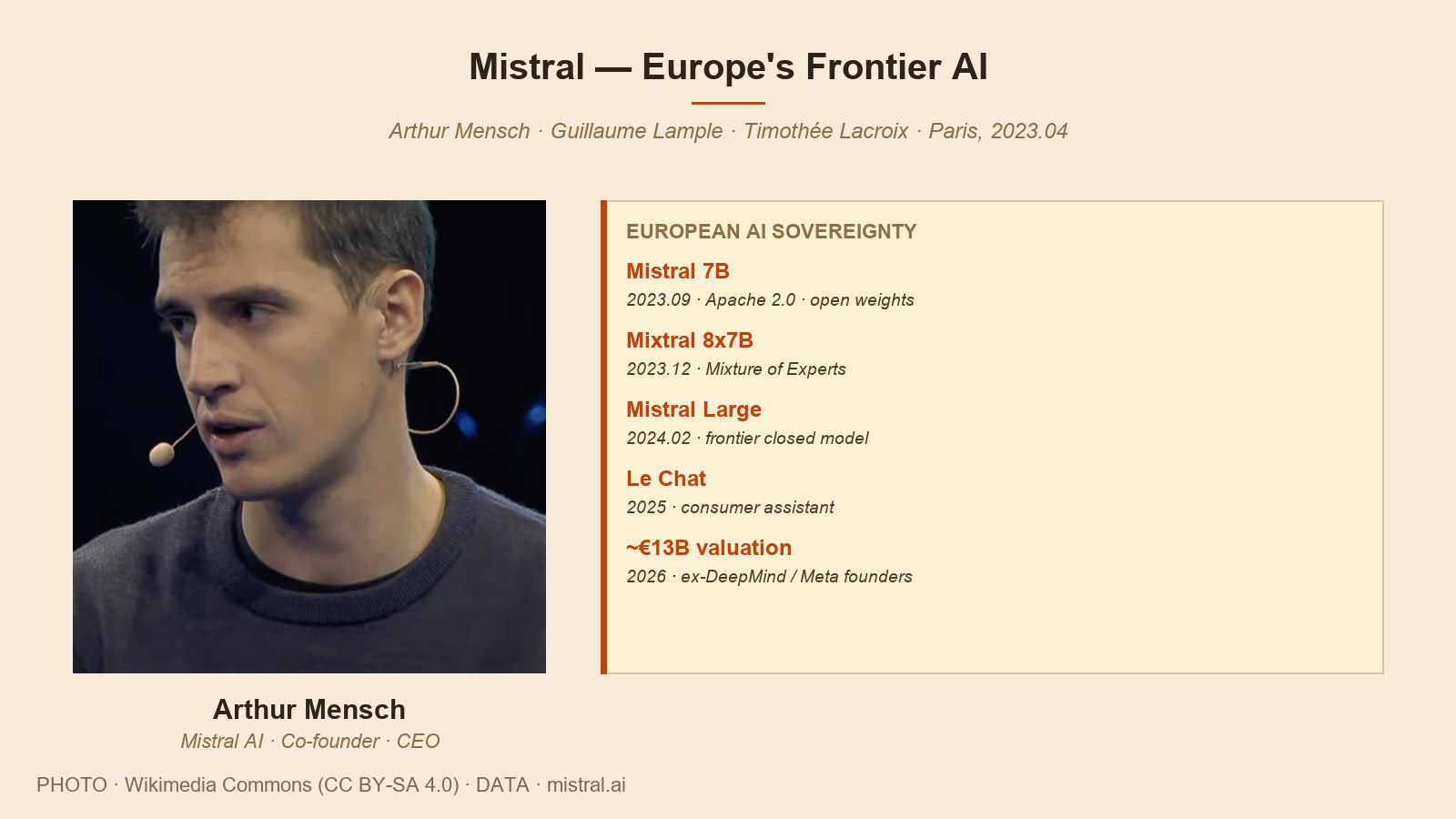
In April 2023, a company was quietly founded in Paris. The name was Mistral AI. Three founders, all in their thirties, all coming straight out of the center of frontier model research at major labs. Arthur Mensch, formerly at DeepMind, was one of the lead authors of the Chinchilla paper, an influential study on the relationship between model size and training data. Guillaume Lample and Timothée Lacroix were both lead authors of the original LLaMA paper at Meta's FAIR.
The start was small, but the capital arrived fast. In June 2023, the company closed a seed round of approximately $113 million. For a company with no revenue and no model yet, the figure was unusual. On top of that capital, three months later, the first model Mistral 7B was released. A fully open-weight model under the Apache 2.0 license. It consistently beat models of similar size on benchmarks, and from that result a clear seat in the small-model corner was secured.
The pace only quickened. In December 2023, Mixtral 8x7B arrived — one of the first open-weight models to use the Mixture of Experts architecture in earnest. In February 2024, the closed frontier model Mistral Large was announced, followed by a partnership announcement with Microsoft. In June 2024, a Series B raised approximately $645 million at a valuation around €6 billion. Fourteen months from founding to that point.
Mistral's real meaning, however, is not captured by model performance or capital figures alone. The company places the position of Europe itself at the center of its identity. As one answer to the question of why all frontier models seem to live between the United States and China, there should be a company that grew inside Europe — that is the case Mistral makes. French government and EU policy support followed alongside. Some of the company's models have been trained from the start in European data centers. As the EU AI Act has been finding its shape, Mistral has become one of the most frequently invited industry voices in that regulation's drafting process.
In 2025 the consumer chatbot Le Chat moved into a proper public release, and the company's broad recognition stepped up by one notch. As of spring 2026, Mistral's valuation is estimated at roughly €13 billion. Compared to OpenAI's ~$300 billion or Anthropic's ~$60 billion at the same point in time, this is small. But the seat of "a frontier-tier AI company that grew in Europe" is one this company has built almost entirely on its own.
Behind the four — the other contenders
Behind those four seats are other companies writing their own answers. Covering all of them deeply is beyond a single installment, so this chapter sketches only the outlines. Some of these contenders will return in installment six.
The enterprise model companies of the United States and Canada. Cohere was founded in Toronto in 2019. Its co-founder Aidan Gomez is one of the authors of the "Attention Is All You Need" paper. The company has focused on enterprise customers — particularly finance, healthcare, and government clients with tight security and data-handling requirements — rather than the general consumer market. AI21 Labs, based in Israel, has the Jurassic and Jamba model lines. Reka, based in Singapore, builds multimodal models. Inflection AI, after a period of high attention, effectively merged most of its team into Microsoft in March 2024. Adept was absorbed into Amazon in 2024. In this corner, acquisitions and team transitions have become part of the frontier round itself.
China's answers. This corner is bigger than one section. Briefly: DeepSeek made the leap into the frontier group in December 2024 with DeepSeek V3 and again in January 2025 with DeepSeek R1. R1 in particular was reported to reach results in the reasoning domain comparable to OpenAI's o1 at substantially lower training cost, and it became one of the most discussed events of that period inside the industry. Alibaba's Qwen series has settled in as one of the strongest open-weight lines. Baidu's Ernie, the upstart Moonshot's Kimi, Zhipu's GLM, and MiniMax — in China alone, six or more frontier-tier companies are moving at the same time.
Korea and Japan. In Korea, Naver's HyperCLOVA X has carved out a seat in the domestic market and parts of Southeast Asia. Kakao, LG, SKT, and KT each operate their own models. In Japan, Sakana AI, ELYZA, and Rakuten's in-house models cover use cases tied to their home market. Both markets place the handling of their own language and the sovereignty of their own data at the center of their identity.
And Hugging Face. This company has not entered the industry with a frontier model of its own, but it built the meeting point where every other company's open-weight model is shared, searched, and compared — the model hub itself. Mistral, Llama, Qwen, DeepSeek — all of them are most often downloaded and compared on Hugging Face. The seat this company occupies is not a seat for a model. It is a seat for where models meet. Its weight inside the industry's landscape is not small.
The landscape made by several answers
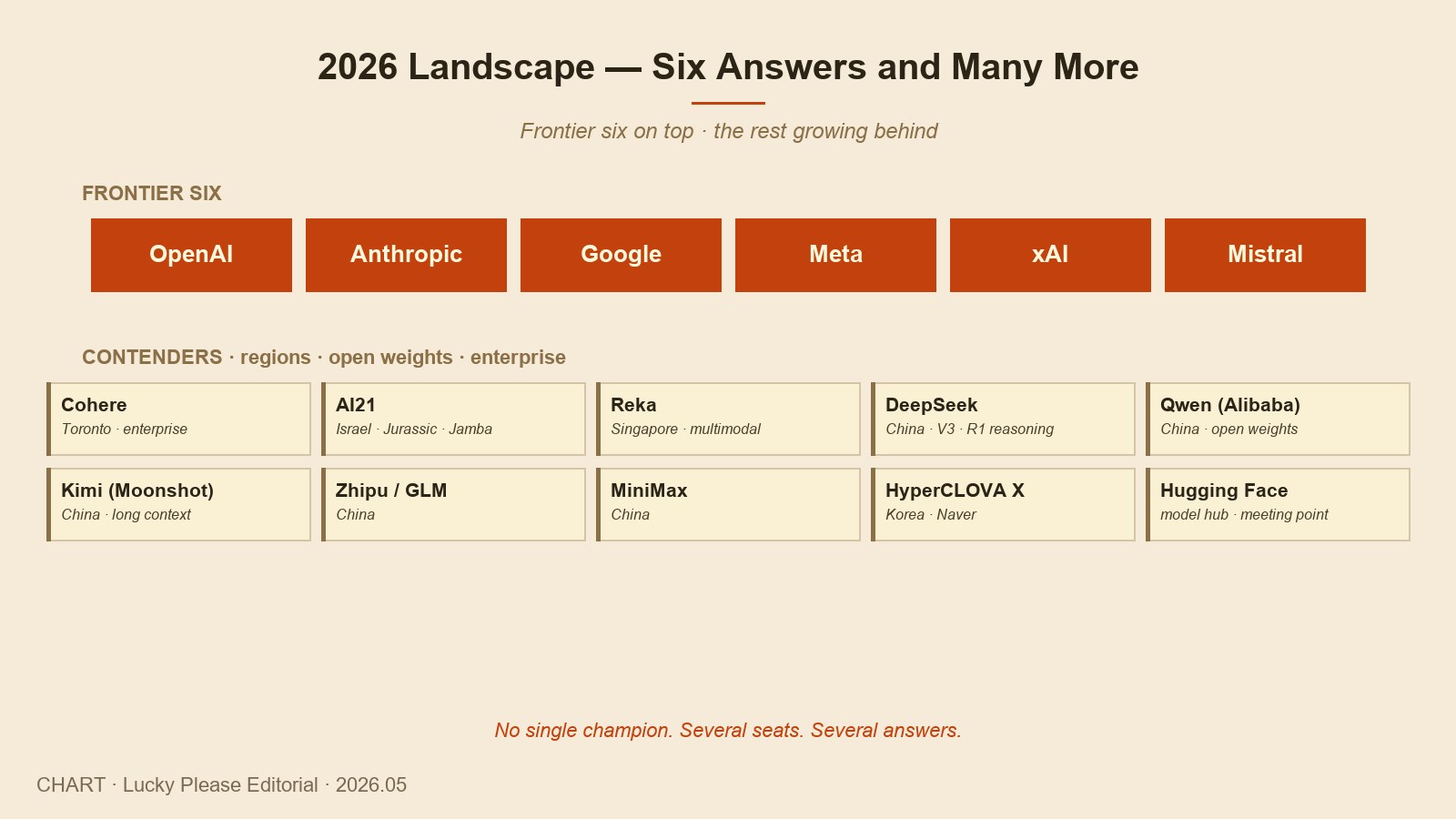
In installment four of this series we looked closely at the two answers of OpenAI and Anthropic. Adding the four seats covered in this installment — Google, Meta, xAI, Mistral — produces this picture:
- OpenAI — go fastest, sit furthest at the front
- Anthropic — tighten the safety foundation first, then go
- Google — merge two large labs, run AI on top of a full-stack ecosystem
- Meta — tip the industry's balance through open weights
- xAI — gather capital and infrastructure at the fastest possible pace
- Mistral — make the position of Europe itself the company's identity
Six answers, existing inside the same industry at the same time. And behind that six, dozens more seats — Cohere, AI21, Reka, DeepSeek, Qwen, Kimi, Zhipu, MiniMax, HyperCLOVA X, Hugging Face. The AI industry of spring 2026 is no longer a landscape where a single champion takes every seat. The best model varies by domain, by use case, by region — and that variation has settled into different shapes in different seats.
That the six-plus answers exist at the same time, in the same industry, is itself a sign of health. At the close of installment four, we wrote that the simultaneous existence of OpenAI and Anthropic's two answers is part of what keeps the industry healthy. The landscape with four more answers added on top of those two is, by extension, an even healthier landscape. That the future of a technology this powerful does not rest on the decisions of just one or two companies — that is one of the things we can say is going well inside this industry right now.
Installment six of this series will take the same landscape and step five years forward, into 2030. How far the models will go in capability, what seat AI will hold inside daily life, where capital will flow, and what shape safety and regulation will settle into. The six answers we have followed in installments four and five will be looked at again, this time inside the five-year window, to see how they may sort themselves out by then.
References · Sources
- Google official announcements (blog.google, deepmind.google, ai.google), 2014.01 – 2026.05 — DeepMind acquisition, Brain–DeepMind merger, Gemini 1.0–3 releases
- Meta AI official announcements (ai.meta.com), 2013.12 – 2026.05 — FAIR founding, LLaMA / Llama 2–5 releases
- "Attention Is All You Need," Vaswani et al., Google Brain, 2017
- "Training Compute-Optimal Large Language Models" (Chinchilla), Hoffmann et al., DeepMind, 2022 — Arthur Mensch co-author
- xAI official announcements (x.ai), 2023.07 – 2026.05 — founding, Grok-1 to 6, Colossus stand-up
- Mistral AI official announcements (mistral.ai), 2023.09 – 2026.05 — Mistral 7B / Mixtral / Large / Le Chat
- The Information, "Inside Google DeepMind's Reorganization," 2023.04
- Bloomberg, "Meta's $60 Billion Reality Labs Bet," 2024.02
- The New York Times, "Inside xAI's Memphis Supercomputer," 2024.10
- Financial Times, "Mistral and the European AI Sovereignty Debate," 2024.06
- DeepSeek official releases and technical reports (DeepSeek-V3, DeepSeek-R1), 2024.12 – 2025.01
- Hugging Face model hub statistics and company materials, 2025 – 2026