A Closer Look at OpenAI,
the biggest competitor that walked the same road differently
In 2015, a small nonprofit lab was quietly assembled. Eleven years later, its name is the name of the AI most people in the world pick up at least once a week. This is the record of a company that began at the same desk as Anthropic and chose a different road.
Two companies that diverged on the same road
In the first two installments of this series we followed how one company came together. The story spanned five years that led Dario Amodei, Daniela Amodei, and a small group of colleagues from OpenAI to the founding of Anthropic. In the third installment we followed what their model, Claude, became over three years. In this fourth installment we want to step over to the other side of that same story, to the seat they left behind, and the company that has remained both the largest companion and the largest competitor in the same industry ever since. The eleven years of OpenAI.
The two companies are unusual in this industry because they share a real starting line. The same people were sitting at the same desks in the same period, and when a certain decision came due, they wrote different answers. The shape that those different answers took has become the shape of the two companies that now stand across from each other. Tracing OpenAI's history, then, is less like reading a single company's CV and more like following what it looks like when one question receives two different answers in the same room.
This essay does not try to cover every event in those eleven years. Instead it follows the joints, the moments where the shape of the company changed: the 2015 founding as a nonprofit, the five days when ChatGPT arrived in late 2022, the November 2023 crisis in which Sam Altman was fired and returned within five days, and the era of multimodal and reasoning models that followed. Along those joints, we will also note where Anthropic was at the same moment.
2015 — a nonprofit with a very big ambition
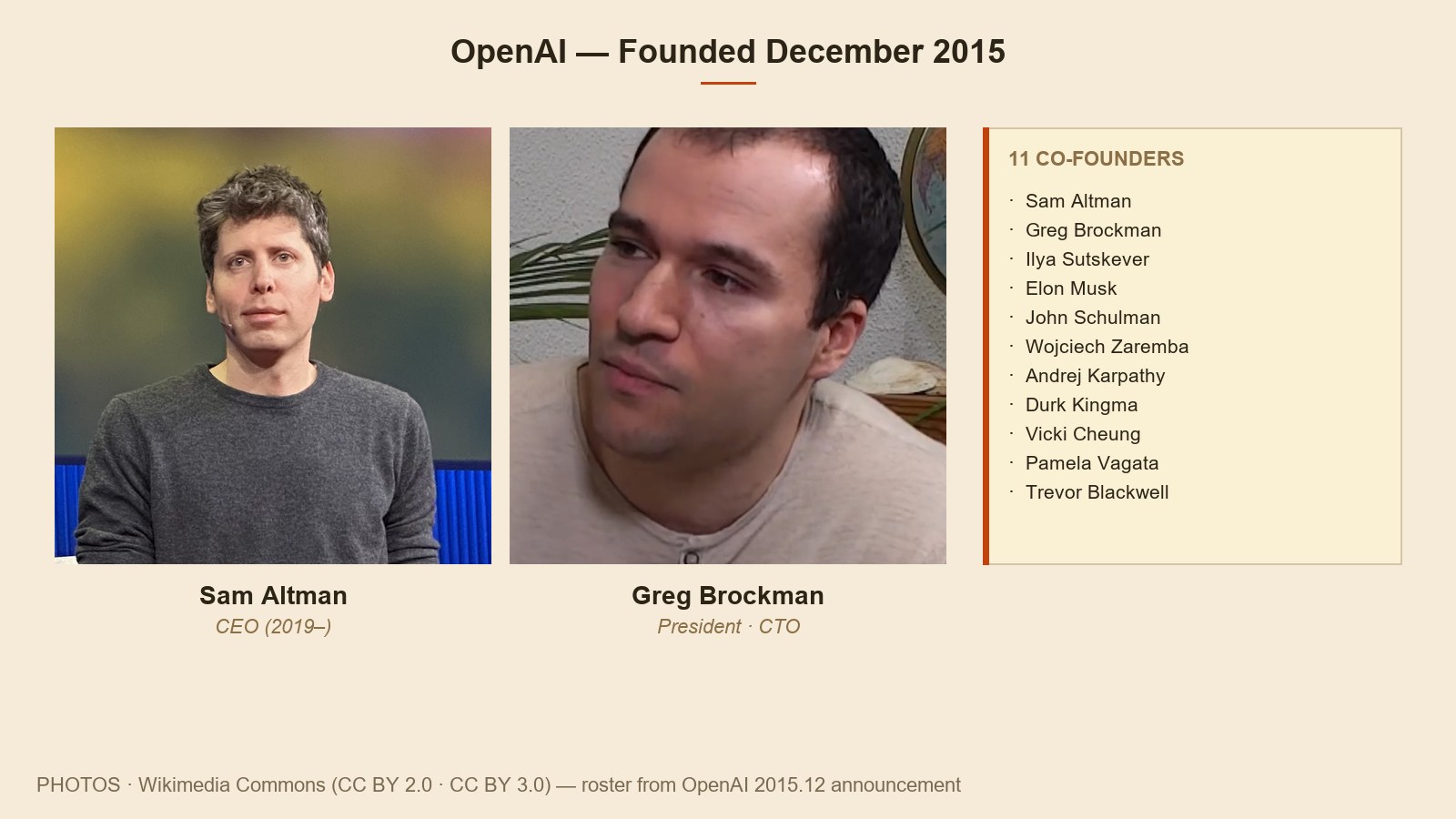
It was December 11, 2015. A short article in a San Francisco outlet announced the start. A new nonprofit AI research organization was forming. The name was OpenAI. The mission was a single sentence. "To ensure that artificial general intelligence (AGI) benefits all of humanity." The funding pledge was one billion dollars. A big number, especially for an organization that ruled out profit as its purpose.
The cast on opening day was striking. Sam Altman and Elon Musk sat as co-chairs of the board. The research lead was Ilya Sutskever, a key figure in deep learning who came over from Google Brain. The fact that he was moving to OpenAI was, by itself, a strong signal to the field. The CTO was Greg Brockman, formerly CTO of Stripe. Beside them were Wojciech Zaremba, Andrej Karpathy, John Schulman, and other young researchers who at the time were among the most prominent voices in the field.
Two assumptions sat under the founding. First, that powerful AI would eventually be built. Second, that if that technology became locked inside a single company's profit motive, the risk to society would be too high. So it was launched as a nonprofit, and the word "open" was placed in the very middle of the name. Publishing research, collaborating, and helping other institutions catch up was the early intent. At this point, OpenAI's identity was quite different from the OpenAI we know today.
From 2016 through 2018, the visible work was reinforcement-learning projects: Gym, Universe, the Dota 2 bot. The clearest single moment was August 2017, when an OpenAI-trained bot beat a top-tier professional in a one-on-one match of Dota 2. Up to that point OpenAI was still mostly a research lab in the public imagination, an institution most people knew by reputation rather than by product.
Then, in 2018, fractures began. In February of that year, Elon Musk resigned from the board. The official reason was a conflict of interest with Tesla's AI work. The unofficial reading, supported by later reporting, was that he had proposed taking over as CEO of OpenAI and that the other founders had declined. After he left, OpenAI had to find a new path for raising capital. The billion-dollar pledge had been a commitment, not a deposit.
GPT — a line of papers that started a movement
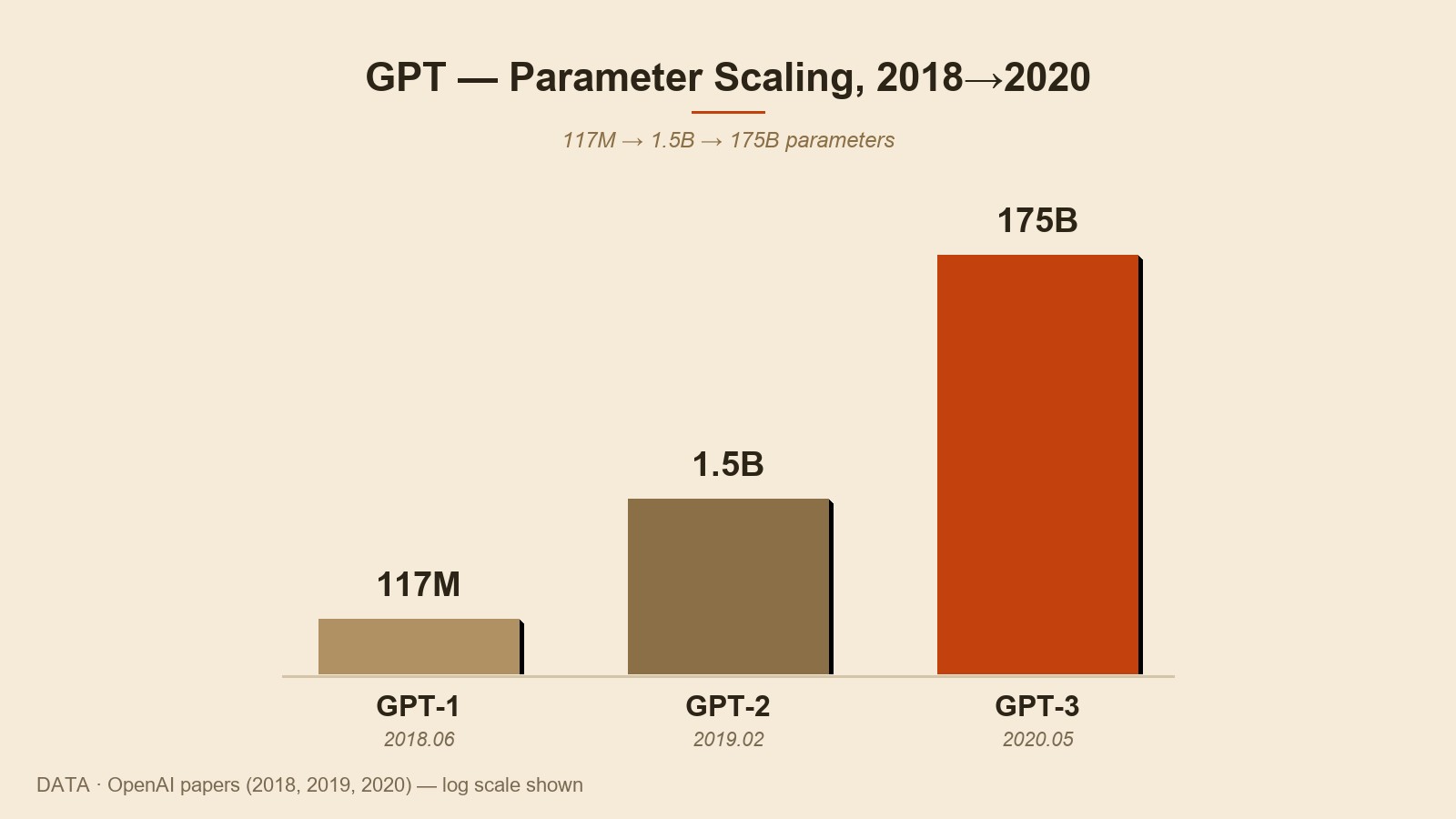
In June 2018, a paper appeared quietly. The title was "Improving Language Understanding by Generative Pre-Training," authored by Alec Radford and colleagues at OpenAI. The model introduced was GPT-1: a 117M-parameter transformer-decoder. At the time, it sat among many other interesting transformer results, drawing modest attention but no real wave.
Then, in February 2019, GPT-2 arrived. 1.5B parameters. Ten times the size of GPT-1. This time the mood shifted. The fluency of GPT-2's text caught people's attention. OpenAI also did something unusual. Instead of releasing the model all at once, it staged the release, citing concerns that the model could be "misused at scale." The decision split the field. Some called it responsible disclosure; others called it overstated risk dressed up as marketing.
At the center of that decision sat Dario Amodei, the same person who appears in installment two of this series. He was then OpenAI's VP of Research. Inside the company he argued, early and persistently, that the larger a model became, the more seriously its societal effects needed to be treated. GPT-2's staged release was one of the early policies that came out of that argument.
Then, in May 2020, GPT-3 arrived. 175B parameters. More than a hundred times GPT-2. From this point the industry's landscape began to change in earnest. Not because the model was just larger, but because the data showed that above a certain scale, the model began to do things its smaller siblings could not, like holding a coherent conversation or attempting tasks given only a brief description. Within the field, this was the moment when the scaling hypothesis became something many people were willing to bet on.
GPT-3 was also the first OpenAI model that ordinary developers could touch directly, through an API. The earlier GPT models had been research artifacts. From this point onward, OpenAI's center of gravity began to shift. From "a nonprofit lab that publishes research" toward "a company that delivers AI as an API."
The Microsoft alliance and the shape of the company
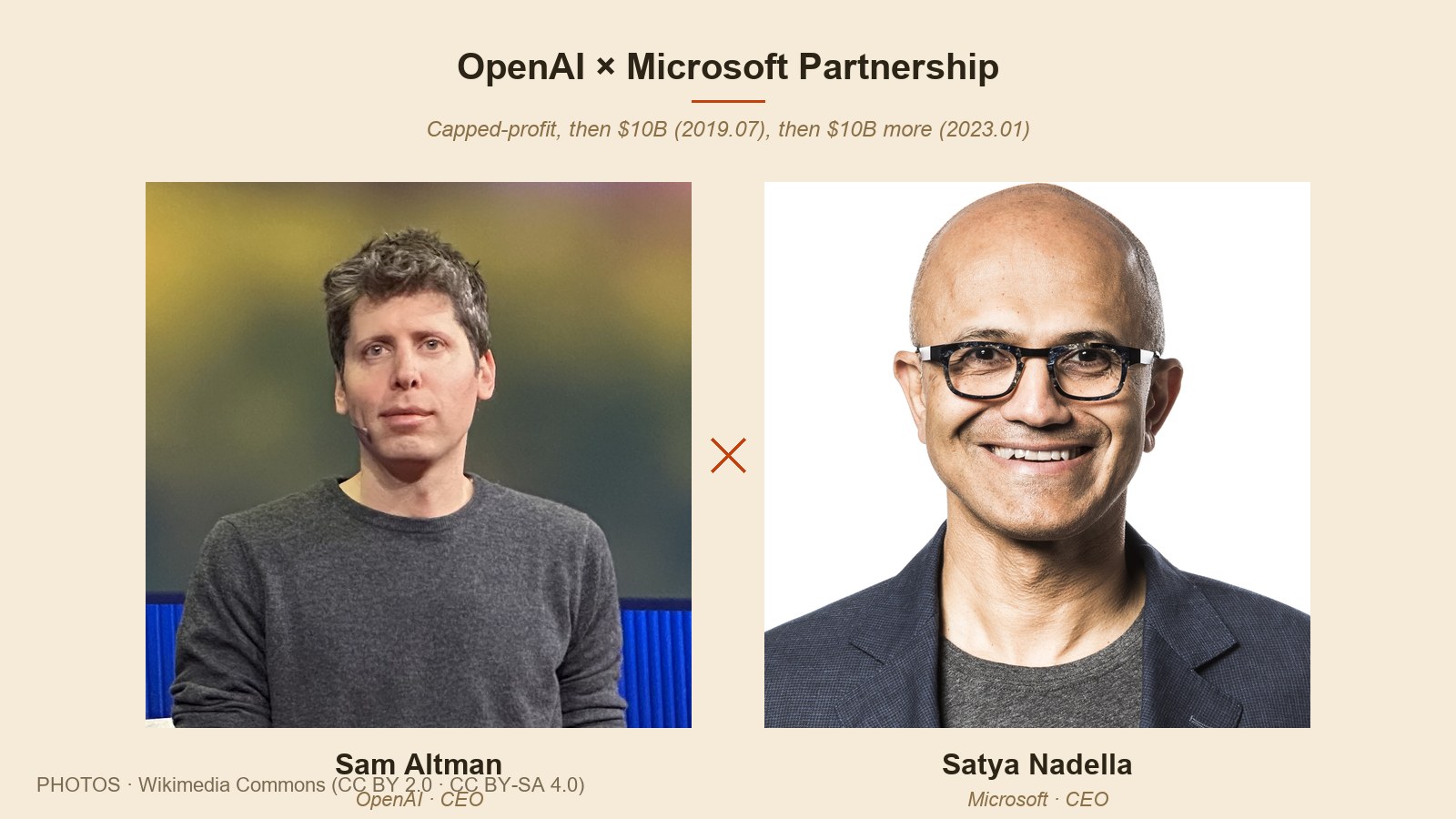
In March 2019 OpenAI announced a major decision. It would split itself into two. The original OpenAI Inc. would remain as a nonprofit parent, and a new for-profit subsidiary, OpenAI LP, would be set up underneath it. The subsidiary could take outside investment and give employees equity, but with a cap. Early investors could recoup up to roughly 100x their stake; everything beyond that would flow back to the nonprofit parent. This was the "capped-profit" model.
The decision was read as a partial step back from the original nonprofit identity. The company's explanation was direct. The amount of capital needed to build AGI had grown beyond what any nonprofit structure could plausibly handle. The first major partner under this new structure arrived in July of the same year. Microsoft. A one-billion-dollar investment, plus an exclusive infrastructure agreement that put OpenAI's training runs on Azure. That one announcement set the direction for almost everything that followed.
On the other side of this decision, an internal fracture was growing. As we saw in installment two of this series, Dario Amodei and the safety-focused researchers were watching the company's center shift toward faster commercialization, and were not at ease with it. The move from nonprofit to capped-profit added weight to that concern. The same people who had once read the same founding document were starting to read its implications differently.
In early 2021, Dario and Daniela Amodei and several colleagues left OpenAI. That same year they founded Anthropic. Installments one and two of this series covered that story. The departure was not just a personnel move. It was the moment when the question of "in what structure should AI safety be practiced" produced two simultaneous, divergent answers in a single industry.
Meanwhile the Microsoft alliance deepened. In January 2023, Microsoft announced an additional ten billion dollars in OpenAI funding. By this point OpenAI's identity had drifted nearly all the way over to that of a for-profit company. The legal shape, though, still had a nonprofit parent governing a for-profit subsidiary. The awkwardness of that shape would lead, less than a year later, to a much larger crisis.
ChatGPT — five days that changed how the world looked at AI
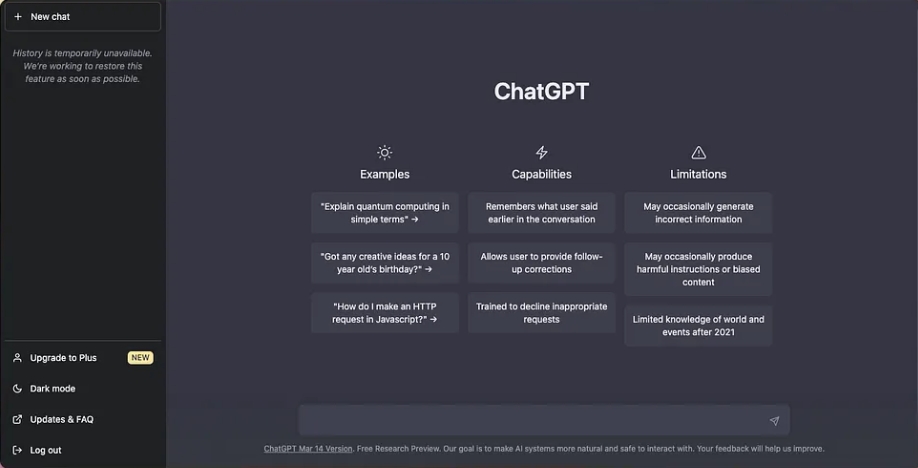
It was November 30, 2022. That day OpenAI made one thing freely available. The name was ChatGPT. The model behind it was GPT-3.5. The interface was a single chat box. Inside the company, there were no large expectations. ChatGPT was being labeled a "low-key research preview." What happened over the next five days was something nobody at OpenAI had foreseen.
Five days after launch, Sam Altman posted a single line on Twitter. "ChatGPT crossed one million users." Five days. For comparison: Facebook took about ten months to reach one million users; Instagram took about two months; Spotify about five. ChatGPT pushed all those records well below. Within the following two months it had passed one hundred million monthly active users. The fastest consumer service in history to reach that mark.
At this point the landscape of the industry shifted again, all at once. Before ChatGPT, AI was a tool for some developers and some researchers. ChatGPT collapsed that boundary in a single push. College students used it to clean up essays. Office workers used it to draft emails. Parents used it to help with their children's homework. AI had walked into the role of an everyday tool, and the first name to occupy that role was ChatGPT.
The competitive picture changed immediately. Google convened emergency meetings and accelerated its own chatbot effort; the result was Bard in February 2023 (later renamed Gemini). Meta, Amazon, and other Microsoft divisions all moved in the same direction. At the same time, as installment three of this series describes, Anthropic was preparing Claude 1.0. The one word ChatGPT had introduced into the mass market — "AI chatbot" — became the market standard that every follower had to address in some form.
GPT-4 — a year of being unmistakably on top
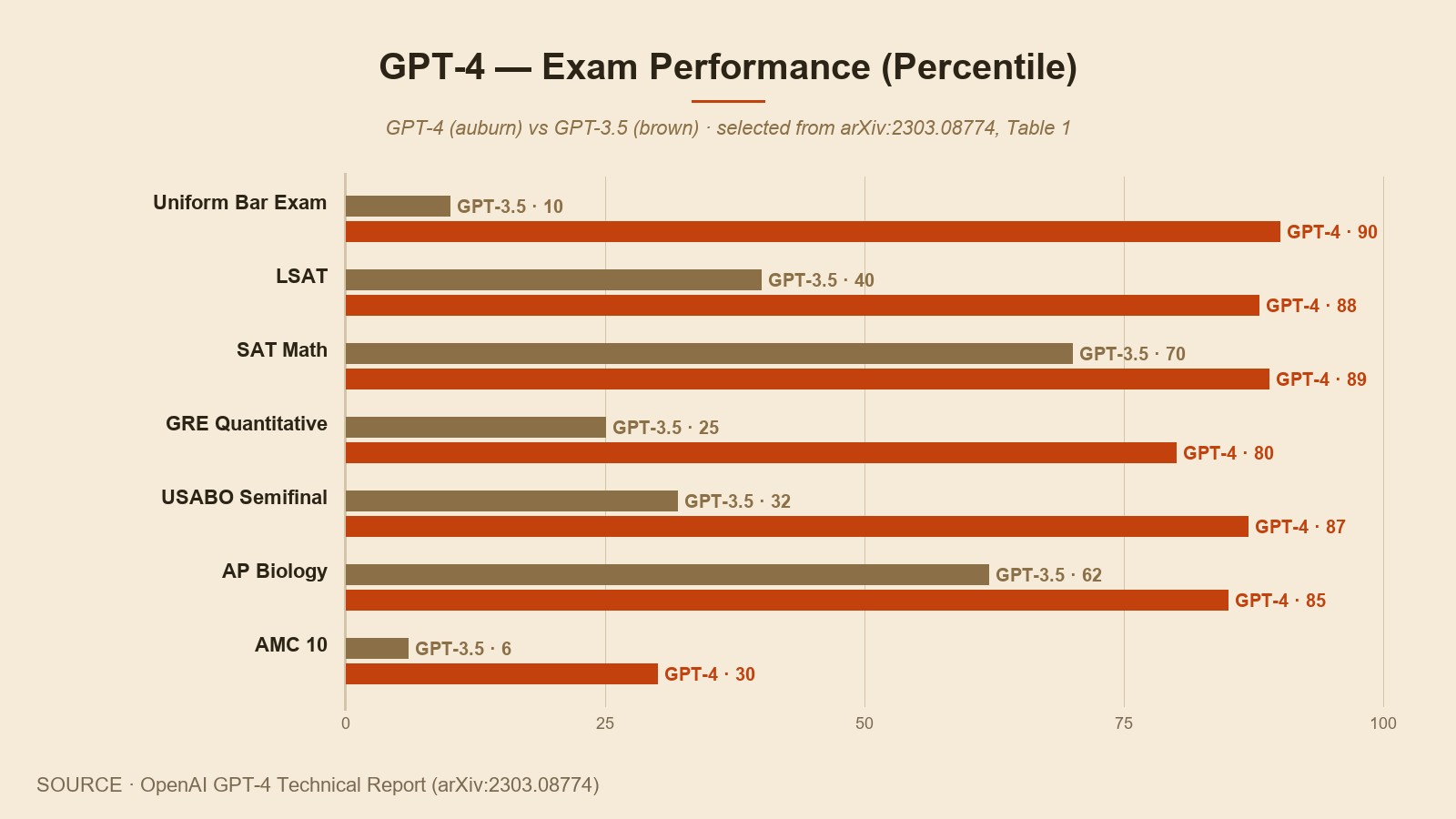
March 14, 2023. Installment three of this series marked this date as the day Claude 1.0 debuted. On the same day, OpenAI announced GPT-4. Two models on the same stage on the same day. But the weight on the two was not equal. At that moment, GPT-4 was the strongest model on virtually every major benchmark. The technical report listed top-decile bar exam, strong GRE quantitative scores, and above-average results across many academic exam settings.
GPT-4 was also the first OpenAI model whose exact parameter count, training data, and training procedure were not disclosed. The company's stated reasons were competitive and safety concerns. The criticism that followed was sharp: a company with the word "open" in its name was no longer opening its models. The shift in identity was no longer being hidden. OpenAI now operated almost entirely as a for-profit company, and it stopped trying to disguise that fact.
For roughly a year after that release, GPT-4 sat on top across most domains. ChatGPT Plus subscriptions grew quickly. By the end of 2023, ChatGPT Plus subscribers were estimated above two million, and API revenue from enterprise customers was rising fast. The company's annualized revenue at that point was estimated at roughly $1.3 billion. Eight years after launching as a nonprofit, this was the number it had reached.
In the same period, as installment three of this series described, Anthropic's Claude 2 had arrived with a 100K-token context window. That difference produced a real gap in one area: for long-document work, Claude was starting to be seen as the more useful tool. But on overall market share, OpenAI was still well ahead. The shape of one model holding nearly all the seats was the defining shape of that year.
On November 6, the first DevDay was held. GPTs, the Assistants API, GPT-4 Turbo, and image input were announced in a single hour-long keynote. Sam Altman walking through these capabilities on stage was a snapshot of where OpenAI's confidence sat in that period. One company was placing its hand on nearly every decisive piece of the industry at once.
Five days — Sam Altman's firing and return
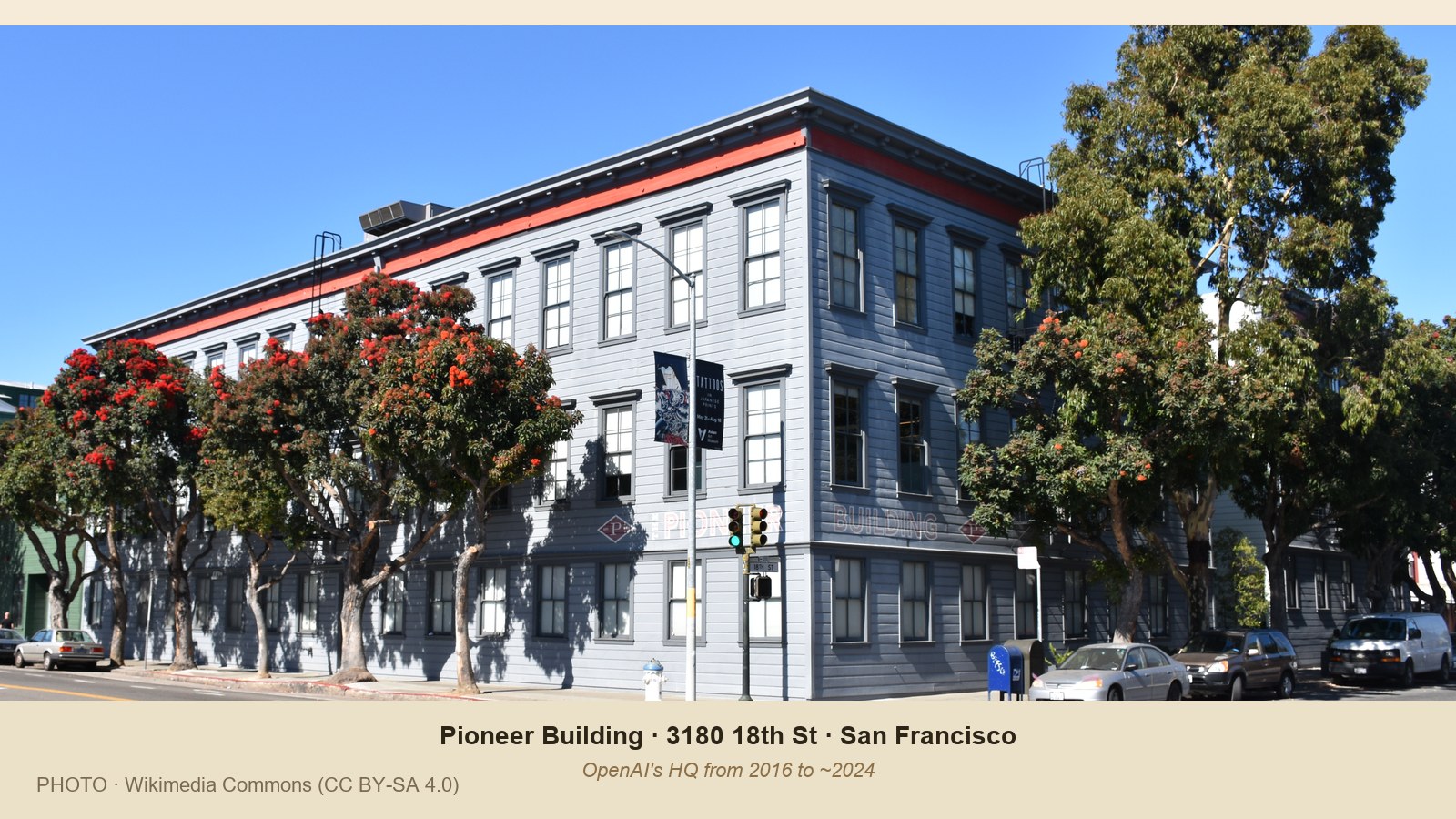
Friday, November 17, 2023, 12:19 PM Pacific Time. A single line went up on OpenAI's official blog. "The board has decided to remove Sam Altman from the CEO role." The stated reason was short and vague. He had "not been consistently candid in his communications with the board." Minutes earlier, Sam Altman himself had received the news on a Google Meet. At the same time, Greg Brockman stepped down as board chair.
The board at that moment had six members. Sam Altman, Greg Brockman, and Ilya Sutskever from the company side, plus three outside directors: Adam D'Angelo (CEO of Quora), Tasha McCauley, and Helen Toner. The exact tally was never fully disclosed publicly, but reports placed Sutskever and the three outside directors on the side that voted to remove Altman. That a decision capable of splitting the company in two had been made by a small six-person board exposed, in the most extreme way possible, the awkwardness of a nonprofit parent governing a for-profit subsidiary.
What happened over the weekend was something close to a drama. In the early hours of Saturday, Microsoft's Satya Nadella was informed for the first time. He was furious. The CEO of a company in which Microsoft had invested ten billion dollars had been removed without any consultation with Microsoft. Over the same weekend, Sam Altman and Greg Brockman moved quickly to map their next move. Microsoft put one card on the table. "Sam Altman, Greg Brockman, and any OpenAI employee who follows them out will be welcomed at Microsoft."
Monday morning, of OpenAI's roughly 770 employees, 738 had signed a single open letter. Its message could be summarized in one line. "If the board does not bring Sam Altman back, we will all leave the company and go to Microsoft." About 95 percent of the workforce, aligned in the same direction. Not an act of loyalty to the company, but a refusal of the board's decision. The fact that the real assets of the company were the people sitting in those rooms, not the model weights or the data, was laid bare in that single signature page.
Late Tuesday, the board changed position. By Wednesday morning, negotiations had produced an agreement to bring Sam Altman back as CEO. The board itself was restructured at the same meeting. Some of the outside directors stepped off, new outside directors stepped on. Ilya Sutskever stepped off the board (and would later leave the company, founding the safety-focused lab SSI in 2024). Bret Taylor came on as the new board chair. The five days of crisis ended.
During those five days, the rest of the industry effectively held its breath. Every other AI company, Anthropic included, watched in suspense to see how the affair would land. Had Sam Altman ended up at Microsoft, the industry's geography would have been redrawn on the spot. That possibility hung over the field for fifty-six hours. It was the moment the structural weakness of "nonprofit parent governing for-profit subsidiary" became most visible, and the moment it became most visible where the real power of the company actually sat.
Sora, GPT-4o, o1 — multimodal and the arrival of reasoning models
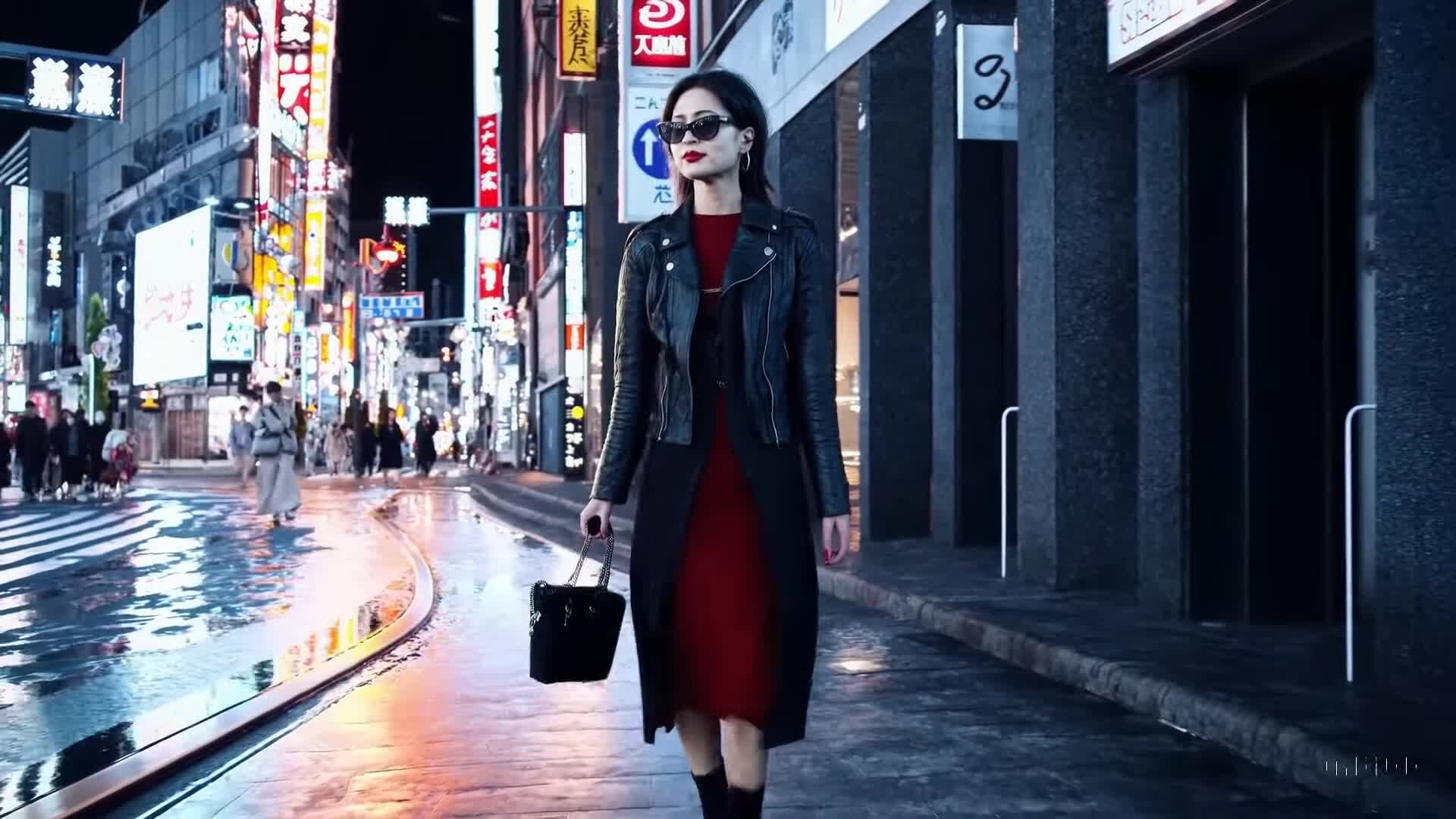
Past the crisis, OpenAI's 2024 was a year of nearly quarterly model announcements. In February, Sora was unveiled. A model that could generate up to one minute of video from a single text prompt. The demo videos shipped with the announcement sat clearly above any other video model of that moment. As installment three of this series noted, Anthropic's Claude 3 family had just appeared. In video, OpenAI was a step ahead.
In May, GPT-4o (omni) was announced. Until then, voice, image, and text had been processed in separate models. This one began handling all three inside a single neural network. Its response time to spoken input dropped close to the pace of an actual human conversation. In the demo, GPT-4o read shifts in the user's tone and reflected them in its replies. The line that followed in the press was that it felt like a scene from the film Her.
Then in September came o1, OpenAI's first model series specialized for reasoning. A model that takes a long pass at thinking before answering. The direction was the same as Claude 3.7 Sonnet's Extended Thinking, covered in installment three, but OpenAI was about five months earlier. On Math Olympiad-level problems and PhD-level science questions, o1 produced results that left the prior GPT-4 line well behind. The era in which AI was simply pattern-matching gave way, in earnest, to one in which AI was attempting something closer to reasoning.
From late 2024 through 2025, o3, GPT-4.5 (codename Orion), and the next-generation models arrived in sequence. Each release added a new record somewhere. In some areas OpenAI remained clearly on top. In others, as installment three of this series noted, Anthropic's Claude received better marks. The market was no longer shaped like a single champion taking every seat. The "best model" for a given task or use case began to differ.
Another thread worth noting from this period was the ongoing reorganization of OpenAI's corporate structure. Across 2024 and 2025 it was reported repeatedly that OpenAI was preparing to step out from under the nonprofit-parent structure and become a more straightforward for-profit company. That move was, in part, the company's answer to the structural weakness exposed by the five-day crisis. It was also criticized. The question that was raised by industry observers and civil-society voices was: "Is it justified for resources committed to a nonprofit purpose to flow to a for-profit company?"
OpenAI in 2026 — the company with the most users
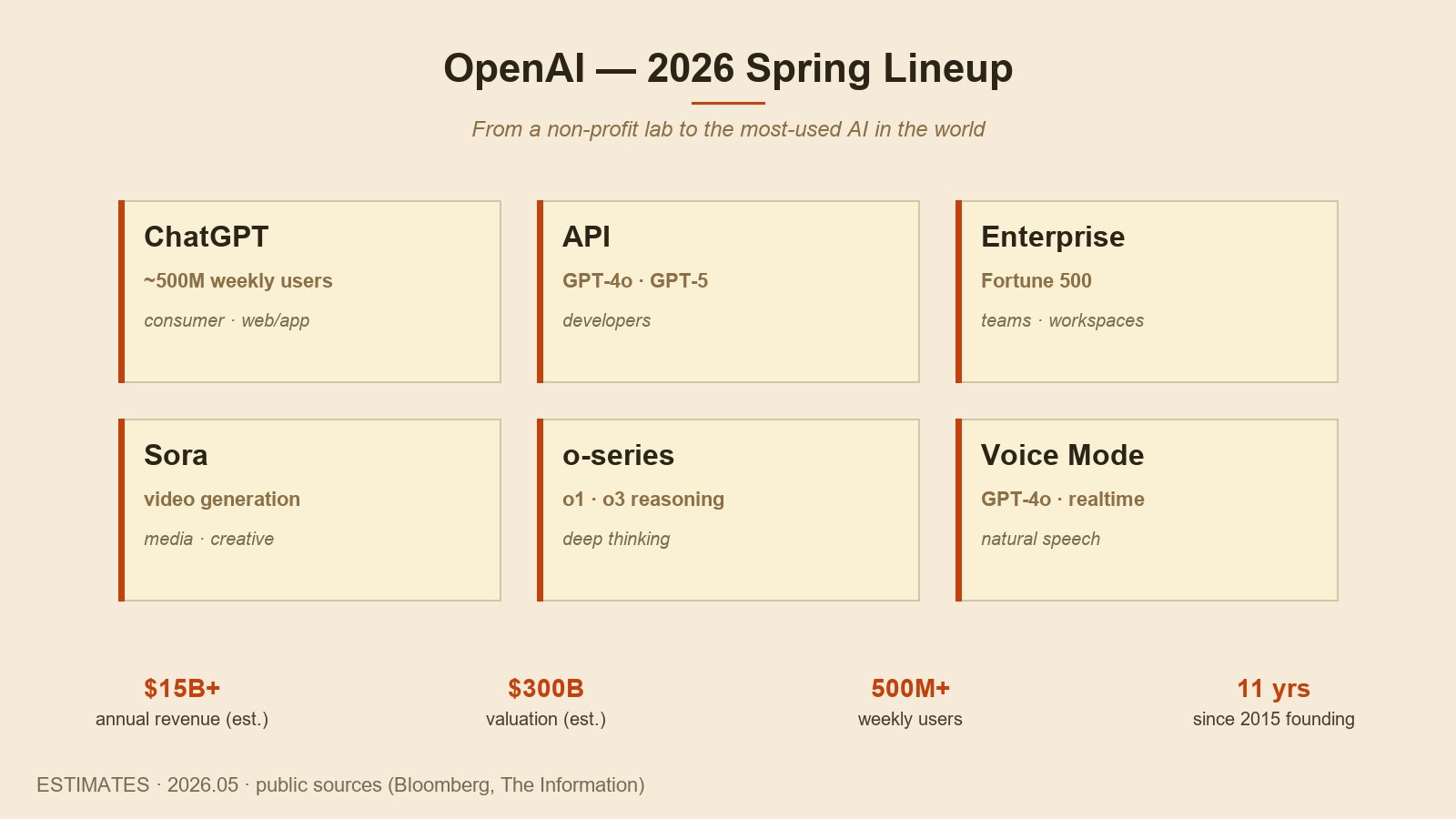
And now, in the spring of 2026 when this is being written, OpenAI looks like this. ChatGPT has more than roughly 500 million weekly active users. Of those, paid subscribers are estimated at around 20 million. Annual revenue is reported in the neighborhood of $15 billion. The most recent funding round valued the company around the $300 billion mark. A nonprofit lab that started eleven years ago with a $1 billion pledge has arrived here.
The product landscape has widened. ChatGPT for consumers, the API for developers, ChatGPT Enterprise for business customers, Sora for video generation, the o-series for reasoning. All of those sit inside one company's lineup. Integration into operating systems has deepened. Microsoft's Windows and Office have OpenAI's models embedded; some Apple Intelligence features call OpenAI's models as well. One company's model is now touching nearly every digital surface of daily life.
The competitive shape has settled differently. As installment three of this series closed on, the market for AI models is no longer a single-champion-takes-all stage. The "best model" varies by domain and by user preference. On total user count OpenAI is dominant, but in certain areas — for instance long-document work or detailed coding — Anthropic's Claude is increasingly the chosen tool. Google's Gemini has anchored a strong position inside its own ecosystem, and xAI's Grok and Meta's Llama family are each building their own seats.
Looking at the two companies that began at the same desk and chose different roads, their positions in the industry are now distinctly different. OpenAI is at the front of the mass market. The AI that the largest number of people pick up every day. The company with the largest revenue. Anthropic is on the side of safety-first identity and depth-of-work tooling. Its revenue is roughly one-fifth of OpenAI's, but it has a clear position in the developer market and the safety-conscious enterprise market. Two different shapes of success inside the same industry.
Two companies that started at the same desk and wrote different answers
If you place installments one through four of this series side by side, one thing becomes clear. In the room where the question of AI safety once sat in front of the same people, two different answers were written, and the difference between those answers has become the shape of these two companies.
OpenAI's answer reads roughly like this. "Powerful AI will eventually exist. To keep it from being locked inside a single company, the right path is to build it the fastest and the most, and to sit at the very front of the market. Safety is best addressed from that position of influence." That answer led to fast capital absorption, fast capture of the mass market, and an emphasis on safety features built on top of that lead. The result, viewed from here, is that OpenAI has become the largest company in the industry, and that "ChatGPT" has become very nearly a synonym for "AI."
Anthropic's answer points the other way. "Powerful AI will eventually exist. But the structure inside which it is built shapes the result. Moving fast without first tightening the safety foundation tends, in the end, to cost everyone more." That answer led to slower and more conservative releases, deeper safety evaluation procedures, and an emphasis on improving model capability inside that structure. Viewed from here, Anthropic is a smaller company with a much sharper identity.
It is not the place of this essay to decide which of the two answers is correct. That conclusion will be written, after the fact, by what the industry produces over the next five to ten years. One thing is worth noting from where we sit now, though. The fact that both answers exist at the same time, inside the same industry, is itself one of the things that keeps the industry healthy. Had only one answer occupied every seat in the market, the future of a technology this powerful would have been a poorer thing.
The next installment of this series will trace the other large competitors in this industry beyond OpenAI and Anthropic — Google, Meta, xAI, Mistral. What seats they are building, and roughly where those seats fall between the two answers above, is the subject of the next chapter.
References · Sources
- OpenAI official announcements (openai.com/blog, openai.com/research), 2015.12–2026.05 — founding statement, GPT-1 through GPT-4o, ChatGPT, DevDay, Sora, o1, and related publications
- "OpenAI Charter," OpenAI, 2018.04 — the company's mission document
- The New York Times, "Inside the Five Days That Shook OpenAI," 2023.11
- The New Yorker, "How Sam Altman Came Back to OpenAI," 2024.03
- The Information, "Inside OpenAI's Restructuring" series, 2024–2025
- Bloomberg, "OpenAI Revenue and Valuation Updates," quarterly estimates, 2023–2026
- Lex Fridman Podcast #419, "Sam Altman: OpenAI, GPT-5, Sora & the Future," 2024.03
- Lex Fridman Podcast #452, "Dario Amodei: Anthropic CEO on Claude, AGI & the Future," 2024.11 — sections referencing OpenAI
- Wired, "The Inside Story of ChatGPT's Launch," 2023.04
- SEC 13F filings and Microsoft annual reports, sections on OpenAI accounting treatment, 2019–2025