The Evolution of Claude,
From 1.0 to 4.7
In the spring of 2023, a model debuted quietly. About three years later, it can handle a one-million-token context, drive a computer directly, and show you its own thinking. This is a record of the decisions in between.
Three years, what that means here
Three years is not a long time. It is the time someone takes to quit college and come back. It is the time a city changes its scenery slowly. It is the time during which a company starts to be tested on the first promises it made. In the world of AI models, however, three years runs differently. Even when the model bears the same name from the same company, what lies between its first day and its last belongs to almost a different dimension of capability. The spring of 2023, when the name Claude first reached the world, and the spring of 2026, when this article is being written, fit that description exactly.
This essay traces how the model called Claude changed across those three years. It is not simply a list of version numbers. At each step, what decisions did the company called Anthropic make, what results did those decisions bring, and what marks did they leave on a user's everyday life and on the shape of the industry. From 1.0 to 2, 3, 3.5, 3.7, then 4 and 4.5, and the current 4.7. Looked at as numbers, the path can look like a simple staircase climbing upward. Look between the steps, however, and quite different landscapes open up.
One thing first. There is something that did not change during those three years. The question the company first raised — "Can this technology actually be built in a direction that helps human beings?" — every new version was a way of asking that question again. As capability grew, the question did not become lighter; it became heavier. The weight of that question is something this essay traces alongside the version numbers.
Claude 1.0 — a quiet debut
It was March 14, 2023. The day Anthropic introduced the name of its own model to the world for the first time. The name was Claude. The company explained that it came from Claude Shannon, the founder of information theory. Two versions were announced on that same day. A full Claude for serious tasks, and the faster, lighter Claude Instant. From the start, the company opened with two tracks.
The mood was calm. Just four months earlier, in November 2022, OpenAI's ChatGPT had already shaken the world. Attention was still firmly on that side. Claude's debut happened without a flashy announcement event or a polished demo. One brother was on stage in the lights, while the other was quietly preparing his own work just off it. From the start, Anthropic chose to send its model into the world through APIs and partnerships, not a consumer interface.
The early partners made for an interesting list. Quora's conversational service Poe, the writing-collaboration tool Notion AI, the search assistant DuckAssist, the note-taking helper Jasper. One of the most striking integrations was with Slack. A bot that let teams call Claude directly from inside their message channels. For many casual users, the Slack bot was the first place they ever encountered the name Claude.
Technically, Claude 1.0's context window was about 9,000 tokens. Small by today's measure, but at the time it enabled work that ordinary chatbots could not. Summarizing long meeting notes. Reviewing hundreds of lines of code in a single pass. More important than the size, though, was something else. This model was the first to have a training procedure called Constitutional AI applied in earnest, a process by which the model evaluates and revises its own answers. An attempt to move past the limits of training based only on human feedback.
Honestly, Claude 1.0 lived in the shadow of GPT-4. March 14, 2023 was, by coincidence, also the day OpenAI announced GPT-4. The two models came out on the same day, and the comparison was immediate. On most public benchmarks, Claude 1.0 did not match GPT-4. That does not mean the appearance was small. The fact that a new option, however small, had entered the market, and the fact that this option carried the identity of "a safety-first AI research lab" attached to its name, drew a new line on the industry map.
Claude 2 — a new territory called context
About four months later, on July 11, 2023, Anthropic announced Claude 2. From the outside it looked like a simple version bump; in reality it was a leap of a different order. Two pieces stood out. First, the context window expanded from 9K to 100,000 tokens. Second, a web interface called claude.ai opened to general users for the first time. A limited release for US and UK residents, but still the first time the front of the stage was lit.
What 100K actually means is worth a moment. An average English novel runs roughly 75,000 to 100,000 words. In tokens, one word is typically 1.3 to 1.5. So 100K tokens is roughly the size of a single book read whole. In the 9K era, a long PDF had to be chopped by a human before a chatbot could review it. In the 100K era, it could be dropped in and asked about directly. A lawyer reviewing a 200-page contract whole. A researcher summarizing a full academic paper. A developer analyzing several large code files at once. Things that became newly possible.
There were jumps in coding and math too. The model scored in the 90th percentile on the US Bar Exam, and in the top tier on GRE writing. On the HumanEval coding benchmark, it reached 71%, well up from 56% on Claude 1. The shift was not just that the model handled longer text. It was a signal that the model had begun to settle in as a genuinely useful tool in a specific domain.
Four months later, on November 21, Claude 2.1 was announced. The context window doubled again. 200,000 tokens. About 500 pages. The more important change at that moment was that hallucination dropped by close to half. The model started saying "I don't know" when it didn't know more often. Tool use also entered beta. The model could now call external APIs, query databases, or run user-defined functions. The seed of the agentic AI that would arrive in earnest a year later was planted here.
Claude 3 — the age of three sisters
It was March 4, 2024. Anthropic released three models in one stroke. Haiku, Sonnet, Opus. A short Japanese verse form, a 14-line Shakespearean form, and a great work composers spend lifetimes on. The three words placed side by side read like a single line of verse on their own. The naming was not just flair. It was a message. Inside one family, models of different breaths live together, and the user picks the one that fits the task.
The lightest, Haiku, was fast and cheap. Suited to chat responses, simple classification, quick lookups. The middle Sonnet took on the bulk of everyday work. The heaviest, Opus, was for deep analysis, complex reasoning, long-form writing. The fact that Anthropic launched the three-tier system at once mattered. Until then, the AI model market had revolved around a single race for "the one best model." Claude 3 twisted that structure slightly. By placing three siblings on the stage at once, it opened the era in which users compare price, speed, and capability and pick accordingly.
The technical changes were also substantial. All three were multimodal models supporting image input. Show it a photo and it would name the objects inside; show it a chart and it would read the numbers; show it a handwritten note and it would transcribe what was written. A model that used to run on a single line of text suddenly had something like a sense of sight.
The benchmarks drew attention too. On MMLU, GPQA, HumanEval and similar headline metrics, Opus surpassed the GPT-4 Turbo of the time by a meaningful margin. This was the moment Claude began to be recognized as a model that could top the GPT line. The market's center of gravity shifted slightly. No longer "what comes after OpenAI," but a company standing on the same stage and competing directly.
3.5 Sonnet — the middle seat takes the top
June 20, 2024. A single line of model released that day quietly bent the market's inertia. Claude 3.5 Sonnet. As the name implied, it was the successor to the middle-seat Sonnet of the Claude 3 family. Yet when one looked at the performance, an odd thing was happening. The middle-seat Sonnet had begun to surpass the heaviest-seat Opus of the same family. The data demonstrated that a bigger, heavier model was not automatically stronger.
To put a number on it, HumanEval reached 92%. Close to human-level coding assistance. On MMLU and GPQA as well, it surpassed the previous Opus. And it did this while Sonnet's inference cost was roughly one-fifth of Opus's, and roughly twice as fast. Cheaper, faster, with better answers. For the user, the reason to reach for the more expensive model thinned out.
The larger shock in this announcement was not the model itself, however, but one interface released with it. Artifacts, a side panel. When you asked for code in the chat, the code did not just sit in the conversation. It opened in a separate canvas on the right side of the screen. Inside that canvas, the code ran and the result appeared in real time. Ask for a document and a clean, polished document opened in the same place, ready to be edited. Ask for a chart, and an interactive chart appeared in the same panel.
The change Artifacts brought was more than a UI improvement. It was a shift in how the outputs of conversation were handled. Before, the user had to copy whatever the model produced and paste it into a different tool. After Artifacts, that output could be handled in the same screen as a living thing. The flow of a human and a model making something together was for the first time compressed into one space. Other companies later introduced their own side panels. This was the starting point of a movement.
Computer Use — when the model drives the computer
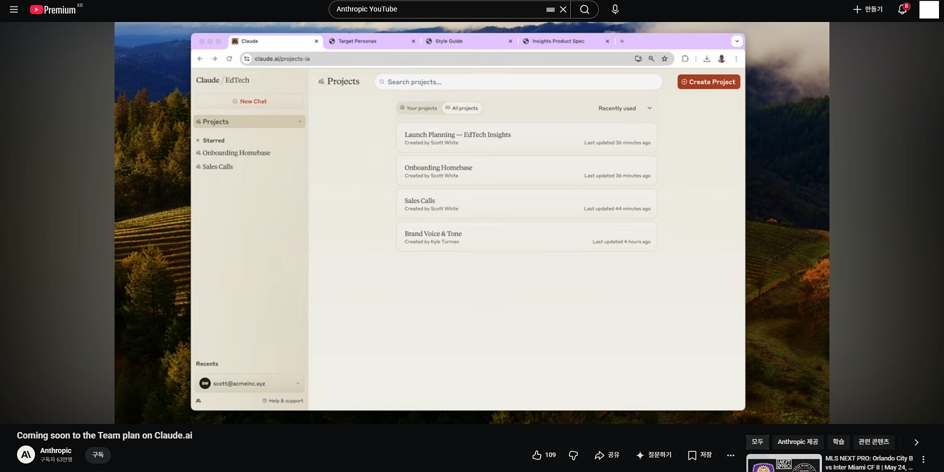
October 22, 2024. The weight of this announcement sat less on the model itself and more on what the model was now able to do. A new version of Claude 3.5 Sonnet (commonly called the "new" or "October" version) was announced together with Claude 3.5 Haiku. And alongside them, a beta capability called Computer Use.
Computer Use worked like this. When the user gave it a task, the model looked at the computer screen directly to do it. More precisely, it received the screen as a screenshot. It analyzed the screenshot, decided where to move the mouse, where to click, which keys to press. It sent those decisions to the operating system. It received the changed screen as another screenshot, and decided on the next action. It repeated this loop until the user's goal was met.
The description sounds simple; the implication was heavy. Until then, AI models were confined to the world of text in and text out. Computer Use opened one edge of that wall. The model could now use tools built for people — web browsers, spreadsheets, email clients, chat apps — exactly the way people use them. No new API needed. No new interface designed for the model. The screen a person sees is the screen the model sees.
The benchmark numbers shifted significantly too. On SWE-bench Verified — a benchmark that measures whether a model can resolve real GitHub issues in open-source projects — the new 3.5 Sonnet scored 49%. The previous state of the art had been around 22%. Roughly a doubling. At the same time, Haiku 3.5 was released, refreshing the lightest tier.
Computer Use was still beta, with plenty of mistakes. The model would press wrong buttons, type into the wrong form, get distracted by ads on the screen. Anthropic itself flagged the feature as "still experimental, not yet reliable enough." Yet the direction the beta pointed to was clear. AI from here on would not stay inside the chat window. The reason the word "agent" became the central industry keyword over the next year traces partly back to this announcement.
3.7 Sonnet — the thinking model arrives
February 24, 2025. The announcement raised the version number by only 0.2, but in practice it redefined one way the model worked. Claude 3.7 Sonnet. And the word that came with it was Extended Thinking.
Here is what Extended Thinking is. When a user puts a difficult question to the model, the model does not produce an answer right away. It first lays out its own reasoning as tokens. Similar to a person pulling out scratch paper for a hard problem and working through the steps. That reasoning is visible to the user. What hypothesis the model is forming, which cases it is checking, where it is getting stuck and how it finds a way through — all of it is exposed. Only after that process does the model give its final answer.
The key was that the same model carried two modes. When a fast response is needed, the model answers without the reasoning trace; when deep thinking is needed, it spends time and tokens to work through the problem step by step. The user picks the mode directly. The structure itself was new. Before, a "strong reasoner" and a "fast responder" usually lived in different models. From Claude 3.7, two paces of breath lived inside one model.
The benchmarks moved with it. SWE-bench Verified hit 70.3%. About 20 points above the 49% at Computer Use's announcement. On math-olympiad-grade problems, PhD-level science questions, refactoring of complex codebases — anywhere hard — Extended Thinking-on Claude 3.7 showed a jump that did not lend itself to easy comparison with the previous generation.
Tied into the same announcement was another tool. Claude Code. In beta at first. A command-line tool that let developers call Claude directly from the terminal and handle code writing, debugging, file editing, and command execution as a unified flow. Not a developer reaching for Claude inside an IDE, but Claude living inside the developer's working environment. The full settling of this tool as an industry standard would take another year. The starting point was February 2025.
Claude 4 — a model that lives with tools
May 22, 2025. Anthropic carried two new names onto the stage at once. Claude Sonnet 4 and Claude Opus 4. The version number jumped from 3.7 to 4 in one step. The naming convention was tidied up as well. Where "Claude 3.5 Sonnet" had put the family name first and the tier second, "Claude Sonnet 4" now put the tier first and the generation number last. A small change to the eye, but a signal that the company was further systematizing how it operated its model family.
Opus 4 was the strongest model in the coding benchmarks at that moment. SWE-bench Verified at 72.5%. The real shift in this generation, however, was not a single benchmark number. It was the integration of how the model worked with tools. Extended Thinking was no longer a separate mode; it became a built-in capability inside the model. Tool calls could now be issued in parallel. The model would call several tools in a single bout of thinking, take in the results, and decide its next action. The flow had become natural.
Claude Code went general availability in the same announcement. The tool that had peeked out as a beta a year earlier now sat squarely as a proper product. Claude Code received automation hooks. Structure that let the model take certain actions automatically at specified moments. A "plan mode" was introduced too — a step where the model shows the user a plan before making actual changes and receives confirmation. As the model gained more autonomy, tools for the user to draw the boundary of that autonomy grew alongside it.
Another change worth noting. A new standard called MCP (Model Context Protocol) began to settle into place during this period. An attempt to standardize how models access external tools and data. Instead of each company making its own tool-connection format, everyone would follow a shared common interface. About half a year after Anthropic published the draft, the other major model providers began to adopt it in turn.
Four months later, on September 29, Claude Sonnet 4.5 arrived. Once again, the middle-seat Sonnet surpassed the same generation's Opus. SWE-bench Verified at 77.2%, along with a published claim of being able to sustain a single autonomous task for about 30 hours. Claude Code reached 2.0. Soon Opus 4.5 entered the heaviest seat, and a period of several small jumps within a single generation began.
Now — the era of Opus 4.7 and a 1M context
And now. As of the spring of 2026, when this is being written, Anthropic's heaviest model is Claude Opus 4.7. The flow from 4.5 to 4.6 to 4.7 has felt less like one big leap and more like several short-breath refinements stacked one after another. A period in which the model's character is being polished within a single generation, and the weak spots discovered in real user workflows are being filled in in turn.
The most visible change is the expansion of the context window. One million tokens. Starting from Claude 1.0's 9K, the number grew about 110x in three years. What does 1M tokens look like? It is enough to put the entire codebase of a mid-sized company in one input with room to spare. It is enough to spread several thick academic books on a single table. It is enough to drop in every meeting recording from one company's quarter at once. The unit of work the model handles has shifted from "one question on a line" or "one page of a document" to "one quarter of one company."
The way the model handles tools has gotten more refined too. Within a single task, the model calls several tools in parallel, lays out its own reasoning, passes intermediate results back as inputs to other tools, and asks the user for decisions when needed. The whole flow happens naturally inside a single conversation. From the user's side it looks like a single model was called; underneath, multiple steps of work are running in parallel.
The shape of the industry has changed too. A company that started three years ago as a small nonprofit research lab has become one of the standard tools many enterprises in the United States and Europe integrate into their systems. In healthcare, for diagnostic assistance. In law, for contract review. In finance, for research work. In content, for editing and translation. The most prominent area is, unsurprisingly, software development. Claude Code sits deeply inside the daily workflow of many development organizations.
And one more thing. The mission emphasized from the very beginning — "safe AI" — is no longer just marketing rhetoric; it has become an operational backbone. With every major model release, the company publishes evaluation results against its own framework, the "Responsible Scaling Policy." If the risk level crosses a defined threshold, releases are slowed or features are restricted. Pre-review procedures with external evaluation bodies are baked in. What started as an internal company commitment has been moving toward a kind of de facto industry standard.
What changed, and what remained
Gathering three years of record into one place, a few things stand out clearly. The context window grew roughly 110x, from 9K to 1M. The model's capability expanded in turn, from single text conversation to multimodal understanding, screen operation, tool use, exposed reasoning, and long autonomous work. The naming was tidied up, the seats inside the family were settled, and prices fell quickly with each generation at equivalent performance. These changes can all be confirmed in numbers and announcements.
What this essay would rather close on, though, is the other side. What did not change during the three years. The question Anthropic raised at founding — can this technology really be built in a direction that helps human beings, and if it goes the wrong way, what method do we have for noticing it in time — has been repeated at every step. As context grew larger, the question grew heavier. As autonomy grew larger, the question grew more urgent.
A single-line question that began in a small company three years ago is now reshaping the way an entire industry works. No one knows exactly what the next three years will look like. One thing seems clear, however. What will make the decisive difference in the next step is not a larger model or a longer context, but the agreement on what structure of responsibility we run these models inside. The shape Anthropic stands in while that agreement is being drafted is a subject the later chapters in this series will take up in more detail.
The next chapter in this series will take up OpenAI — the biggest companion and the biggest competitor met along this road. Where the two companies diverged, what they shared, and where they stand now. That is the next chapter's subject.
References · Sources
- Anthropic official announcements (claude.ai/news), 2023.03–2026.05 — Claude 1, 2, 2.1, 3 family, 3.5 Sonnet, 3.5 Haiku, Computer Use, 3.7 Sonnet, Sonnet 4, Opus 4, Sonnet 4.5, Opus 4.5/4.6/4.7
- "Constitutional AI: Harmlessness from AI Feedback," Bai et al., Anthropic, 2022
- Lex Fridman Podcast #452, "Dario Amodei: Anthropic CEO on Claude, AGI & the Future of AI," 2024.11
- Anthropic, "Responsible Scaling Policy v1.0," 2023.09 (with later revisions)
- Anthropic, "Introducing Computer Use," 2024.10
- Anthropic, "Introducing Extended Thinking with Claude 3.7 Sonnet," 2025.02
- Anthropic, "Claude Code: AI in your terminal," 2025
- SWE-bench Leaderboard (princeton-nlp), 2024.03–2026.05 — generation-level scores
- HumanEval, MMLU, GPQA public results — Papers with Code, 2023–2026
- The Information, "Inside Anthropic's Model Roadmap" series, 2024–2025