The Seven Who Left OpenAI,
and Built a Safety-First AI
December 2020, a San Francisco office. Dario Amodei walked into a meeting and handed in his resignation after five years. His sister Daniela did the same. Within days, the lead authors of the GPT-3 paper followed. This is the story of how Anthropic began.
Two siblings left on the same day
It was a day in December 2020. In a meeting room in San Francisco's Mission District, Dario Amodei rose from his chair. He had spent five years building the seat he was leaving. He was OpenAI's Vice President of Research, and he had been at the center of the work that brought GPT-2 and GPT-3 into the world. At the same time, he was responsible for the safety research behind every model the company built. Two weights on one shoulder. Either one alone would have left a sizeable mark on the company.
On the same day, his sister Daniela Amodei also resigned. She had been Vice President of Safety and Policy, and she ran much of the company's hiring and operations. Two siblings leaving on the same day was already enough to send a ripple through the building. The story did not end there. Within a few days, five lead authors of the GPT-3 paper handed in their resignations as well. Tom Brown was the first author of that paper. Sam McCandlish was the person who had first written down, in math, how a model's performance scales as you make it larger. The theoretical scaffolding under that work belonged to Jared Kaplan, a physicist by training. Jack Clark had crossed over from the UK and was running policy. Chris Olah had been quietly building an entire field of his own called interpretability, the work of looking inside a model's head. Seven people. Far too many for a single company to lose at once.
Through that winter, the AI community in San Francisco buzzed with a single question. Where were they all going. No one could say with certainty. Only one thing was clear. Something large was underway.
That something acquired a name in February of the following year. The company was called Anthropic. By May, a seed round of 124 million dollars had been announced. Five years have passed since. Today the company stands as OpenAI's most serious competitor, and not by accident. It got there by choosing, deliberately, the most different path it could.
This article is about the starting point. Why did they leave, and what did they want to build instead.
Why they left OpenAI
On the surface, the reason was simple. OpenAI was commercializing too quickly. In 2019 the company shed its purely nonprofit clothing and put on a new form known as a "capped-profit" structure. On paper it was a way to keep the mission of safe AI development while becoming able to take outside capital. In practice it was the groundwork for a one billion dollar investment from Microsoft. After that, things moved at frightening speed. GPT-3 was released in June 2020, the API followed in the same month, and soon Microsoft acquired the exclusive license for GPT-3. All of it happened within eighteen months.
For Dario the unease ran deeper than the timeline. He was the head of safety research. His job was to study what new dangers might emerge as models grew more capable. As the company tilted toward shipping faster, the review processes his team proposed began to feel more like rituals than genuine deliberations. The stamps were applied, but the weight of thought behind each stamp grew lighter. Anthropic's later founding statement carries an echo of this period in a single line. AI capabilities were running ahead of AI safety research.
The second crack came from the Microsoft alliance. In 2020 OpenAI signed an agreement that made Azure its effective sole compute provider. It was not just a cloud contract. It was the start of a path where every model OpenAI built would be folded, one by one, into Bing, into Office, into Azure itself. Dario and the safety researchers saw that this integration would create an irreversible pressure to ship. A model embedded in a shipping product cannot be paused by the will of one company alone.
The third crack was about governance. OpenAI still wore its nonprofit identity, at least in public. The reality inside the conference room was a different shape. The largest external stakeholder was Microsoft, and no large decision was free of that fact. A gap was opening between the language of the mission and the language of operations. Dario described that gap in only one restrained sentence in a 2023 interview. "The mission of OpenAI and the way it was actually being operated had drifted further apart than we could accept." Beyond that he has never criticized his former colleagues in public. He simply rose from his chair.
Seven people, one company
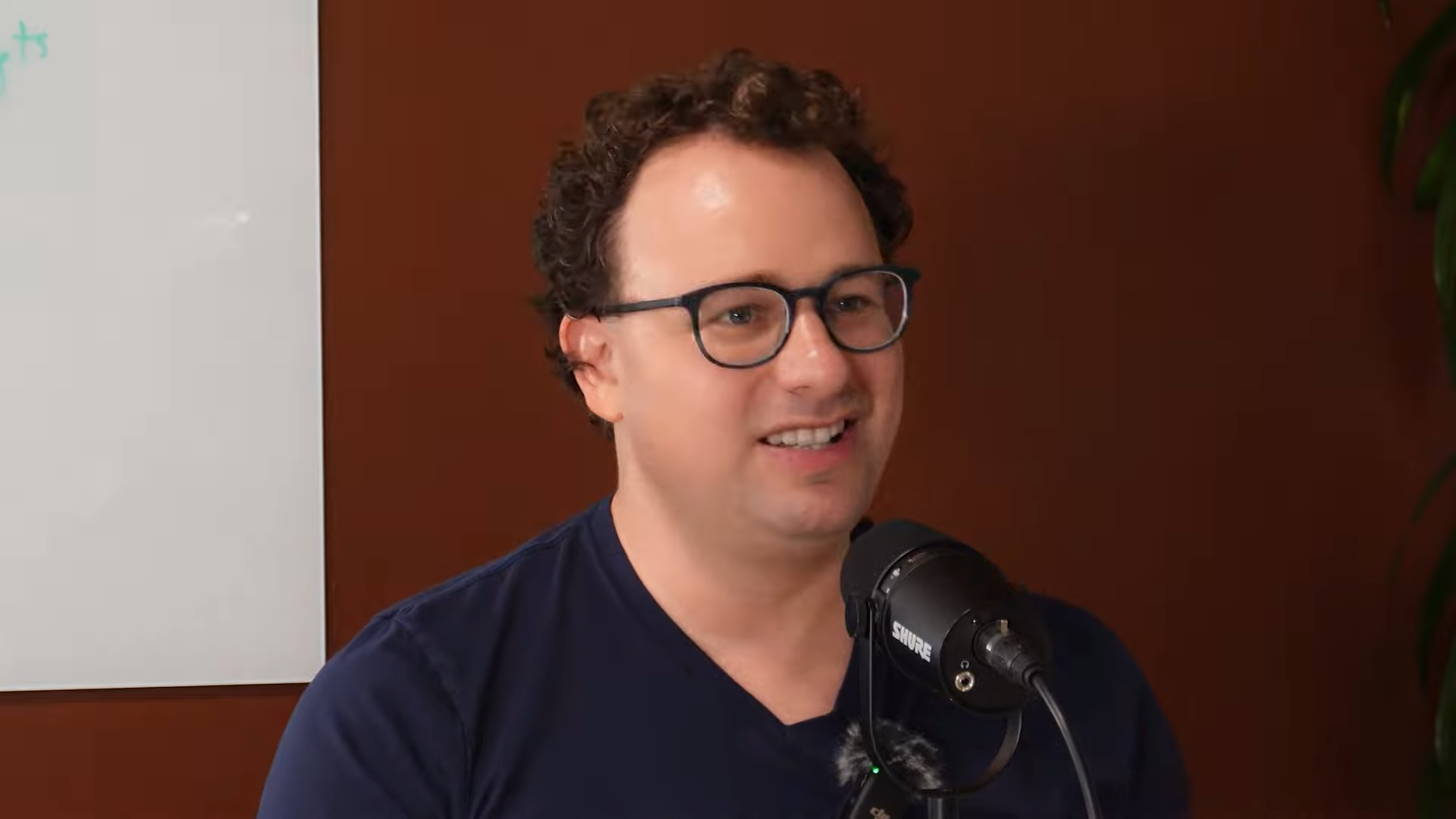
One cold morning in January 2021, in a temporary space in San Francisco's Mission District. More precisely, it was someone's borrowed living room. The space was barely furnished. Seven people gathered there. These would soon become the official co-founders of Anthropic. The list is short, but its weight is not.
- Dario Amodei · CEO · Former OpenAI Research VP · Stanford PhD in computational neuroscience · Lead researcher behind GPT-2 and GPT-3
- Daniela Amodei · President · Former OpenAI VP of Safety and Policy · Operations leader who had managed people, policy, and process at Stripe and OpenAI
- Tom Brown · First author of the GPT-3 paper "Language Models are Few-Shot Learners" (2020)
- Sam McCandlish · Lead author of "Scaling Laws for Neural Language Models" (2020), the first paper to put the relationship between model size and performance into precise mathematical form
- Jared Kaplan · Professor of physics at Johns Hopkins, the theoretical architect behind the scaling laws work
- Jack Clark · Former OpenAI Policy Director, British, in charge of policy and international governance
- Chris Olah · A researcher who came through Google Brain and OpenAI, and who effectively built the field of interpretability on his own. The person who took the work of looking inside an AI model's head more seriously than almost anyone else
If you take all seven together, the picture becomes sharper. Half of the people who had brought GPT-3 into the world were now in one company. The deepest trust came from a sibling relationship. The instinct for governance came from a British policy lead. The theoretical depth came from a physicist, and the tools for looking inside models came from the founder of interpretability. None of this was accidental. The composition was designed. Researchers with capability, people who understood the system deeply, and people who knew how to place it inside society. All three kinds, in one room.
Beyond the seven, about fifteen more researchers joined within the first six months. Most of them came from OpenAI, Google Brain, or DeepMind. By the middle of 2021, Anthropic was a small organization of around thirty people. The compute infrastructure was not yet adequate, and the office was tight. What was clear, to everyone in the room, was the kind of thing they wanted to build. The name of that thing is the subject of the next chapter.
A philosophy called Constitutional AI
Begin with the name. Anthropic comes from the Greek ánthrōpos, meaning "human." Unpacked, the word carries a grain of "concerning humanity" or "human-centered." The real philosophy of the company, though, is better captured by a paper than by a name. A paper published in December 2022.
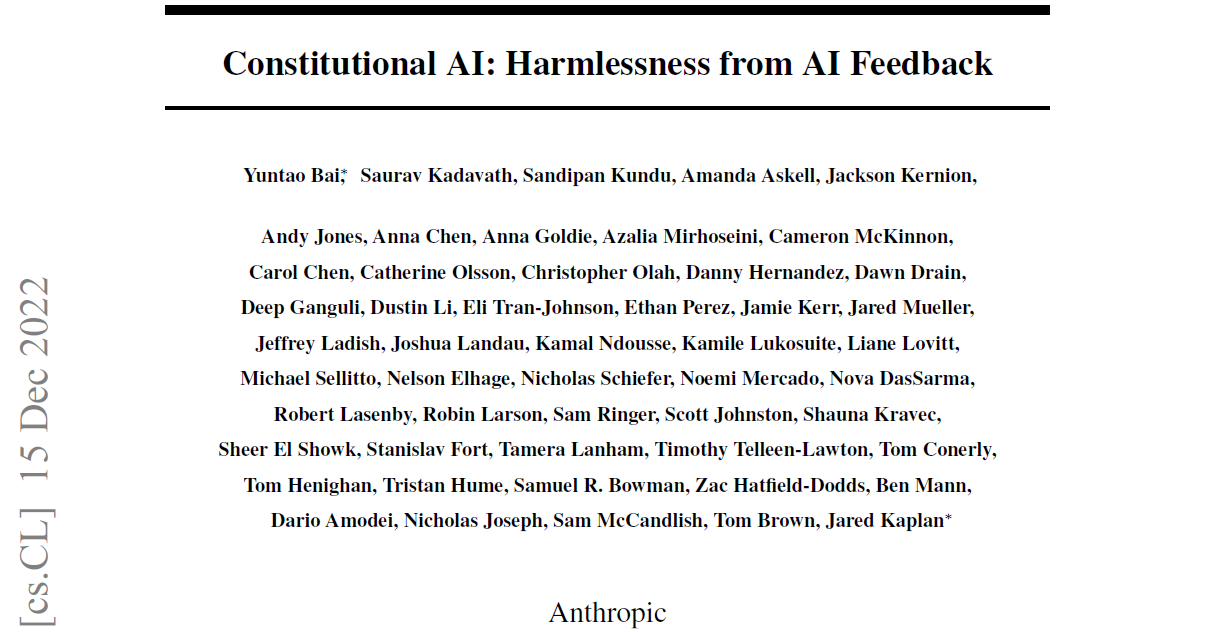
The idea behind Constitutional AI (CAI) was simple in shape and provocative in implication. Until then, the standard for AI safety training was RLHF, where human reviewers labeled responses as acceptable or not. The method was powerful, but it had limits. A small army of labelers was needed, and even then, no group of people could imagine every dangerous scenario in advance.
Anthropic's proposal could be summarized in one line. Give the AI a constitution. A set of written principles is shown to the model first. Questions like these. Could this response harm someone. Is this response honest. Does this response respect the user's autonomy. Then the model is asked to critique and revise its own answers against those principles. A human reviewer no longer needs to look at every output.
Two things made this work. The first was cost. Ten thousand human evaluations could now generate millions of self-critiques. The second mattered even more. The grounds on which the model refused or revised an answer became visible. Not only the outcome but the reason was written down. This sat naturally next to Chris Olah's longer-running pursuit of looking inside the model.
This philosophy shaped every decision that came after. With every release of Claude, from 1.0 through 4.7, half of the launch notes have always been about a new safety mechanism added to the model, not just about its new capabilities. This is not coincidence. It is in the company's DNA.
$124M seed, and one building in San Francisco
When the company was just starting, the first wall Anthropic ran into was money. Building large language models is not a job that smart researchers alone can finish. Thousands of cutting-edge GPUs are needed, along with the electricity to run them around the clock for weeks. Cloud infrastructure must hold all of it together. Training a model on the scale of GPT-3 cost millions to tens of millions of dollars per run. A mission alone, however clear, could not start that work without capital.
So Anthropic's first round was unusually large by the standards of a typical seed. In May 2021, 124 million dollars. Jaan Tallinn, the co-founder of Skype, led the round. A 580 million dollar Series A followed, and another round came in the same year as Series B. By early 2022, the company had raised around 700 million dollars in total.
From 2023 onward the scale changed. In May of that year Google added 450 million dollars. In September, Amazon committed 4 billion dollars. In 2024, Amazon committed another 4 billion, and Google followed with a further round. By 2025, Anthropic's cumulative outside funding had crossed 20 billion dollars. Second only to OpenAI in the AI sector.
One choice in this funding story stands out. Anthropic consciously avoided the path OpenAI had taken, the deep integration with a single Big Tech partner. While OpenAI was being absorbed into Microsoft in practice, Anthropic took capital from both Google and Amazon, while designing its products so that neither could exclusively host them. Claude runs on Amazon Bedrock. It runs on Google Vertex AI. It runs on Anthropic's own API. All three behave the same way. Dario had watched, from inside OpenAI, what happens when one company is bound too tightly to one cloud. He did not forget the view.
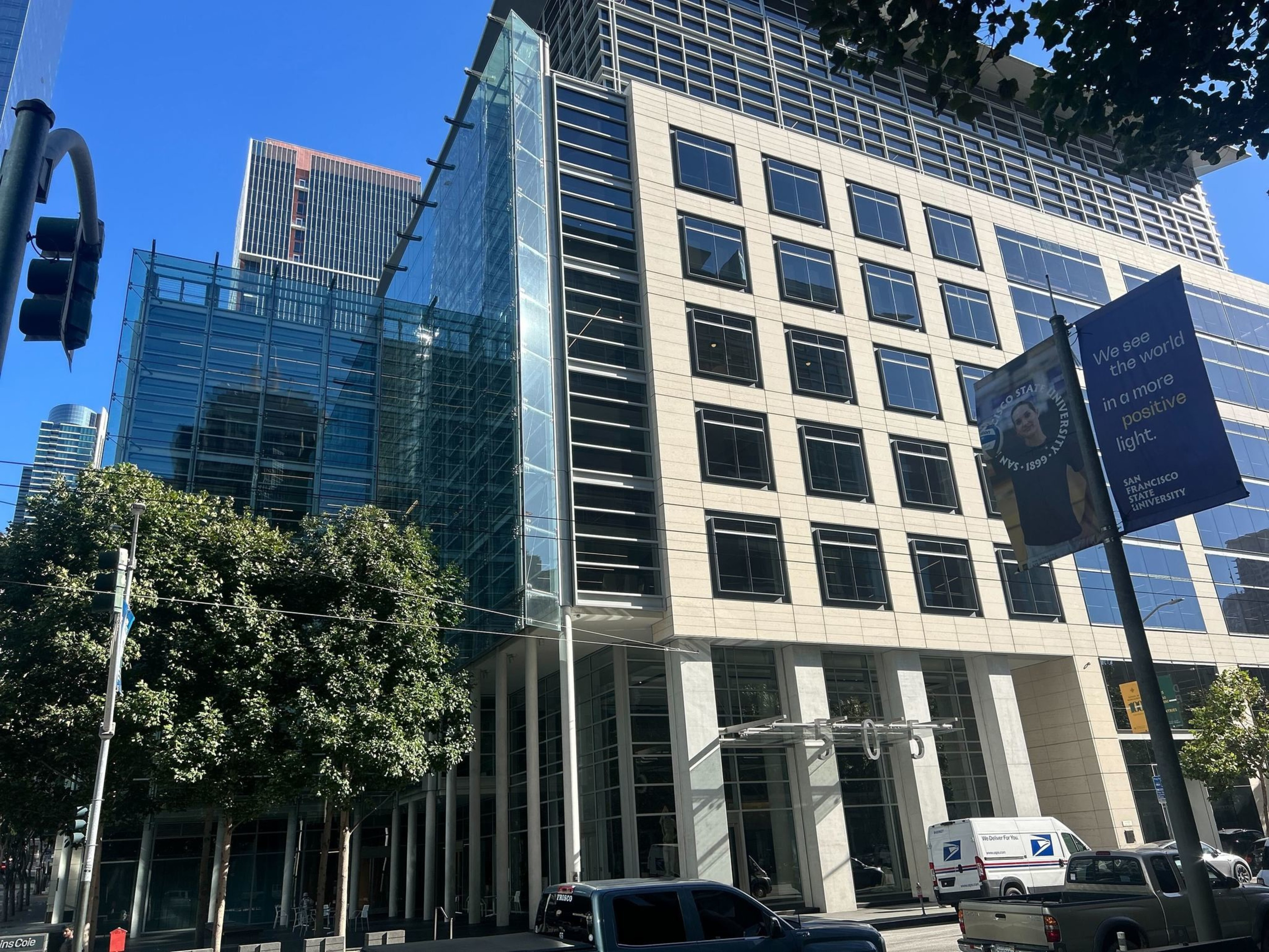
The headquarters settled in San Francisco's SoMa district. A different scene from the early days, when the temporary space was a borrowed living room. The company moved into its proper office in 2022. The building shown above, where glass meets stone in restrained modernism, says something about how the company sees itself. Not flashy. Solid. Dario and Daniela chose a spot not far from the Mission Street area where they had spent their OpenAI years. Like a quiet declaration that they would solve the same problem from a different angle, the two siblings stayed in the neighborhood.
Claude — "Helpful, Harmless, and Honest"
On November 30, 2022, OpenAI released ChatGPT to the world. One million users in five days. One hundred million in two months. The fastest-growing consumer product in the history of AI had just appeared. At that exact moment, Anthropic had not yet released its model to the public. The market asked the obvious question. Why are you not shipping faster.
The answer was already inside the company. A model called Claude had been running internally well before ChatGPT entered the public stage. Anthropic's release standard was simply one beat more conservative. Four months after ChatGPT had shaken the public, on March 14, 2023, Claude 1.0 became publicly available. The first paragraph of the launch note began with three words. Helpful, Harmless, and Honest. Helpful, harmless, and honest. Those three words became the company's slogan from that day on.
The meaning of Claude 1.0 in the market was not small. For the first time, a real alternative to GPT had appeared. Not just a slightly different model trained in similar ways. A model trained on a completely different philosophy. Aligned with Constitutional AI rather than RLHF, with refusals rooted in written principles rather than evaluator intuition.
Three more years have passed since. Claude has walked from 1.0 to 4.7. The context window grew from 100K (May 2023) to 200K (February 2024) and again to 1M (March 2025). Computer Use, the ability to operate a computer directly. Artifacts, which presents code and documents as a side panel. Claude Code, a CLI tool for developers. The Agent SDK. All of them have been added in turn.
The evolution of Claude itself, however, is the subject of a later chapter in this series (Episode 3). The purpose of Episode 1 was singular. "Why did this company begin?" That answer now feels reasonably clear. To make AI safety not a side effect of building a company, but the reason the company exists at all.
2026, and after
Five years after its founding, Anthropic is now a company of around one thousand people. Its valuation has crossed sixty billion dollars, and revenue grows by double-digit percentages each quarter. The largest asset, though, is not the number. It is the fact that the seven founders are still in the same room. Dario as CEO, Daniela as President. Tom Brown, Sam McCandlish, Jared Kaplan, and Chris Olah remain at the center of the company. Only Jack Clark, who moved to a policy advisory role in 2024, has stepped slightly to the side.
The AI market in 2026 looks much like what Dario sensed on that December day in 2020. A race between speed and safety. OpenAI sits at the top of the consumer market with GPT-5 and 5.1. Google keeps pace with Gemini 3, 3.5, and 4. Meta's Llama 4 has settled in as the standard of the open-source camp. In the middle of this race, Anthropic has made its position clear. It does not have to be the fastest. It will be the most responsible.
The next chapter steps one layer inward. It is about Dario and Daniela themselves. Two siblings who grew up in an Italian-American family, passed through Princeton and Stanford, Google and OpenAI, and arrived at the seat of building their own company. What kind of curiosity did Dario's doctoral thesis carry. How did Daniela become her brother's most trusted partner.
This chapter closes here. The story, in some sense, is only beginning.
References · Sources
- Bai, Yuntao et al. "Constitutional AI: Harmlessness from AI Feedback." arXiv:2212.08073 (2022.12.15)
- Brown, Tom B. et al. "Language Models are Few-Shot Learners." arXiv:2005.14165 (2020.05.28) — the GPT-3 paper
- Kaplan, Jared et al. "Scaling Laws for Neural Language Models." arXiv:2001.08361 (2020.01.23)
- The Verge, "Some former OpenAI researchers have spun out new AI safety lab Anthropic," 2021.05
- Forbes, "Inside Anthropic, the Top AI Safety Lab," 2023.07
- The Information, "Daniela Amodei on Building Anthropic's People Function," 2024.02
- TIME, "100 Most Influential People in AI: Dario Amodei," 2024.09
- Anthropic.com official blog — founding announcement (2021.05), Series A/B/C posts, Claude 1.0 launch note (2023.03.14)